


News
Wales "does not need onshore wind to meet carbon reduction targets"
Martin Shipton
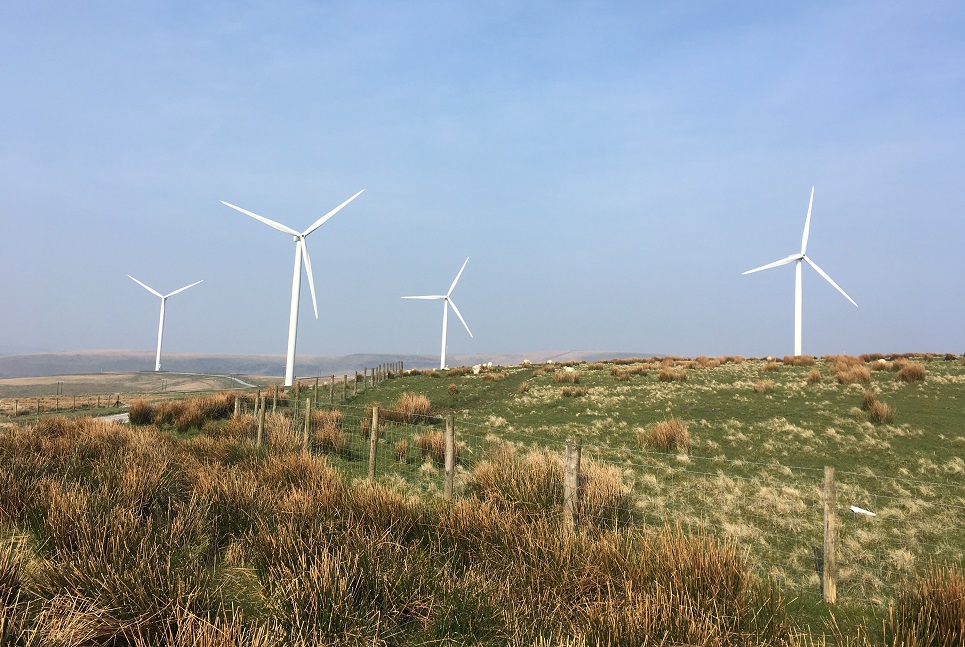
A new analysis of Wales’ energy needs has concluded that the nation has no need of onshore windfarms to achieve carbon reduction targets.
The conclusion will be eagerly accepted by campaigners who have opposed the building of wind turbines in beautiful landscapes across Wales.
The analysis has been undertaken by Dr Jonathan Dean, a trustee of the countryside charity Campaign for the Protection of Rural Wales.
Dr Dean writes: “It cannot have escaped many that the Welsh and UK governments’ drive to achieve net zero has produced a ‘gold rush’ of proposals from developers keen to get in on the action while the legislative environment is supportive and commercial opportunities still exist.
"This is particularly so in Wales where there has never been a de facto ban on onshore wind turbines as there was, until recently, in England.
“But how many proposals are there currently, how much electricity will they produce, and how much more might be needed? From examining the database of the National Energy System Operator (NESO) we get a glimpse of what we might soon be seeing on our hilltops and fields
"Until recently NESO was a part of National Grid plc, and are the body who operate the electricity system. They agree who can connect to the grid, when those generators are required to produce, and balance the supply of electricity day by day, hour by hour and minute by minute, such that supply always meets demand.
"In 2024, at the request of Ofgem, the market regulator, they were separated from National Grid plc and are now a stand alone, state owned company.”
[lower-mid-content-banner]
Surplus
Dr Dean states that Wales already generates about half of all electricity used in Wales from renewables, with the main sources being onshore wind (1,266MegaWatts); solar (1,179MW); offshore wind (726MW) and hydro (170MW).
However far more electricity is still produced from fossil fuels at three main gas power stations: Pembroke (2,200MW); Connah’s Quay (1,400MW) and Uskmouth (900MW).
Dr Dean states: “It is mainly due to these gas power stations that, overall, Wales generates twice the amount of electricity we consume. In order for the UK. Government to achieve the Clean Power 2030 objective, the operation of these gas stations will have to be significantly reduced
“Long before a developer applies for consent to build a wind or solar farm, they apply to NESO for a connection agreement. By law, NESO has to grant an agreement, but exactly where or when the connection can be made is down to the transmission and/or distribution companies. In Wales these are National Grid Electricity Transmission (NGET), National Grid Electricity Distribution (NGED) in the south and Scottish Power Energy Networks (SPEN) in the north. All connections to the transmission system, or which will have an impact on it, are recorded in the Transmission Entry Capacity Register (TEC Register) which is available online for anyone to access.
“As of the end of January 2025, there were a total of 149 agreements in place, recorded in the TEC Register, for new generating capacity, not yet built, to supply the grid: Offshore wind (7,100MG): Onshore wind (4,900MW); Solar with storage (11,500MW); Storage (10,600MW); Biomass 200MW; and Tidal (400MW).
“There will also be many small developments that will connect directly to the distribution systems without having any impact on the transmission system, so this snapshot is less than the total.
“In addition to this there is also:
* 3,600MW capacity connecting to Connah’s Quay of hydrogen/combined cycle gas turbine as demand/generation and it is not clear if the stated capacity is demand from the grid to produce hydrogen or supply to the grid from burning hydrogen;
* almost 1,000 MW capacity of nuclear at Trawsfynydd, although this site is no longer being considered for new nuclear, possibly due to grid and site constraints in north Wales;
* 600MW of hydrogen/Battery Energy Storage System connecting to Wylfa as demand/generation. This could be either demand from or supply to the grid.
“There is no guarantee that all these connection agreements/developments will even progress as far as submitting a planning application, never mind get consent and actually be built, but in the current ‘gold rush’ climate there is high likelihood that they will, and if they are could generate over 55 TeraWatt hours (TWh) of electricity a year. This would be in addition to the 7 TWh currently produced.
“In Future Energy Scenarios 2024 (FES2024) NESO shows that in 2050, when the whole of the UK has achieved net zero, Wales will be consuming 41 TWh per year of electricity, so the current ‘connection queue’ already has 30% more capacity than is necessary for net zero.
“However, FES2024 also shows that Wales will be generating 71 TWh per year, as Wales will remain a net exporter of electricity to the rest of GB. A further 12GW of capacity is anticipated in the Celtic Sea, and an undisclosed additional capacity can be anticipated in the Irish Sea. The TEC Register already includes over 20GW of capacity connecting into Devon. If only half of the 12 GW was classed as ‘Welsh generation’, that would add an extra 26TWh, giving a total of 81TWh, well in excess of the NESO estimates.
“The UK Government has published a Clean Power Action Plan, including estimates for onshore wind, solar and battery storage by region of Great Britain. A breakdown between England and Wales is not given but includes the following anticipated installed capacity by 2030: Solar 44,100MW; Batteries 19,600MW; Onshore wind 8,600MW.
“The connection queue in the TEC Register shows that Wales already has connection agreements in place for about quarter of the England and Wales solar allocation and over half the battery storage.
“As has been said many times before, Wales has more than enough offshore wind potential to generate sufficient electricity to achieve net zero, as a nation, by 2050, and continue exporting electricity to other parts of GB.
“Onshore wind is not needed at all for net zero, or to keep the lights on, and remains less popular with the UK public than offshore wind.
“However, as progress with offshore wind in Wales is painfully slow, unlike in England and Scotland, this is unlikely to come online to contribute to the UK Government’s Clean Power 2030 aspiration.
“Onshore wind is thus being used to ‘fill the gap’, with Wales providing over half of the England and Wales level of generation. Wales is ‘ahead’ in the onshore renewables race due to the de facto ban that was in place in England.
[lower-mid-content-banner]
Exploitation
“It could be argued that Wales is being exploited for onshore wind, and offshore wind is being deliberately held back, but this risks vanishing down political conspiracy rabbit holes, where there is little chance of a concrete conclusion.
“The level of solar and battery storage being planned appears grossly excessive compared to the levels required by the Clean Power Action Plan, and solar is likewise not required at all for net zero, only to achieve the 2030 target.
“Whether by accident or design, Wales would seem to be doing a disproportionate amount of the heavy lifting to decarbonise England. As the transmission grid in Wales is just a small part of the interconnected grid across the whole of GB, and Wales will be a net exporter as a nation, there is no need for any generation other than offshore wind.
“The demand estimates include for producing hydrogen for balancing and any storage losses. Nuclear is not needed by Wales due to the wealth of renewables, although there may be a case for specific industrial applications or if waste heat were being used for industrial or domestic heat networks.”
A Welsh Government spokesperson said: “We need to keep pace with the growth in demand for electricity as our homes and businesses look to decarbonise, and we have set a target for Wales to host enough renewable energy to meet the equivalent of our electricity needs by 2035 and to keep pace thereafter.
"Our analysis shows we will need a range of technologies – including onshore and offshore renewables – to achieve this.
“Our vision is to decarbonise in a way that generates greater benefits than the energy system we have today through the generation of green jobs and economic growth in our communities.”
Support our Nation today
For the price of a cup of coffee a month you can help us create an independent, not-for-profit, national news service for the people of Wales, by the people of Wales.
Get more trusted Welsh news
Choose Nation.Cymru as a preferred source in Google News to see more of our journalism.
