


News
Unpopular pylons are only being pushed because of a failure to press ahead with offshore energy schemes, says charity
Martin Shipton
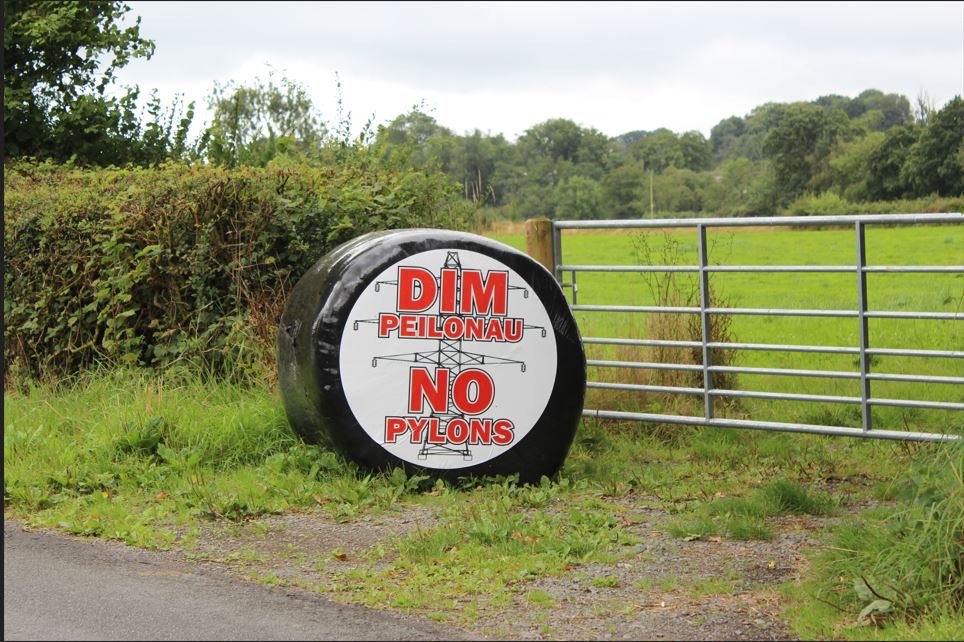
A group considering whether controversial plans to build a network of tall pylons across Wales is necessary has been told that such plans are only being considered because of a failure to move ahead with offshore energy generation.
Dr Jonathan Dean, a trustee of the countryside charity CPRW, has written a lengthy submission to the Independent Advisory Group on Future Electricity Grid for Wales in which he argues that a new transmission grid from north to south Wales is wholly unnecessary.
He states: “In our experience, the main issue the public have with overhead electricity lines is pylons. The public just don’t like them. The bigger they are, the more they dislike them.
“The subject has been extensively studied in the academic literature. There are even books on the topic, and a study into the Hinckley C connection by Matthew Cotton and Patrick Devine-Wright in the Journal of Environmental Planning and Management reached the following interesting conclusions:
* The findings show how potential health effects from electric and magnetic fields (EMF) and visual impacts are perceived to industrialise rural places,disrupt place attachments and provoke local opposition.
* The findings challenge the ‘not-in-my- back-yard’ assumption that citizens are selfish place-protectionists that lack the technical sophistication necessary to take a strategic viewpoint on transmission system development.
* They also reveal how decision making under the … Planning Inspectorate … presents a challenge to procedural justice, as front-loaded developer-led consultation practices curtail citizen input to key decisions on alternative technologies (for example, underground or undersea lines). This is likely to exacerbate public mistrust of transmission system operators and provoke further organised protest.
“So in brief, people don’t like them due to health worries and visual amenity loss, it’s wrong to brand them NIMBYs and things won’t change unless the planning process does.”
Presumption
Dr Dean points out that there is a presumption in favour of pylons as the default technology, but that offshore wind, and any associated infrastructure is deemed a Critical National Priority, with the highest level of support in the planning system.
He states: “The stage seems set for more public opposition as the plans for progressing to net zero, in the long term, and clean power, in the short term, get revealed.”
Pylons are used by both the transmission grids and distribution grids. For pylons carrying a voltage higher than 132 kV, the development of overhead lines is consented via the Planning Act 2008, with applications examined by the Planning Inspectorate and decided by the Secretary of State for Energy Security and Net Zero, Ed Miliband.
132 kV is the highest distribution voltage and consented the same as transmission, except for the cases of lines serving Welsh generators that are totally in Wales, in which case they are examined by the Welsh Government’s planning body PEDW and decided by Welsh Ministers.
Wooden poles
Dr Dean states that lines of under 132 kV are typically on wooden poles or double poles, and are far less controversial with the public. It is the 132 kV and 400 kV lines that cause the majority of issues, and most of these are consented by the Secretary of State.
He continues: “Wales has committed to be globally responsible by hosting enough renewables to at least meet its own electricity needs by 2035.
“It is entirely feasible for Wales to generate the equivalent of 100% of its electricity demand by 2035 using only offshore wind power. This would have a dramatic impact on the requirements of the transmission and distribution grids.
“It is our opinion that the reason this is not happening is because the Welsh Government has failed to secure sufficient development leases from the Crown Estate, either under the previous UK government or the current one. This may be due to the constant confusion between a need for more offshore capacity and the desire for the Crown Estate to be devolved.
“It would be entirely possible for Wales to have far more offshore wind power irrespective of the status of the Crown Estate. While CPRW does support devolution of the Crown Estate in Wales, this should not be seen, or used, as a means of delaying the building of more offshore wind capacity, particularly in the Irish Sea which is shallow and able to be developed using conventional fixed base turbines (like the North Sea).”
Energy needs
Dr Dean states that plans to develop onshore wind generation have nothing to do with the energy needs of Wales: “If we consider a rural county like Powys, the estimates of 2050 electricity demand … show that two 132 kV distribution circuits are sufficient to provide for 2050 peak demand. The county already has those circuits.
“ …The connection issues the energy sector desires are transmission connections, driven by the desire of the Welsh Government to generate energy in places where there is no transmission network, and where none is required by consumers. The transmission system is not devolved and the Welsh Government has, at best, some influence over it, but cannot make demands
“Bute Energy has taken a somewhat ‘innovative’ approach to this conundrum by both proposing a series of onshore wind farms and a series of 132 kV ‘distribution’ lines. They have proposed three individual lines of 27 m high 132 kV pylons to connect their wind farms to the transmission grid. As far as is publicly known, these lines will not connect to any of the existing distribution infrastructure and will consequently do nothing to alleviate the issues of consumers.
“They will simply transmit (at distribution voltage) energy to the existing 400 kV transmission system. Bute have consistently refused to consider underground cables (as per Planning Policy Wales) using Ofgem regulation as an excuse.”
Transmission system
Dr Dean states: “The issue in Wales is … the simple fact that there is no transmission system in much of the Welsh interior, so if offshore wind is not to be used, then a transmission system is required to extract energy from the interior.
“Using rough rounded numbers, it’s a simple matter to show that when using onshore wind, more ‘collection’ capacity is needed than distribution capacity, even if on average all the energy generated in an area is used in that area. This is because of the relatively low capacity factors of onshore wind. If large quantities of energy are to be produced by onshore wind, it is the collection that drives the investment rather than the needs of consumers.
“If consumers in the interior were only supplied by offshore wind then the local distribution system needs half the capacity it would do than if they were to generate the energy locally.
“We believe that the Welsh Government has a fundamental decision to make. If there is a genuine desire to protect the Welsh countryside, landscapes, tourism, agriculture, lifestyle, biodiversity and nature, then the solution is to use offshore wind to power the entire nation, and facilitate community scale generation schemes wherever these are
desired. To use onshore wind as a ‘national power station’ drives infrastructure and cost well beyond that necessary for rural residents. “Wales can easily achieve net zero using only offshore wind, but it is impossible using only onshore wind.”
The Independent Advisory Group is expected to report soon.
Support our Nation today
For the price of a cup of coffee a month you can help us create an independent, not-for-profit, national news service for the people of Wales, by the people of Wales.
Get more trusted Welsh news
Choose Nation.Cymru as a preferred source in Google News to see more of our journalism.
