


News
Report exposes link between Welsh food, Brazilian deforestation and river pollution in Wales
Molly Stubbs
On the opening day of COP30 in Brazil (10 November), a new report has revealed that everyday food choices in Wales are contributing to the destruction of tropical forests, human rights abuses and pollution, from the Amazon to Welsh rivers.
Published jointly by Size of Wales and WWF Cymru, Food, Forests and Injustice: The Hidden Link Between Wales and Brazil reveals how the Welsh food system plays a part in deforestation, environmental harm and injustice.
The report is released ahead of COP30 in Belém, Brazil, known as the 'Forest COP', where world leaders will meet to tackle deforestation and climate change.
According to the report, every year Wales imports around 190,000 tonnes of soy and 12,000 tonnes of beef, much of it linked to deforestation and land-grabbing in Brazil. Approximately 80% of the soy brought into Wales is used as livestock feed particularly in intensive poultry and dairy farms.
Barbara Davies-Quy, Deputy Director of Size of Wales, said: “Every time we buy cheap chicken fed on soy or buy corned beef from South American countries linked to deforestation risk, Wales is contributing to a system that drives the destruction of the Amazon and the Atlantic Forest and harms Indigenous Peoples.
“What we eat and produce here in Wales can have a profound effect on the future of forests and those communities that depend on them”.
The soy grown in Brazil, often on deforested land, also has a direct impact on Welsh rivers.
Soy, high in phosphorus, becomes a pollutant when excreted in livestock manure which in turn is spread on farmland, resulting in run off into rivers. This accounts for significant amounts of pollution in rivers like the Wye, Usk and Cleddau, which can kill fish and wildlife, and risks human health.
The report urges the Welsh Government to support farmers through the Sustainable Farming Scheme to adopt deforestation free and regenerative feed systems, reducing reliance on imported soy feed.
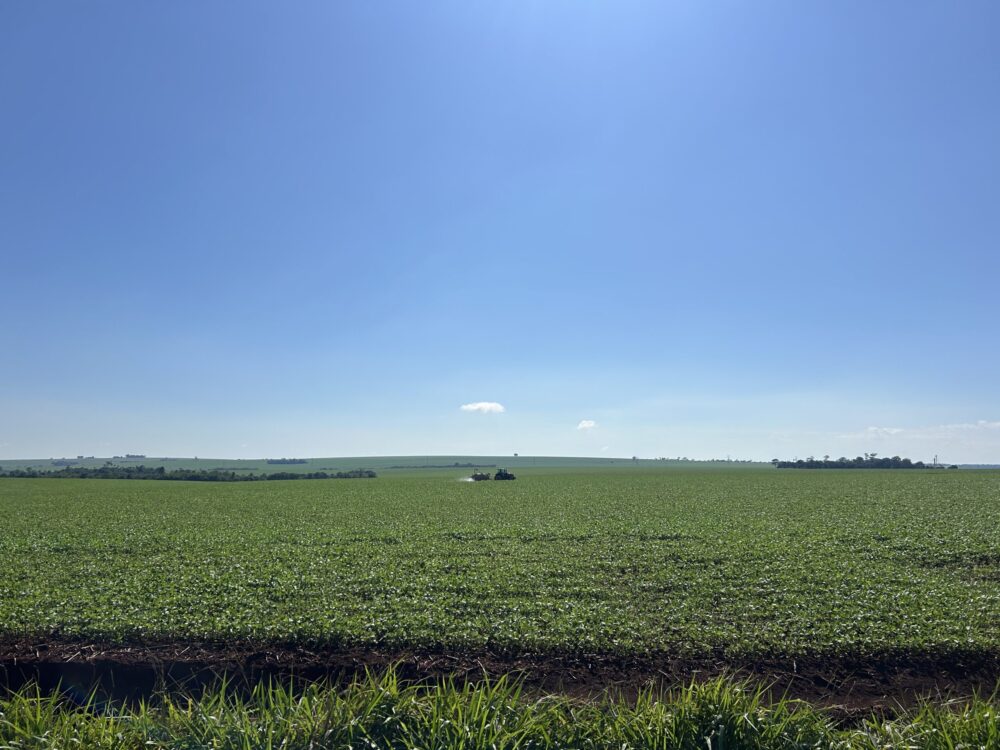
In western Paraná, Brazil, the Avá Guarani people have seen their ancestral lands devastated by vast soy plantations that supply the global livestock industry. The expansion of soy has driven the destruction of the Atlantic Forest, with only 10% of this habitat remaining.
“Agribusiness came and destroyed everything - our rivers, our forests, our food. The land is sick. It cannot breathe,” said Karai Okaju, an Avá Guarani leader.
Intensive soy production in these areas also depends on the heavy use of pesticides, many banned in the UK, which contaminate rivers and soils, harm wildlife and people’s health. Brazil now accounts for 20% of all pesticide use worldwide.
Shea Buckland Jones, WWF Cymru Head of Policy and Advocacy, explained: “Sadly Wales' reliance on imported soy and beef leaves a trail of destruction from the forests of Brazil to the rivers of Wales.
"Importing high-risk soy for livestock feed is not only fuelling deforestation in Brazil and accelerating climate change but contributing significantly to the pollution choking our rivers at home.
"We may be a small nation but we can show global leadership by urgently removing deforestation from our supply chains to secure a just future for people, nature and climate.”
The report calls on the Welsh Government, public sector and businesses to commit to deforestation free supply chains by 2028, ensuring that public procurement avoids products linked to forest loss or human rights abuses. It calls for a ban on deforestation-linked beef, including corned beef from Brazil.
The report also encourages the promotion of sustainable diets with “less, but better” Welsh meat and dairy, and more plant-based foods, alongside long-term solidarity with Indigenous Peoples who act as forest guardians.
Despite its stark findings, the report highlights positive examples of Welsh leadership. Councils such as Monmouthshire and Caerphilly are pioneering deforestation free school meals and supply chains, while more than 30 schools and Welsh businesses have joined the Deforestation Free Champions programme.
Farmers like Aled Evans in Carmarthenshire are demonstrating that regenerative, soy-free beef production can protect both livelihoods and nature.
Barbara Davies-Quy added: “If we change what’s on our plates, we can change the planet.
“Producer and consumer choices here in Wales are shaping the future of tropical forests, and that of current and future generations, but every meal can also be part of the solution.”
The Welsh Government affirmed that they are proud to support Indigenous communities such as the Wampís people and know that protecting forests is key to turning climate ambition into real action.
It added that new procurement duties in the Social Partnership and Public Procurement (Wales) Act 2023 – which comes fully into force in early 2026 – will require public bodies to take action to meet well-being objectives, including being globally responsible.
A Sustainability Risk Assessment is included in the procurement process to ensure that environmental, social and economic impacts are considered when making public sector purchasing decisions, with biodiversity protection a key priority.
The Welsh Government said: “Stopping deforestation is central to tackling the climate emergency and one of the fastest and most effective ways to cut global emissions.
“We are taking ambitious steps to tackle the climate and nature emergencies and recognise the importance of playing our part in reducing deforestation-linked impacts, particularly through our supply chains and international partnerships.
“However, it is a challenge that requires a whole Wales effort, and one that we must face together to protect our planet for future generations. For example, we can all reduce our impact by checking the products we buy for sustainable palm oil certifications or choosing products with no palm oil at all.”
Processors are also responding to consumer and supply chain pressure to reduce reliance on imported soya, updating contractual requirements and assurance schemes, and in some cases making soy-free feeding a condition of supply.
The Welsh Government's Growing for the Environment scheme is designed to support farmers in the growing of crops such as unsprayed cereals, protein crops, mixed leys and cover crops, which benefit both farm businesses and the environment.
The report, Food, Forests and Injustice: The Hidden Link Between Wales and Brazil, is authored by Size of Wales and WWF Cymru, funded by the Joseph Rowntree Charitable Trust, and will be available in English and Welsh from 10 November 2025.
The transition to soy-free diets is further supported by the UK Soy Manifesto, which promotes alternative protein sources.
Support our Nation today
For the price of a cup of coffee a month you can help us create an independent, not-for-profit, national news service for the people of Wales, by the people of Wales.
Get more trusted Welsh news
Choose Nation.Cymru as a preferred source in Google News to see more of our journalism.
