


News
Progressive parties in Wales may have to work together to keep Reform out of power, says Mark Drakeford
Martin Shipton
Reform UK will seek to “tear down” Welsh devolution if it gains a significant presence in the Senedd after next year’s election, according to Mark Drakeford.
To combat such a threat, progressive parties will have to work together to ensure that a functioning Welsh Government is created.
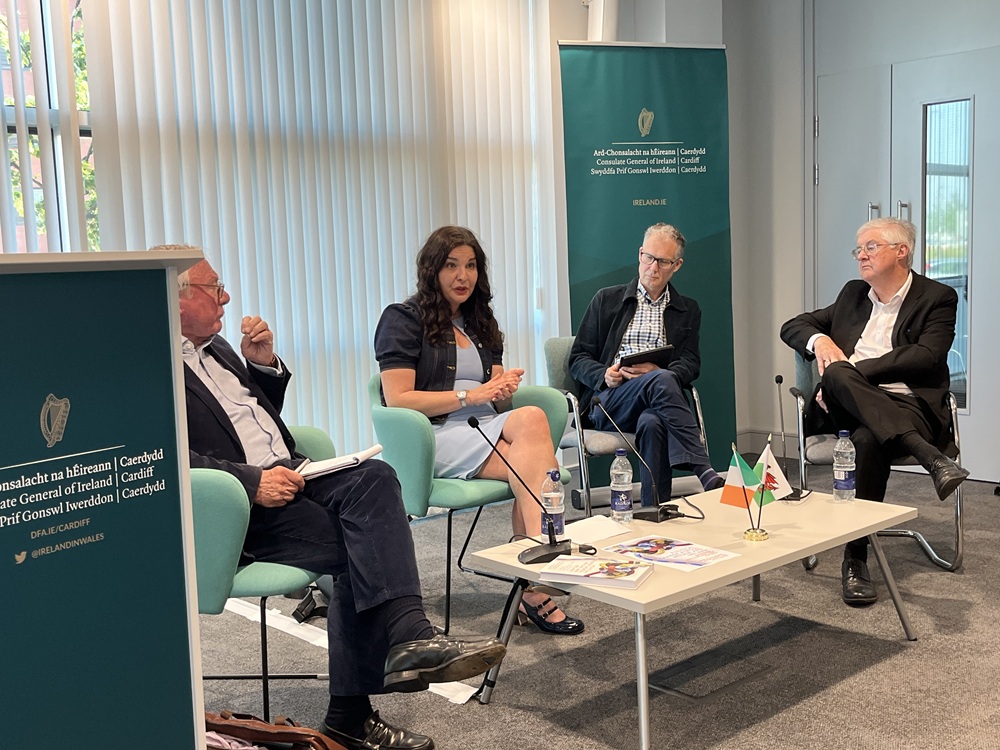
The former First Minister and current Cabinet Secretary for Finance made the prediction during an event to launch a new book that examines political change in Britain and Ireland.
[mid-content-banner]
'Implode'
Speaking at the Irish Consulate in Cardiff Bay, Mr Drakeford responded to a question about the rise of Reform in Wales, saying: “Nothing is inevitable in politics. A year is a very long time. I don't think I would use the word likely in relation to Reform. I'd use the word possible, because parties that mushroom up can also implode on one another - and there's plenty of evidence of that in the past as well.
“Reform is essentially an English nationalist party, attempting to find a foothold for itself in Wales. My hope will be that the disinfectant that comes with sunlight when the spotlight is on them will expose some of that for what it is. And that is what happened when we had seven Ukippers whose company we enjoyed for five long years [between 2016 and 2021]..
“Not a single one of them survived the next election because as people saw them for what they were, that superficial and initial attractiveness wore off. So I don't think we should be afraid of the way that democracy will deal with that threat.
“If there is a significant number of Reform people in the Senedd, they will be there to tear the institution down, rather than to make it a success. And that will place an additional obligation on progressive parties to come together to make sure that the Senedd can be run, that a government can be formed that can meet the needs of those people in Wales who have always preferred political parties on the part of the spectrum. So I think [the threat of Reform] will have an integrative effect on others.”
[lower-mid-content-banner]
One-way relationship
Speaking of the book of essays Political Change across Britain and Ireland, Mr Drakeford said there were three reasons why he thought it made a major contribution: “The last time the British Irish Council met in Wales, it met in St Fagans.
“Wales is responsible for the strand in the British Irish Council, that deals with lesser-used languages. In the plenary session, there were six different languages spoken. I was there with Jeremy Miles, so we made our contributions in Welsh;. Kate Forbes represented the Scottish Government, so she spoke in Scots Gaelic; Michael Martin, represented the Republic government and, of course, he spoke in Iris;. The Jersey representative spoke in Jèrriais;. the Manx Prime Minister spoke in Manx; and only Michael Gove spoke in English.
"I think what that did is what the book does, really: it pulls us away in Wales from what is sometimes our obsession with a one-way relationship with our most powerful neighbour, where when we think about Wales inside Britain and the wider islands, it's that relationship which dominates our thinking.
“In a forum where six different languages were being spoken, it just reminded you of the enormous diversity that there actually is within such a small geographical area. And what the book does is it just pulls us away from that focus on England and Wales, and instead allows us to explore the many other relationships that Wales has with other parts of Britain and Ireland. And I think that's a very liberating thing. And it quite certainly does open up all sorts of other possibilities for the way in which those relationships might be configured in the future. So my first reason for commending the book is quite definitely that if you want to see those different perspectives and to be able to think again about those bilateral, trilateral, quadrilateral, relationships, then the book is a very, very good entry point for all of that.
“Secondly, the book is written in a post-Brexit context. I think it powerfully reminds us that Wales goes on being a European country. Most of our most powerful affiliations remain at that European level. But handled sensitively, our relationship with the Republic of Ireland is our most obvious entry point back into some of those doors that have been semi-shut to us and the enormous prizes to be won as a result of that.
“I remember Nicola Sturgeon used to refer to the UK Government's failure to negotiate continued membership of Erasmus+ as an act of cultural vandalism. But its refusal to negotiate continued membership of Interreg [a series of EU funding programmes that support cooperation across borders] is another culpable failure on the part of the UK Government at that time. I would go to meeting after meeting in which I would make the case for, and the European Union were absolutely open to, continued Interreg relationships. We have, in our modest way, tried to keep some of that alive. There is a small amount of money from Wales in that.
“Paschal Donohoe, the Finance Minister in Ireland, has been a huge supporter of that, mobilising some funds from the Irish side as well to prevent the complete atrophying of relationships that have been built up for over 20 years, through membership of Interreg.
“In many ways, when I think of all the many meetings and conversations that I had around Brexit, one that absolutely remains with me is going to Aberystwyth and talking to a group of academic colleagues there. A sense of loss from the end of Interreg: it's not just the end of a bit of funding. It's not just that you're not going to be able to do something you used to do.
“There was a sense of a 20-year investment that they had made alongside colleagues in different institutions in Ireland, somehow just being wiped off the table as though it mattered for nothing, and wasn't worth investing in in the future.
“We absolutely did not take that point of view, and we were very lucky to have willing partners in that through the government in Dublin. So the second reason for anybody wanting to engage with the book is that as well as offering an entry point to the relationships between the component parts of Britain and Ireland, it also places that in a wider context of what relationships with the EU can still mean, for the component parts that we have here.
“My third and final reason for wanting to commend the book very boldly to you all, is that it does something in a space which we have had a preoccupation with, here in Wales. It was a preoccupation of my great friend and predecessor, Rhodri Morgan. It's something which I've been interested in the whole time I've been involved in Welsh politics, which is the breaking down of the barriers between people who work in the practical trade of politics and people who work in our universities and offer us the raw material that we need and the analytical tools we need in order to be able to do the jobs we do to the best of our ability.
“We need more people who are able to have at least one foot in both of those worlds in order to be able to fertilise between the two. So the people who develop theoretical understandings and assemble the data and things like that are able to test that against the way in which the political world operates, and people in the world of politics are better informed and equipped to do what they do because they have the advantage of being able to draw on the work that is done in universities.”
Political Change Across Britain and Ireland, edited by Irish Times journalist and academic Paul Gillespie, Michael Keating and Nicola McEwen is published by Edinburgh University at £90.
Support our Nation today
For the price of a cup of coffee a month you can help us create an independent, not-for-profit, national news service for the people of Wales, by the people of Wales.
Get more trusted Welsh news
Choose Nation.Cymru as a preferred source in Google News to see more of our journalism.
