


Tuesday, 14th July 2026 Cardiff 25° · Clear sky
NationCymru A news service by the people of Wales, for the people of Wales.

News

MPs who changed law to decriminalise women who had late abortions had death threats
By Mark Mansfield
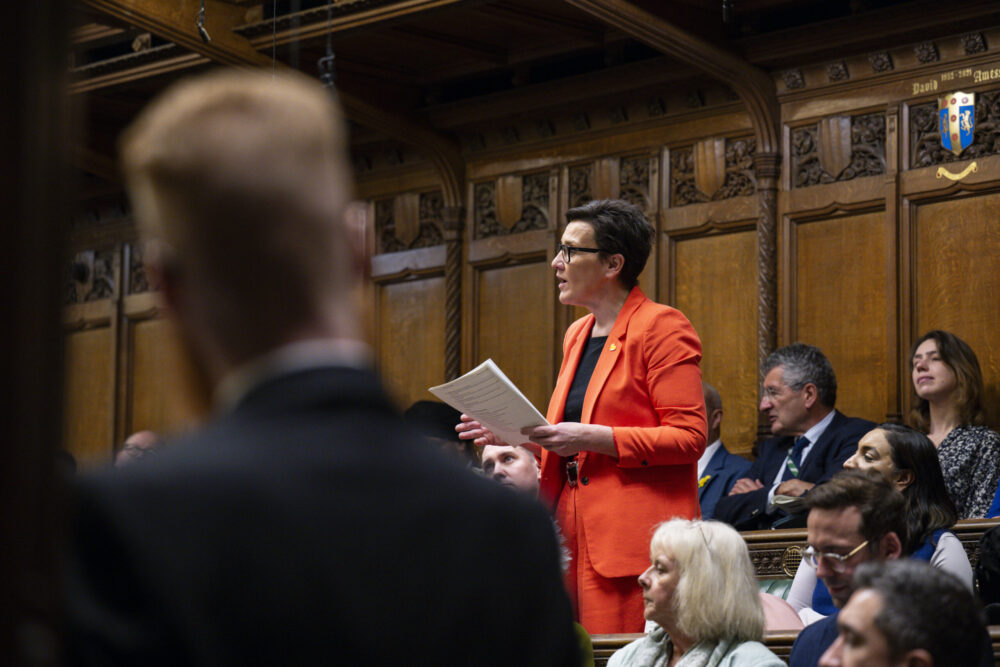
Tonia Antoniazzi speaking during Prime Minister's Questions in the House of Commons. Photo House of Commons/PA Wire

Martin Shipton

The Welsh Labour MP behind a controversial amendment to abortion law has spoken of the death threats received by proponents of the change that decriminalises women who have late abortions.

Gower MP Tonia Antoniazzi told BBC Radio 4’s Woman’s Hour on the eve of the Crime and Policing Bill getting Royal Assent: “There has been a backlash. There have been death threats, things like that have to be passed on to the police. I've had people outside my office with photos of myself and of foetuses. Luckily the police have been very supportive. There is backlash and it's not very pleasant, but we've done the right thing. We've changed the law and we are supporting women.”

Ms Antoniazzi’s amendment removes criminal liability for women who end their own pregnancies and pardons those who have been convicted of illegal abortions.

She explained that while women were decriminalised, doctors who perform late abortions beyond 24 weeks of pregnancy when, for example, the woman’s life is not at risk remain criminally liable, as do coercive partners who force women to have abortions.

Ms Antoniazzi told the programme: “The change for women is huge because we've seen about 100 cases in the last few years of women being picked up by the criminal system and questioned about the termination of their pregnancy. It pulls the current law into line with the law in 50 other countries and Northern Ireland, where women are not criminalised ending a pregnancy.”

She said she had met Nicola Packer, who last year was acquitted of having an illegal abortion. Ms Antoniazzi said: “Her story was that she had accessed telemedicine. She hadn't known how far gone she was. It was during Covid and she went to the hospital having given birth to the foetus and they reported her to the police. Then she was taken into custody and was treated like a criminal. That case went on for nearly five years. It went to the Crown Court and she was put under huge scrutiny, which was completely unnecessary and at a great cost to her wellbeing and her pocket, because it cost a lot of money.

“It was just heartbreaking to see, having experienced termination myself and knowing how vulnerable you feel and how lonely you feel to have had such huge scrutiny and to be put in that position where her browsing history was being read out, her sex life was being discussed, when that's nobody's business. I feel that to see somebody being put in that position and then for the case to be thrown out of court, it really does show that it was a waste of time, a waste to the public purse. It's not in the interests of anybody, particularly vulnerable women, to be put in that situation.”

Catholic

Discussing her own circumstances, Ms Antoniazzi said: “I’d been brought up a Catholic, with a Catholic education. I was a student at the time and I didn't know where to turn. I couldn't go to my parents - I didn't have that kind of ability to be able to discuss it.

"It was actually my older brother at the time who was very supportive and his wife - and they helped me again when I had another unwanted pregnancy when I was a mum. And I had to juggle that between work. It was over the Christmas period, I had to wait to access the pills and have an appointment. It took so long and it was just so awful.

“I felt so strongly that women were being treated and controlled by a legal system that was making it more unsafe for them, because they had that fear that if they went to the hospital or accessed any medication, they may be criminalised. What this law does is very simple: it decriminalises the woman. It doesn't change the terms of the Abortion Act.”


Support our Nation today

For the price of a cup of coffee a month you can help us create an independent, not-for-profit, national news service for the people of Wales, by the people of Wales.

8 comments

John

Not comfortable with people being able to abort a baby that can survive outside the womb, a minute before it is born, which is exactly what this legislation means.

Reply
Evan Aled Bayton

Yes

Reply
Guess Again

Always struck me as weird how those who claim to be "pro-life" are always the first to threaten violence against those who disagree. I suppose we should be grateful that the debate around abortion isn't yet as polarised as the U.S, where abortion clinics are bombed and doctors murdered by terrorists.

Reply
algebra museums

The "I'm pro-life, but I am going to kill you" has always been mystifying to me. This is yet another one of those extremist USA-funded movements that we seem to have to put up with week by week here. The bill decriminalises women who have abortions, but it does not remove the legal and medical responsibility that applies to Doctors. It doesn't in any way extend the term for women who self-abort; they remain the same. This still requires the consent of two Doctors to make it legal when happening at a later date, and it would only be legal in extreme medical circumstances of there being a severe risk to the life of the mother or what is medically classed as a severe foetal anomaly in which a born child would suffer and be unable to survive anyway. Again, this would require approval by two Doctors qualified in the field. What the bill actually changes is that it decriminalises women who self-abort in the already legal time frame. In the UK 325 and 350 cryptic pregnancies occur every year, in which women give birth without even knowing they were pregnant or didn't find out until after the period they would be able to abort without jail. Of course, that is a tiny percentage of the expected 6.5 or so births every year, but it's still hundreds of women every single year. Many of the side effects of pregnancy also happen when people aren't pregnant, and not all of them happen to all pregnant women. People may question the "obvious bump" or lack of it, I questioned it, and one of the people I read about was Bryony Mills-Evans simply because she's pretty local to me. She shared photos of herself at different stages of her pregnancy, and even at full term, I wouldn't be able to tell visually looking at her stomach, not that I walk around looking at strangers' stomachs, because it's really weird.

Reply
Evan Aled Bayton

The problem is twofold. First a viable baby is being killed which is ethically pretty close to infanticide. Second in effect this is legalising the opportunity for a woman to have a self induced stillbirth. If the Labour to expel the dead fetus or baby is concealed there is a risk of maternal death. This whole area of law needs serious rethinking. Criminalising it is not necessarily wrong but more likely to lead to concealment.

Reply
algebra museums

A "viable" baby, that's an incredibly cold way of expressing what is such an incredibly emotive topic. Serious rethinking? You may be new to this, but this exact topic has been under "serious" discussion from medical, social and maternal experts for nearly 30 years now, and we are still sending women to jail, who then have to fight for what is years, sometimes years, to overturn an incorrect conviction. Irrelevant of the changes that are going to happen, which laround 10% of the UK public still oppose. Irrelevant of the decriminalisation that is happening, much of the decision is going to be based on the discussion between the pregnant lady and their medical professionals because no test can tell us whether a foetus is 23 weeks and 6 (legal) or 24 weeks (illegal). It always has been and will continue to be done in what is described as "in good faith". That is not going to change; there are clear differences between the embryonic period and foetal period of growth, but within each growth period, there is no basic yes or no way of doing it. It's not like somebody being arrested for underage drinking; there's a clear delineation between allowed and not allowed in that situation, and it can be categorically proven. That simply doesn't exist in pregnancy; nature is far scruffier than the pure, clinical absolutes of human law. Cymru is known for being forward-thinking, but in this situation, the whole of the UK really has been left behind the civilised world. One of the many reasons that the law has changed is because around 64% of the population believes it should be decriminalised, whilst only 21% of people feel that it should have remained a criminal act. Dozens of professional health and legal bodies have been fighting to decriminalise this for decades. This is not deregulation; the protections are there as they always have been. Women still have to go through the same medical process as they did prior to the change.

Reply
Jeff

Lot of far right religious money in attacking it in the Uk. Farage is in this mix. Lot of blokes as well telling women what they can do.

Reply
Rob

What do anti-abortionists suggest women should do if they got pregnant through rape? These Christian fundamentalists who would impoe their moral values on other people, would be better off moving to the American Mid West, they would get along well with the Trump MAGA cultists.

Reply

Leave a reply

Replying to Guess Again Cancel

Always struck me as weird how those who claim to be "pro-life" are always the first to threaten violence against those who disagree. I suppose we should be grateful that the debate around abortion isn't yet as polarised as the U.S, wher...

Comments are reviewed before they appear.
