


Mon, 31st August Cardiff 20°
Nation.Cymru wordmark
Advertisement

News

Latest vote failure triggers new call for STV in all Welsh council elections
By Mark Mansfield
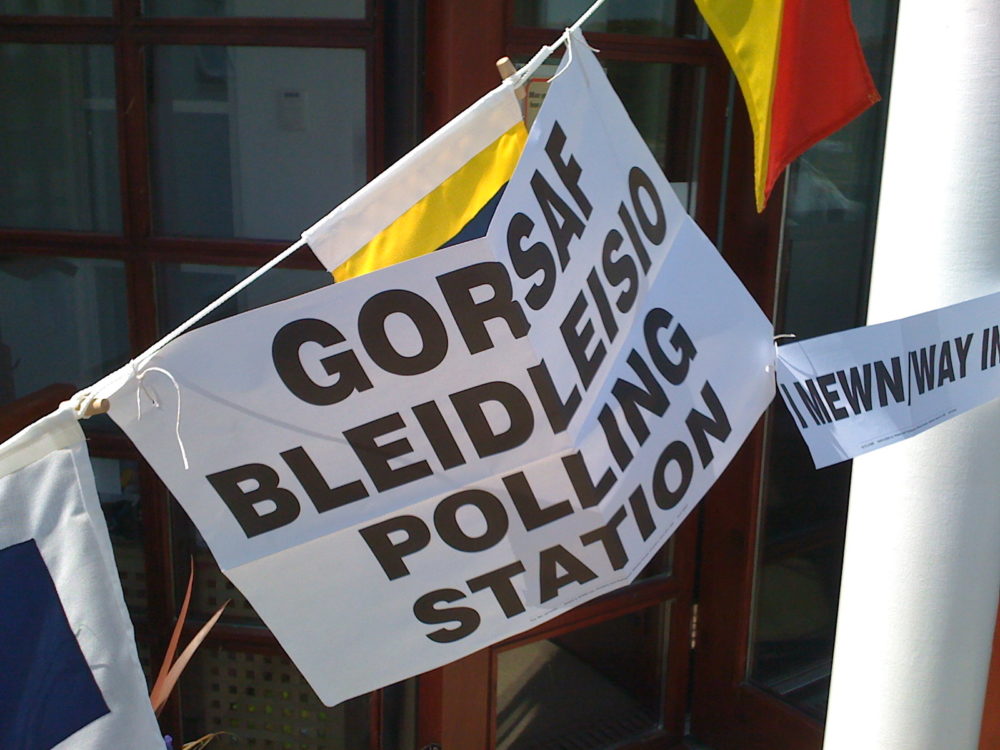
Gorsaf Bleidleisio. Photo by blogdroed is licensed under CC BY-NC-ND 2.0.

Martin Shipton

The “absurd” outcome of votes at two local authorities has prompted one of Wales’ leading democracy campaigners to renew calls for all the nation’s councillors to be elected by STV.

Ceredigion became the second council in Wales to back a switch from First Past the Post (FPTP) to the Single Transferable Vote system of proportional representation with an 18 to 17 majority.

This followed councillors at neighbouring Gwynedd Council voting 65% in favour of moving to STV in October.

But because under rules insisted upon by the Welsh Government neither council supported STV by a two-thirds majority, the change will not happen.

Consultations in both council areas had shown overwhelming public support for what is seen by many as a fairer voting system, with respondents favouring a move to STV by over 70% in Gwynedd and 67% in Ceredigion.

Councillors in Powys rejected a move to STV by 33 votes to 21 in October, despite its consultation showing 60.5% support in favour.

[mid-content-banner]

Democratic mandate

Jess Blair, director of Electoral Reform Society Wales, said: “These votes now create the absurd situation where councils cannot move to STV despite the public in those areas overwhelmingly backing the move and it having a democratic mandate from the majority of councillors in two areas.

“This means that Wales risks repeating the farcical scenes seen at the 2022 local elections where over 100,000 people were denied a vote as only one candidate stood in their ward, meaning the election was decided before a vote was cast.

“The current FPTP system, which often creates uncompetitive wards where other parties have little incentive to stand, was a prominent factor in so many people being denied a vote. FPTP also frequently produces unrepresentative results where council chambers don’t accurately represent the way the electorate as a whole in the area voted, with parties often getting seats out of proportion with the share of the vote they won.

“Moving to STV would help drastically reduce the number of uncontested seats in Wales. For example, Scotland, which has STV for council elections, has had fewer uncontested seats in all the elections combined since STV was introduced in 2007 than the number in Gwynedd council alone at the last local election.

“ERS Cymru is now calling on the Welsh Government and parties in the Senedd to address the absurd situation where councils are being prevented from moving to a fairer voting system, which the majority of councillors have voted for, by bringing in STV for all councils across Wales.

“This would mean Wales would join Scotland and Northern Ireland, which both use STV, and ensure that at local elections every vote counts, and council chambers better reflect the way their area voted.

“The onus is now on the Welsh Government to address this unfair, undemocratic situation and act to avoid a repeat of the last local elections where thousands more people are locked out of having a vote.”

[lower-mid-content-banner]

Resistance

The outcome of the recent council votes reflects the huge and long-standing resistance to electoral reform across much of local government in Wales. Labour groups in particular have opposed a move away from FPTP because it has provided them with majorities that on a proportional basis they do not deserve.

And instead of legislating to introduce STV in local authorities across Wales, Labour grudgingly agreed to let individual councils make the choice - but only if they achieved a two-thirds majority.

As long ago as 2002, in the then National Assembly’s first term, a Commission chaired by Eric Sunderland, a former vice-chancellor of the University of Wales, recommended a switch to STV in council elections by 2008. But the report was shelved.

Proposals made by successive ministers to reduce the number of local authorities in Wales have also faced considerable resistance and have got nowhere.

Set up as part of the Assembly Coalition Deal in June 20001, the nine-strong committee, led by Eric Sunderland, has spent the past year probing how councillors are elected.

The review started as one of the conditions within the coalition deal that was brokered between Labour and the Liberal Democrats.

Having considered seven voting models, the Sunderland report recommended a form of PR known as the Single Transferable Vote.

For the price of a cup of coffee a month you can help us create an independent, not-for-profit, national news service for the people of Wales, by the people of Wales.

Get more trusted Welsh news

Choose Nation.Cymru as a preferred source in Google News to see more of our journalism.

Choose Nation.Cymru as a preferred source in Google News

15 comments

Adrian

Just in case there's anyone out there who hasn't yet worked out that the Welsh Labour government are collectively insane... https://news.sky.com/story/call-for-dog-free-areas-in-wales-to-tackle-racism-13253986

Reply
hdavies15

Barking mad ! I've got a black dog and an off white dog. Does that qualify as inclusivity and diversity, or should I have a dog and cat to be more species inclusive ?

Reply
Glen

Maybe one of your dogs identifies as a cat?

Reply

In reply to Glen

hdavies15

I know he likes chasing them.

Reply
Brychan

There's a well-founded cultural behavior in parts Africa, especially Nigeria, that dogs best be avoided due to rabies. Some religious sects there claim that the devil resides within the dog. This is the reason why BAME Cymru reckon dogs in outdoor spaces in Wales is a disincentive to those of darker skin tone to visit. It should be noted, however, that Wales is rabies free since 1922. Perhaps the Labour Welsh Government should stop winging policy on superstition and mythology. It scares me that such numties run our NHS let alone our National Parks.

Reply
Brychan

In the race to being the first leader of a country to restrict democracy we have Putin in the lead, Morgan second, with Trump expected to make a significant challenge.

Reply
Adrian

The Labour party are way ahead of Trump kn that score.

Reply
John Ellis

'“This means that Wales risks repeating the farcical scenes seen at the 2022 local elections where over 100,000 people were denied a vote as only one candidate stood in their ward, meaning the election was decided before a vote was cast.' Not only the 2022 local government elections; there's a history of this in the county council elections in the rural ward in which I live, as with numbers of electoral wards in country areas across Wales. And it's long-standing: I recall the same situation when I was living in rural Powys in the '70s. In the election before last our ward was uncontested, with the result that the Conservative candidate was automatically returned. However only a few days after the election he announced that he intended to sit as an independent. Apparently this was a consequence of a dispute which he was having with the Welsh Conservatives, but he told me that he was retaining his membership of the UK-wide Conservative party. The consequence was that the Welsh Conservatives stood a candidate against him at the subsequent country council election, but again no one else entered the contest. With the result that my sole choice on election day was between two Conservatives - one 'official' and the other 'unofficial'. In a functioning democracy that's really not how it ought to be! So I spoiled my ballot paper.

Reply
Rob Pountney

STV won't change this in any meaningful sense, see my comment on the main thread...

Reply
John Ellis

I'm not under any illusion that STV would be a guaranteed solution to the problem to which I alluded in my previous post. I'm now in my second stint in a deeply rural area of Wales, and my impression, from experience in both places, is that the root problem in thinly populated country areas such as these is that few people in the localities have much political affiliation. The consequence being that just the odd local person who has a keen interest in local government is likely to put himself or herself forward as a candidate, and that the party affiliation of that odd local person is in practice pretty much a matter of chance. So I'm in principle prepared to look favourably on any change to the current system which might conceivably excite more interest and involvement on the part of local electors. Maybe this one would, but I acknowledge that it might not. But I'd be inclined to give it a try.

Reply
Rob Pountney

STV would only marginally improve things, logically the merged wards would have to be a maximum of 4-5 councillors, any more (assuming enough people stand that there is actually a choice then the count would probably take weeks, rather than the 4-7 days it usually takes in places that use STV), we already have many wards where 2 or more councillors are elected, these also often have insufficient candidates, given 2 adjoining wards with 4 seats that had 4 candidates under the old system, why would there suddenly be an adequate choice of candidates standing where only 4 could be bothered the last time? It's not a solution, in the sense that it is better is only by a tiny increment... As usual it demonstrates the reluctance of (Labour) government in Wales to make any genuinely democratic reforms, every time they get dragged in to making the least effective smallest possible moves after decades of kicking and screaming, I'm still waiting for the implementation of (almost any) one of the many proposals for local/regional government reforms... Strong regional councils elected under full list PR are the only logical solution, this has been recommended time after time often by a commission (cleverly) timed to report just after Senedd elections, though it backfired when the 2015 election was delayed, all was going well until the election was done, then we heard the plan was to be completely ignored, in essence they pretended to take the report seriously because it had entered the news cycle before the election, only to bin it the day after they won... It's an absolute disgrace, we are never going to able to properly tackle the many problems we have without effective government... Just look at this... Did you even know there are (4) 'Joint corporate committees' "These are considered to be "local government" by the Welsh Government"... Did you know there are (currently 15 though the number is apparently variable) 'Public Service boards' "Other regional partnerships include regional economic boards (for city/growth deals or Ambition boards), Regional Partnership Boards, Adults' and Children's Safeguarding Partnerships, Community Safety Partnerships, Public Service Boards, Regional Housing Support Collaborative Groups and Area Planning Boards"... It is an absolutely insane mess, and government is pratting about with the tiniest possible reform with legislation designed to make sure it does not happen... From 730(ish, no one even knows exactly how many) 'community councils' to 2 'Trunk Road Agents'... About the only thing we don't have is a 'Partridge in a pear tree'...

Reply
Alwyn Evans

What about STV for the Senedd? Instead Labour intend to foist on us the ‘Closed List’, where a list of members CHOSEN ONLY BY THE PARTIES THEMSELVES will be offered up for a vote. You cannot say to WHOM you want you vote to go, only WHICH PARTY you want to support. STV will ensure you vote for a PERSON not a PARTY SYMBOL.

Reply
Rob

The real stumbling block is the Welsh Labour Party. Its not in their interest to get rid of FPTP. I remember shortly after the AV referendum Peter Hain tried to argue that the no vote was a mandate for the Welsh Assembly (as it was called then) be elected entirely by FPTP - In other words a Labour one party state. The opposition parties need to play hardball here, and insist that STV is rolled out across Wales, no exceptions. The Lib Dems achieved this in Scotland when they went into coalition with Labour in the 2000s.

Reply
Jack

Have STV but only single member electorates. You don't need multi-member electorates. With STV sinvngle meber events will then still have contested elections as more will stand - and the most popular candidate would win. Multi member STV is really a backdoor proportional representation move which will mean all councils end up being clumsy coalition ruling groups.

Reply
Arthur

The only reason that politicians in power change a voting system is to ensure they have an advantage in the next elections. I CAN VOTE, I WON'T VOTE.

Reply

Leave a reply

Replying to Brychan Cancel

There's a well-founded cultural behavior in parts Africa, especially Nigeria, that dogs best be avoided due to rabies. Some religious sects there claim that the devil resides within the dog. This is the reason why BAME Cymru reckon dogs in...

Comments are reviewed before they appear.