


News
Labour MS will propose Bill to change Senedd voting system to STV
Martin Shipton
A former Welsh Labour Minister is working with the Electoral Reform Society to introduce a Bill that would change the Senedd’s electoral system again - this time to the single transferable vote version of proportional representation.
Alun Davies, the MS for Blaenau Gwent, argues that STV is far preferable to the “closed list” system which will be used to elect the expanded Senedd next May.
The change he is proposing would be implemented, if passed, at the following election in 2030.
Under the closed list arrangement, Wales is being split into 16 “super constituencies”, each of which will elect six MSs. People will vote not for individual candidates, but for party lists. MSs will be elected in proportion to the votes cast for their parties, with the parties deciding the order in which candidates win seats.
This system has been brought in following agreement on a Senedd reform package between Welsh Labour and Plaid Cymru that is also increasing the number of MSs from 60 to 96. Former Plaid leader Adam Price, who negotiated the deal with former First Minister Mark Drakeford, has said he was told that if the closed list system wasn’t agreed to, the whole reform package would be off the table.
[mid-content-banner]
Strongly criticised
The decision to adopt the closed list system has been strongly criticised on the basis that it takes power from voters and hands it to the parties. Under STV voters rank candidates in order of preference based on who they think will do the best job.
Many have expressed concern that the closed list system makes it easier for parties to exclude candidates who are out of favour with the leadership - thus creating a class of timid politicians who become tribal loyalists and don’t engage in independent thinking.
Professor Laura McAllister of Cardiff University chaired an expert panel that examined options for Senedd reform. Earlier this month she told The Welsh Politics Podcast hosted by Labour MS Lee Waters: “Closed list PR was one of the electoral systems that we rejected in the very early stage of our analysis of different electoral systems - notwithstanding the fact, of course, that there are weaknesses and strengths to every electoral system, and you’ll never have one that ticks every box.
“But what we tried to do back in 2017 was to have a set of criteria - values, as much as anything, that we felt should be enshrined in a more proportional electoral system, Hardly any of those are carried forward with closed list PR, and the most significant thing to say is that it reduces voter choice and gives more authority to the parties in terms of candidates.
“One of the traditions of voting systems, traditionally and historically in Britain, has been that people go out and vote for a candidate that represents a party, rather than the other way round.”
[lower-mid-content-banner]
Welsh Executive Committee
Explaining how the closed list system was settled on, Mr Waters said that after the 2021 election a sub-committee of Labour’s Welsh Executive Committee was established to consider Senedd reform.
He added: “My understanding is that the MPs who were elected there didn’t want the extra numbers, but they accepted that was going to happen. What they weren’t prepared to compromise on was electoral systems, because STV has always been the call from the Richard Commission [in 2004] onwards, They did not like STV, partly because in Westminster there is an attachment to First Past The Post, and partially because of individual hang-ups. So for example [former Cardiff West MP] Kevin Brennan, who was Mark Drakeford’s close constituency colleague and very influential with him, comes from an Irish family and has an experience of STV promoting parochialism, getting internal candidates to be competing with each other with voters rather than campaigning for the party as a whole, and really did not like the system and thought it would be a retrograde step for Wales. And I think that was very influential on Mark. Mark himself would have preferred STV - but what could he get through?”
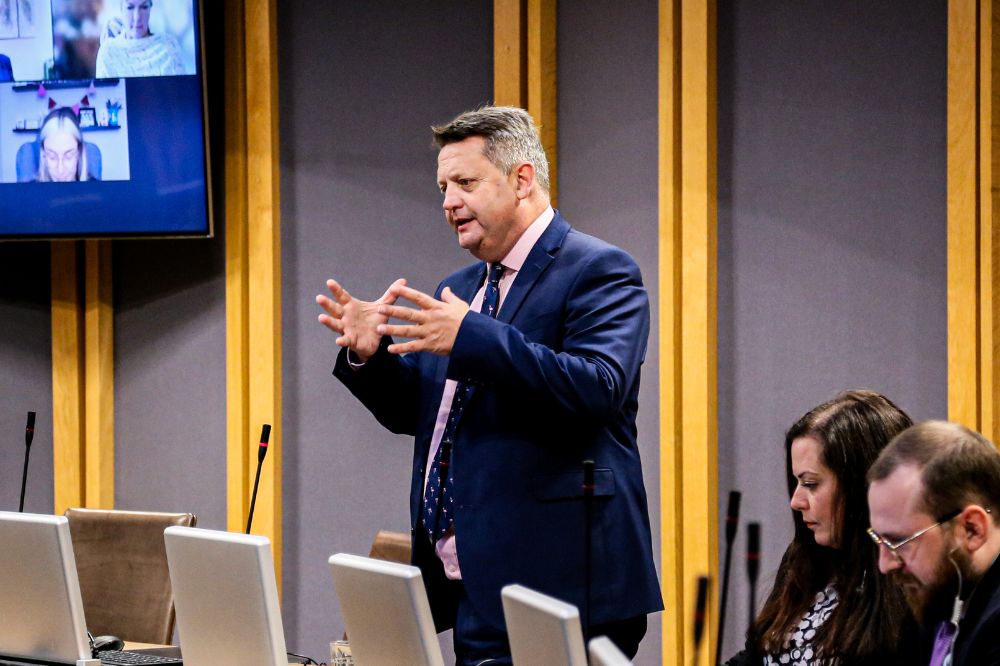
Alun Davies, who is all but certain to be re-elected to the Senedd next May, said: “I have always supported STV and want to put down a marker for the next Senedd with a Bill already drafted to get rid of the closed list and replace it with STV.
“I have been talking with the Electoral Reform Society [ERS] and they have been drafting such a Bill.”
Accountability
Jess Blair, Director of ERS Cymru, said: "The Senedd election next year will be held under a system no one wanted – the closed list system. Closed lists will deliver a proportional result but will not deliver accountability, with voters only being able to back political parties rather than the individual candidates on the ballot paper that will actually represent them in the Senedd.
"Both the Committee on Senedd Electoral Reform and the Expert Panel on Assembly Electoral Reform recommended the single transferable vote (STV) instead of the closed list system, which would deliver both proportionality, ensuring the Senedd looks the way the Welsh people voted, and direct accountability to voters for MSs.
"We warned from the start that closed lists risked being a lose-lose compromise and that we needed a voting system that works for the Welsh people. This draft Bill demonstrates how easy the change from the closed list system to STV would be, if the circumstances after the May election meant a change would be possible.”
It’s not by any means certain that the Bill will succeed in the new Senedd, however. The change to the closed list system could only be introduced with a two thirds majority, which Labour and Plaid Cymru were able to secure between them. It is highly unlikely that they will retain such a majority next May.
Support our Nation today
For the price of a cup of coffee a month you can help us create an independent, not-for-profit, national news service for the people of Wales, by the people of Wales.
Get more trusted Welsh news
Choose Nation.Cymru as a preferred source in Google News to see more of our journalism.
