


Wed, 29th July Cardiff 22°
Nation.Cymru wordmark
Advertisement

News

43 civil servants unable to translate eight English words into Welsh after a day of trying
By Amelia Jones
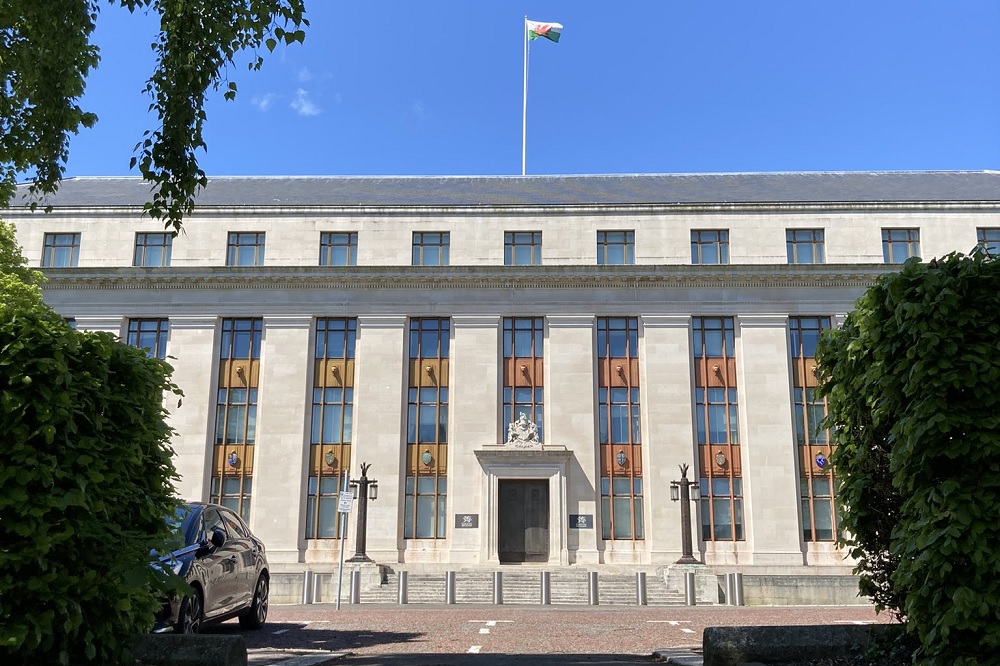
The Welsh Government building in Cathays Park, Cardiff. Picture by Richard Martin.

Amelia Jones

43 civil servants spent an 'away day' trying to find Welsh alternatives for eight English words, but were only able to translate four.

The project was carried out as part of an academic research project examining how people describe sound environments in different languages. The terms were being considered for use as part of a new environmental assessment about how noise affects people's wellbeing, which required agreement on consistent Welsh language descriptors.

During the Soundscape Attributes Translations Project, officials and academics discussed whether some of the English words could be translated directly, or whether Welsh-adapted loanwords of descriptive phrases would be more appropriate.

The discussions were spread over a four-part initiative, that involved over 43 officials and 8 academics.

While many took part remotely via Microsoft Teams, the project also included a day described as a 'Translation Service away day' at Welsh Government offices in Cathay Park, Cardiff.

Welsh translations were agreed for four of the eight terms, including 'llonydd' for 'calm', 'undonog' for 'monotonous', 'caotig' for 'chaotic' and 'bywiog' for 'vibrant'.

However, participants concluded that there was no one-word equivalent in Welsh for the words: pleasant, uneventful, annoying or eventful.

According to a report in the Telegraph, "the research explained how members of the Welsh Government’s translation service struggled to find a Welsh word for 'chaotic' before eventually opting for 'caotig', an “English loan word”. The word 'annoying' was equally problematic, with staff choosing 'niwsans', a Welsh-sounding version of the English word “nuisance”."

Niwsans, which was one of the proposed Welsh translations for annoying, caused disagreements among the group owing to it being a term of "Wenglish" origin.

Unanimity was only achieved for the words 'vibrant' and 'monotonous.'

Welsh language specialists have previously noted that translation into Welsh often involves interpretation rather than direct substitution, particularly when dealing with abstract or technical terminology.

In such cases, meaning is often conveyed through phrases or context rather than exact equivalents.

It was said that a proper translation of the project was a 'necessity' as part of the Noise and Soundscape Plan for Wales project.

The work formed part of a broader research programme involving external experts, with officials emphasising that developing agreed terminology is essential to support the use of Welsh in specialist and academic settings.

It is not known how much the research cost, it was funded by Research England and involved academics from the University College London (UCL).

Andrew RT Davies, a Conservative member of the Senedd for South Wales Central and the party's former leader in Wales, said it was "ludicrous" to put such efforts "towards translating eight words".

When asked for comment, a Welsh Government spokesperson said: "There was no cost to the Welsh Government for taking part in this research. It was a UCL project which a small number of staff contributed to.

"The project was discussed as one item during a routine training day for Translation Service staff in a Welsh Government office.

"Welsh Government staff contributions were made over Teams or in Welsh Government offices, most through informal, brief discussions in short meetings. They did not travel to the UCL campus to meet researchers."

For the price of a cup of coffee a month you can help us create an independent, not-for-profit, national news service for the people of Wales, by the people of Wales.

Get more trusted Welsh news

Choose Nation.Cymru as a preferred source in Google News to see more of our journalism.

Choose Nation.Cymru as a preferred source in Google News

24 comments

Keith

"According to a report in the Telegraph" So completely distorted and unreliable.

Reply
Agnes Nutter

Undoubtedly

Reply
Evan Aled Bayton

This is quite common - words in one language do not map exactly onto another. Moreover idioms are different. The skill in translation requires finding the same sense as in the language of origin. A good example of how not to translate is the translation of Tredegar House into Ty Tredegar. It would be better as Neuadd Tredegar or Plas Tredegar. The word house in English has different shades of meaning to ty in Welsh. One handicap is that the dictionary used is only one way (The Irish have done the same). This is a mistake - it is necessary to look a word up from both ends.

Reply
Cynan

Why do people always insist that all languages have to function like English? Many languages would struggle to have direct translations for particular words as things are said slightly differently in all languages. There are ways to convey the terms mentioned above without the need of a direct translation. It sounds to me like those involved made the most of this task in order to avoid other work. Were these people even fluent Welsh speakers?!

Reply
Zarah Daniel

They made the most of this task so that research conducted across both languages could be said to have any academic rigour or validity at all!!! You cannot compare the reactions to soundscapes with people providing responses that don't actually mean anything close to the same thing. Please apply just a tiny bit of common sense. This wasn't just "Think up Welsh versions of these English terms". It was "We are providing these terms to respondents as possible replies to our questions in both Welsh and English and we need to know that response A actually means the same (or at least a very close equivalent that might be understood to mean the same) as B because otherwise all of our data will be bunk".

Reply
Adam

Herein lies the problem with languages. Most will only align approximately with other languages and Cymraeg evolved as a living language, as in its words meanings can change according to context.

Reply
William Robson

Microwave Nuclear power station Air fryer Motorway Are examples of new words that did not exist in olden times so why make up new words

Reply
Keith

Exactly. No need for "microwave" in English when they can just say "magic box for heating food quickly". The French have the Académie Française to solve this problem.

Reply
Cadwgan

Microwave -Microdon Microwave oven - Pobdy ping Nuclear power station -Atomfa. The word micro is Greek for small. They did not exist in English but they frigged and borrowed and hybridised to make English words, that are generally understood

Reply
coldcomfort

I remember when I was working on one Bill in the 1990s the last thing to be decided was how the word "Agency" would be translated into Welsh. So no, it's not just the Telegraph making things up. But also, as Aled Evan Bayton points out, it is perfectly normal for words in one language not to map perfectly onto those in another, especially abstract concepts. It can be extremely difficult to decide the best compromise. I went on to work in the European Commission, where the difficulties were many orders of magnitude greater. And no, Telegraph and others, the answer is not just to do everything, everywhere, worldwide in English.

Reply
Ian Papworth

So it didn't cost much, was a useful exercise, and the participants are not thick as the headline implies.

Reply
Rhufawn Jones

Fydd ein hiaith ni ddim yn bodoli cyn bo hir ond fel cyfieithiad o'r Saesneg.

Reply
Nia James

I'd be fascinated to know how that erudite scholar of Cymraeg, Andrew RT Davies, would have translated them. Over to you Andrew.

Reply
Zarah Daniel

:-)

Reply
Agnes Nutter

Could they not just ask a Welsh speaker?

Reply
Keith

They wouldn't have jobs if they were unemployable.

Reply
Adam

What an absolutely disgusting and appealing attitude you have.

Reply
Keith

Says you in only one language.

Reply
Keith

How little you think of humanity if survival is all that matters.

Reply
Evan Pierce

William Robson is the type of person who will not be happy until the Welsh Language is made extinct,England tried for many centuries but didn't succeed so my advice to him is, "Paid a dal dy anadl"

Reply
Nathaniel

The thing is the way welsh works is it doesnt translate yhe words directly what ut does is it describes the focal word then it says that word like if you where to say red microwave in welsh it would be y meicrodon coch, L the microwave red

Reply
Cadwgan

Vibrant colours, a lifetime of chaos, a tranquil and monotonous evening. A pleasant uneventful day, followed by an annoying and eventful journey home Lliwiau bywiog, oes o anhrefn. Noson dawel ac undonog. Diwrnod dymunol a di-drafferth ac yna taith adref annifyr a llawn digwyddiadau. Google Docs translation. Only a 2 suggested correction di-drafferth -->di-ddigwyddiad. a llawn--> yn llawn 15 minutes one person and US AI

Reply
Zarah Daniel

I'm not even a Welsh speaker but Andrew RT Davies' utter contempt for the language offends me on a quite visceral level. Welsh didn't fade away from a lack of interest. It was stamped out over hundreds of years by one aggressor after another using money, violence, humiliation, and deeply distorted "studies" to condemn the language purely as a means to subdue the population of a dominion that refused to behave themselves and accept their submission. Now that the language has, quite rightly, been given some legal protections and the public are showing more signs of wanting to reclaim the heritage that was stolen he is just DESPERATE to stomp his jackboot all over the face of any hint of Welsh pride or revival. If either the Tories or Reform get any real power the language will be the first thing that goes in the bin. They can hardly wait. :-(

Reply
Richard Thomas

Typical pot-stirring garbage from the Telegraph. Languages constantly grow and evolve. There are Welsh words that don't readily translate into a direct English word; Hwyl being an obvious one. Languages always take on new words and transliterations and it cuts both ways; Pont may be a quintessentially placename prefix, but it's of Latin origin (hence it occuring from the same root in Pontefract). Meanwhile, for example Cardiff, Abergavenny, Blaenavon and Varteg, are Welsh transliterated into English but Prestatyn, Mostyn, Fflint and Wrecsam are English transliterated into Welsh.

Reply

Leave a reply

Replying to Nathaniel Cancel

The thing is the way welsh works is it doesnt translate yhe words directly what ut does is it describes the focal word then it says that word like if you where to say red microwave in welsh it would be y meicrodon coch, L the microwave red

Comments are reviewed before they appear.