Feature
Schooled but not satisfied: Hyphens in Welsh place names
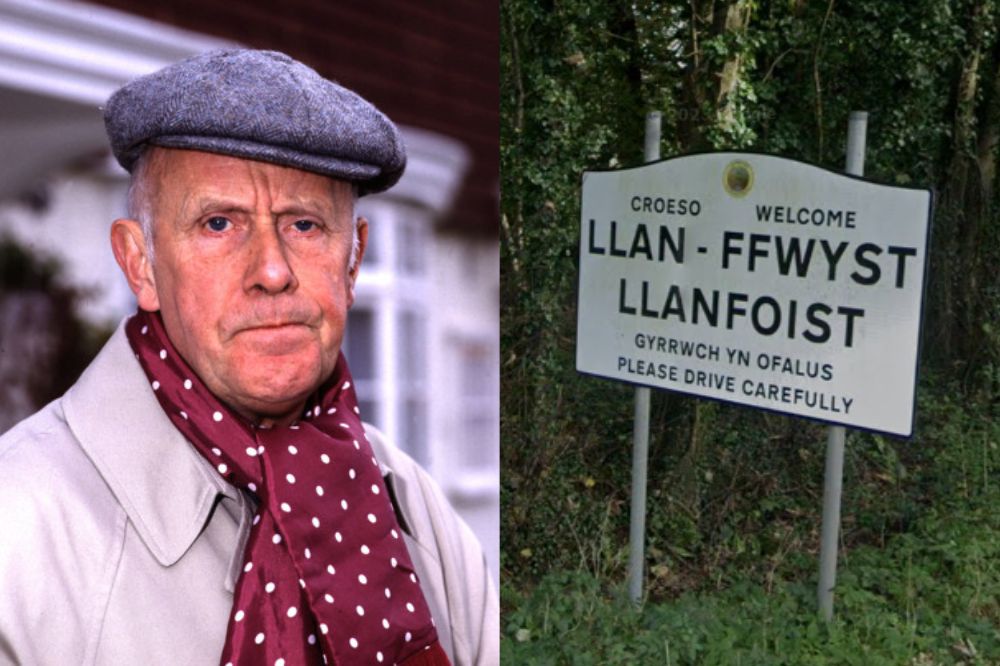
Stephen Price (Fictor ap Meldrew)
Like the great man Victor Meldrew himself, the older I get, the more “I don’t believe it”.
Modern life just isn’t for me (besides fast food, global holidays, hot water on tap and the other good bits) so it’s not rare that I have a little rant, and I’m the first to put up my hands if my rant is unfounded.
But there’s an opinion piece I’ve had brewing in my To-Do list for some time now that I’ve put on the back burner after being put in my place, but I still can’t let this one go.
Yes, some people have real problems, but I don’t - so allow me this, OK.
[mid-content-banner]
What’s-he-on-about-now-mun?
So what is eating Mr Price this week?
The good old hyphen.
I’m ambivalent most of the time. I use them sometimes, I don’t use them others. I wince at the use of e-mail and the like, but I let most go.
Try and try as I might to feel OK about them appearing in standardised Welsh place names, however, and it’s just not working.
From Bryn-mawr to Ynys-ddu, Aber-arth to Wern-ddu, Welsh signage it is a-changing.
And it’s perhaps insignificant to most, but to this lover of languages and rules, I’m not quite getting the point.
Taking to the streets
Let’s take Brynmawr for example.
Bryn-mawr?! Surely not. Being of Brynmawr stock, an ex-Brynmawr School pupil.... Seriously?
Taking my frustration to Iaith, a popular Welsh language Facebook group, I posed the following question, assuming I’d be the torch bearer for other people’s frustrations, and get a cheeky little op ed written in the process:
“Shwmae pawb! I’m planning to write a piece on the over-use of hyphens in standardised Welsh place names.
"Second language here, so would be good to get first language speakers’ opinions and any particular pet hates.
"Aber-porth.. Waun-lwyd, Llan-gors Llan-ffwyst... Surely a language that flows and mutates as beautifully as Welsh doesn’t need these clunky additions?"
Sharing the Welsh Language Commissioner’s List of Standardised Welsh Place Names, I sat back, awaiting an onslaught of approval and shared annoyances, but in place of that, I got schooled.
We all learn, we all make mistakes, I’m wrong.
[taboola-banner]
It’s not right, but it’s okay
81 comments later, the gist is that: ‘the hyphen indicates how to pronounce the name properly. Without the hyphen, Aber-porth would be pronounced AbERporth. In Welsh, emphasis is on the last syllable but one. Waun-lwyd would be pronounced WAUNlwyd’.
OK, so I get it in theory.
But taking this to its logical conclusion, we would therefore need hyphens in every single Welsh word to ensure learners don’t make the mistake of emphasising the wrong syllable. Ridiculous, no? So why necessary with Welsh place names?
Another wrote: “They aren’t ‘clunky additions’. They help with pronunciation. But there is some inconsistency - there should be a hyphen in Caer-dydd and Llan-rwst, and two in Pont-y-Pridd.”
I repeated my point and stressed that I find that the use is condescending and also makes the reader take a pause between words, but for the most part I seemed alone in my battle.
One Facebook user did agree, however, using examples of Maesteg and Coedpoeth not having a hyphen, saying: “If you want complete consistency, you want an artificial language."
[lower-mid-content-banner]
“I’m running late sorry, it’s the hyphen’s fault"
So, if I text my sister in Welsh to meet in Llanfoist, I now have unnecessary extra work added to each and every text message and need to type out Llan-ffwyst.
Welsh language speakers, or writers, or those in a future Wales where we (hopefully) have one name for (most!) places will have to get used to hitting up extra buttons on their mobile phone keyboards.
And if Cardiff really should have a hyphen - then give it one. I’m a stickler for a rule, and it’s ridiculous to say that people know how that’s pronounced so it doesn’t need one.
I’d hazard a guess that people might just call out its absurdity if it happened in a place where more people might stand up and take notice.
English speakers get to seamlessly write out a name, schoolkids learning Welsh now have to become adept at hyphen usage in names where they once weren’t.
Imagine it now... “Mam, what’s the Welsh for Brynmawr?"
“Oh, it’s Bryn-mawr, love. Don’t forget the hyphen or learners might emphasise the wrong bit."
“Â is in Aaaaaaghhhhh!"
And if the purpose is intonation, then where do you draw the line?
Back to my square mile, I’ve heard people call Brynmawr ‘Brynmore’, a chapel there called Libanus (Welsh for Lebanon) 'Libe-Anus', Beaufort (Cendl in Welsh) ‘Bewfort'... The intonation is of far less concern than pronunciation.
Do we go one step further and put "Bryn as in ‘in’, aw as in ‘plough', ll as in ‘put your tongue in place like an L but blow a bit’" beneath each word?
Or perhaps we could add a string to each and every sign in Wales that you pull so it says the name out loud?
I’m leaving it to the experts.
Professor Ann Parry Owen writes: "The Panel follows specific Standardisation Guidelines in formulating its recommendations. Those Guidelines emphasise the importance of following the rules of standard orthography when advising how to spell place-names.
"In 1967 the University of Wales Press published Rhestr o Enwau Lleoedd / A Gazeteer of Welsh Place-Names, with a brief preface by Elwyn Davies explaining those rules in relation to place-names. This is the foundation of the Commissioner's Guidelines and the List of Standardised Welsh Place-names."
“Perfectly natural”
So what about the hyphen then?
Ann writes: "Nothing has changed here either, and the Panel follows the general rules of the Welsh language. One of the main reasons for having a standard spelling for a place name is to guide people on how to pronounce it.
"In Welsh the main accent of a word almost always falls on the penultimate syllable: penbleth, ysgol, ysgolion. So, if this main accent is in a different place to what’s expected, a hyphen can provide useful guidance on how a word is supposed to be pronounced correctly.
"Let’s take Penyberth (pen + y + berth) and Pen-y-bont (pen + y + bont). The former is written as one word, and accented in the usual manner, with the main accent of the word on the penultimate syllable: Penýberth.
"As for the second, the main accent on the last syllable is contrary to the norm, and the hyphens indicate that. There is a Llysfaen in Conwy (the accent on Llys) but a Llys-faen (Lisvane) in Cardiff (and the accent on faen). This is the principle behind forms such as Aber-porth, Bryn-glas, Pentre-cwrt, Tre-saith and so on.
"However, some nationally established names, such as Caerdydd, Llanrwst and Pontypridd, are considered exceptions to the rule. The original Panel's view was that these names were so famous that confusion was unlikely.
"But these exceptions are few and far between. Of course, everyone knows perfectly well how to pronounce their own local place-names – and so it's perfectly natural to feel that the hyphen is unnecessary.
"But we must remember that it is there to guide pronunciation for everyone – to inform someone from Llysfaen in Gwynedd that Llys-faen in Cardiff is pronounced differently."
I’m ‘avin’ the last word orite!
I very much wish to see the vast majority of Wales have one Welsh place name only, save perhaps for those areas where a Welsh name never was, or dual named areas with differing histories, but I’ll be using Llanffwyst and Brynmawr when I type like a true Welsh rebel.
And if you happen to see any tip-exed hyphens on signage in my locale, it wasn’t me.
View the List of Standardised Welsh Place Names here.
View 'Why do we need hyphens in standardised place-names’ by Professor Ann Parry Owen here.
Support our Nation today
For the price of a cup of coffee a month you can help us create an independent, not-for-profit, national news service for the people of Wales, by the people of Wales.
Get more trusted Welsh news
Choose Nation.Cymru as a preferred source in Google News to see more of our journalism.
