Feature
Tory wipe-out would be bad news for democracy - Tom Watson
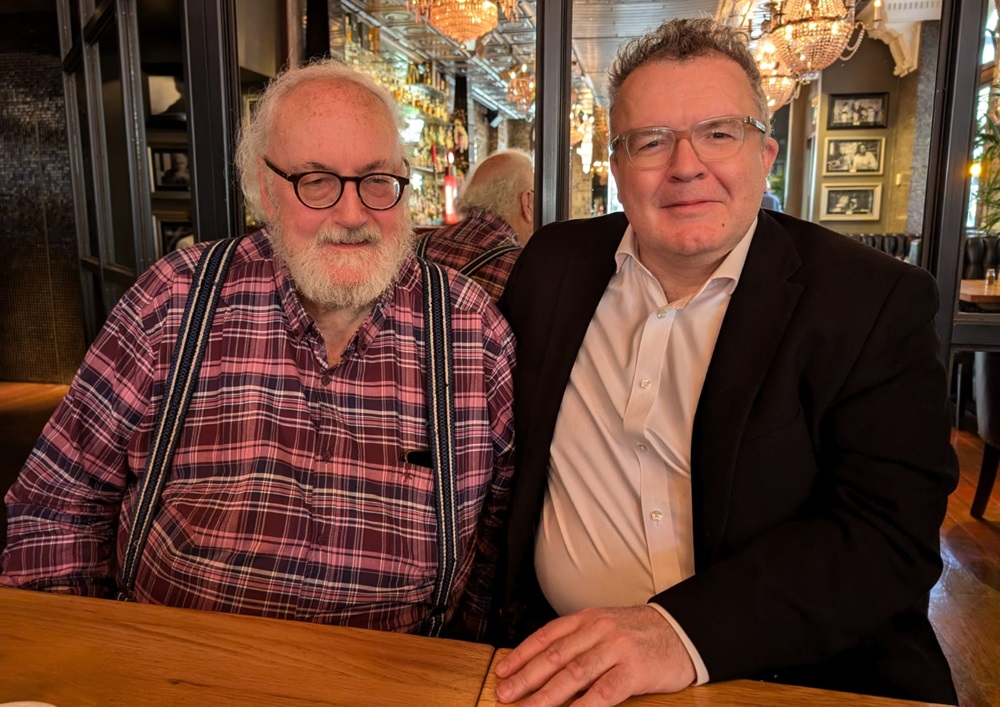
Martin Shipton
An electoral wipe-out for the Tories would be bad news for democracy, according to former Labour deputy leader Tom Watson.
In an exclusive interview with NationCymru's Martin Shipton, Lord Watson talks about what he expects from a new Labour government and the threat posed by Nigel Farage.
MS: We’re about 10 days out from the election. The polls have consistently said that Labour is well in the lead, and it’s going to be verging on, if not a super-majority. Do you see anything changing between now and July 4?
TW: It’s very difficult to tell. For the last 20 years I’ve broadly said that aggregate polls are generally accurate, but these polls are so extraordinary that they’re very hard to believe. What I do know is that Labour needs one of the largest swings in history to get a majority of one, that the Tory campaign is trying to convince people that Labour have already won before many votes have been cast and that organisationally this is not won.
So one would hope that in the next 10 days the polls are accurate, but we can’t take that for granted. Also, as the former MP for West Bromwich, I’ve been to too many West Bromwich Albion games where they go 2-0 up and you just know they’re going to lose 3-2. So I don’t want to believe it until the polls are actually here. But Labour have run a really good campaign and the Conservatives have run a very poor campaign. So who knows?
[mid-content-banner]
MS: So if they get this big majority, how do you think that will change the dynamic in the House of Commons and in the country generally?
TW: Let’s just deconstruct what a big majority is. Where this big majority idea comes from is these relatively new things, MRP [multi-level regression and post stratification] polls, that suggest tactical voting to get the Tories out will be much greater. The problem there is that when you actually look at these polls, they give a spread of outcomes that include almost every possible option, from the Tories having 50 MPs to over 200 MPs - so they’re just not very accurate.
What Keir Starmer needs is a working majority, which is 40-plus, and anything around that number allows him to honour the manifesto that he stood on. There’s some tricky stuff in there, not least planning reform, which will lead to a big house building programme, bringing in sustainable energy in a more decisive way. And I think those kind of things are what a majority gives you. I think the big fear for everyone was that Labour needed such a big swing, it would only ever have a tiny majority - five, 10,20 - and therefore it would be much harder to enact the manifesto. And of course he’s also got some very radical reforms in there.
Where I am, in the House of Lords, he wants to abolish 92 hereditary peers. I’m sure those 92 hereditary peers will have something to say about that when the legislation comes through. A working majority allows him to enact his programme, and it also helps him make some of the top decisions we’ve got to make. We’re at war in Europe. Defence has been a much bigger part in this election debate than I’ve known in many, many years. There will be a strategic defence review that could actually change our resource and make us change how we do security in Britain. These are big issues and only a majority will help him do that.
MS: One of the criticisms that have been levelled against Labour is that the programme being put forward in the manifesto is a bit timid and it’s not actually going to change people’s living circumstances to the extent that they would expect - and that therefore there’s likely to be some disillusionment after the election.
TW: I don’t buy that. I think the economic circumstances that Rachel [Shadow Chancellor Rachel Reeves] and Keir will inherit are so serious, they can’t over-promise. And it’s going to be a really tough few years ahead because there are very obviously great expectations of Labour governments. The unfairness of that is that people expect Labour to do more, quickly, than Conservative governments, and that their room to manoeuver is very limited. I was really impressed with their approach in the manifesto.
This idea of a mission for growth, and this idea of a 10-year plan for national renewal - there are some pretty big things you’ve got to do to recraft the economy: get the skills base right, invest in some of the new industries of the future, make sure the school curriculum is OK, make sure our workers are equipped for the modern age. It takes time for all that to get in. On infrastructure, people don’t take trains any more because they’re not reliable. How do you get the rail network right? How do we stimulate economic growth in areas of the UK outside London?
There was some promise of that with [ex- Tory Chancellor] George Osborne and [David] Cameron, but that’s just gone now, hasn't it? They’ve got to get all that back, and it’s going to take a long time. To turn this economy around is a 10-year plan, I think. So the programme isn’t without ambition. It’s just bitingly realistic. They're not putting any empty promises in there, and I don’t think people would have expected them to do that, if they’re serious about government.
MS: I think some people are concerned about the possibility that in the new Parliament, if there is disillusionment, you could have a move to the populist right, and particularly if Farage is elected. He has said himself, hasn’t he, that the important election is not the 2024 election, but the 2029 one. He’s obviously got very ambitious ideas about what he can do. He wants to take over the Tory party, essentially.
TW: It’s a really interesting point. If I just take a step back, we in this country are genuinely proud of our two-party system. The problem with that is that when one of the parties malfunctions, the whole system is malfunctioning. I don’t want to make a big fuss about this, but people could arguably say that Labour was malfunctioning when I was deputy leader between 2015 and 2019, in the sense that we didn’t have a realistic programme that was electorally successful.
It was visionary, it was radical, it was motherhood and apple pie, but it wasn’t realistic - and that’s why Labour didn’t win the election. Voters didn’t buy it. Arguably this time round, after three Prime Ministers in one parliament, huge dysfunction at the very heart of government, and actually a Tory manifesto that has either not been heard or is a bit ‘makey-uppy’, arguably the Tories have been malfunctioning for five years, so we’ve had a decade where one of the major parties has not been fulfilling its electoral role - and that’s bad for all of us. I mean this with all sincerity.
If the Tories do lose, I hope they sort out their internal problems really quickly, because without a good opposition, you can’t be a good government - and that’s just the way it is. On the Farage thing, I never thought I’d ever say this, but there is a potential outcome where he ends up in Parliament and tries to take the Tory party from the right. For me, that would also be a reflection of the two party system malfunctioning, and I hope that wise heads who’ve been senior figures in the Conservative Party can head that off, if we’re heading that way.
There’s also another scenario - that Farage doesn’t get any seats, that the people of Clacton unite around a very young man called Jovan [Owusu-Nepaul, the Labour candidate] in his early 20s, and they realise that what Nigel Farage stands for would harm our international prestige and our national pride in government, and Liberal Democrats and Greens and moderate Conservatives vote to stop Farage embarrassing Clacton for five years in Parliament. Who knows where it lands? If you believe in strong Parliaments and two-party politics, both parties have got to be functioning normally for that to happen.
MS: Isn’t there something a bit weird about the fact that back in 2019, the election campaign was framed from Johnson’s point of view as ‘let’s get Brexit done’, and now you’ve got a situation where neither of the two main parties want to mention Brexit? What does that tell you about our political culture now?
TW: Well obviously as a semi-retired politician I’m going to give you the positive spin on that, and I’ll let you do the negative bit in your story. The positive spin is that both parties are trying to reunite both ends of the vote on that. They’re trying to unite Brexiteers and Remainers - and taking a critical position on what happened in that referendum is sort of vaguely pointless in the sense that it’s done: we’re out of the EU.
What do we do next? We need to find new ways of bringing inward investment, making sure that we have robust trade, that we can open up new markets, that we have a close working relationship with our EU partners, outside the framework of the EU. I could cry over spilt milk again, but it seems like history to me, that referendum now - there’s not a lot of point in doing it, which is why I think both parties are just trying to put that vote behind us and building the economy around the decision.
MS: A lot of economists would say that as a consequence of the decision to come out of the EU, and also specifically out of the single market and the customs union, that the economy is being damaged, it’s not going to be growing as much as it would have done. Is there anything we can do ? Freedom of movement is seen as a big no-no, so how far can a new Labour government go in terms of repairing relations with the EU and getting improvements?
TW: This is where I think the debate within the parties is very interesting. An industrial strategy and a skills strategy with greater clarity is actually a response to that decision. There has been a failure of inward investment - there will be an argument about why that is. I personally think it’s as a result of us leaving the EU, but others will say it’s because of Covid, it’s because of the changing nature of global economics, the direction of travel set by Boris Johnson trying to open up new markets.
For me it’s really about the fact that we live in a country where there’s a skills gap and we live in a country where there are workers who want to be re-skilled. The government’s job as the intermediary is to do that. The Tories for the last five years have actually been ideologically opposed to a thing called an industrial strategy. In their mind this is about … they say the government can’t bet on so-called winners. Look - it’s not beyond the wit of man to realise that there’s going to be a tech revolution in the world. It’s happening around us.
Where is the investment in quantum computing? Where are the cyber security skilled workers we’re going to need to keep our data safe? You’ve only got to look at what’s gone on in the NHS in London this past week, which by the way if Parliament was sitting I think would have required an urgent question in the House, With three million records going missing, potentially by Russian-backed hackers, it’s the government’s responsibility to put that apparatus in place - and the Tories have been missing on the job. I think Rachel Reeves, [Shadow Business Secretary] Jonny Reynolds and Keir understand that. Putting those building blocks for future growth will take time, but that’s what I think a working majority would give them.
MS: In terms of the party itself, clearly there are those on the left who feel that they’ve been treated very badly, and they’ve been excluded from candidate selections and things like that. Do you think there was a need to be so harsh in excluding people in that way?
TW: The last minute, when you don’t have time to give the members their full say, you always end up with a handful of seats where the party machine has to step in. It’s quite hard for local members on the ground. But I think in the scheme of things, provided the Labour Party has been very responsible with the talented people that they do put in, I think that’s OK.
What I'm really encouraged by, maybe because it’s just because I’m getting old now, is I keep seeing all these energetic, bright young candidates with very diverse backgrounds. I think Labour this time round will genuinely be able to say we’ve got a front bench and a Parliamentary party that reflects all parts of society. There’s going to be a lot more Cabinet members from state schools, from working class backgrounds; you’ll have hopefully the first Black Foreign Secretary ever. I think Shabana Mahmood might be the first Muslim woman ever to be in a Cabinet and Lord Chancellor of the country - although Sayeeda Warsi attended the Cabinet, Shabana would be the first full Cabinet minister.
And then on the new MPs, we’ve got people with all sorts of backgrounds, from a screenwriter who helped write the scripts for the Teletubbies, to those who’ve held very serious office in the military, in things like the marines and the other forces. We could end up with 10 military veterans in our Parliamentary party, which hasn’t happened since after the Second World War. So I think Labour will look very different after this election , if we get to a working majority.
MS: As you’re aware, and I know you’re a big mate of Kevin Brennan’s, there’s been a particular concern in Cardiff West about the imposition of this lawyer from the Labour Party, who may have spent a few years as a child in north Wales but doesn’t actually mention the school that he went to on his LinkedIn profile.
As far as his education went, it began when he went to the LSE.There’s a lot of people who are unhappy about this, there are people who have left the party, there’s all sorts of ructions going on within the CLP [constituency Labour party]. Do you think that sort of thing is a mistake or was it avoidable?
TW: Firstly, can I thank Kevin for his service to the Labour Party and his 20 years as a colleague and MP, and wish him well with his health. I’m afraid I don’t know the candidate. The only thing I know is people tell me he’s a really nice guy, but I think there are more senior people than me who can cast a view on that. He’d better be a good candidate, because he’s in the constituency of Mark Drakeford, who’s a very honourable and decent man, and if he can win Mark Drakeford over, I think he’ll do OK.
Support our Nation today
For the price of a cup of coffee a month you can help us create an independent, not-for-profit, national news service for the people of Wales, by the people of Wales.