


Sat, 18th July Cardiff 17°
Nation.Cymru wordmark
Advertisement

Feature

New polling: Reform is winning over Christian support
By Mark Mansfield
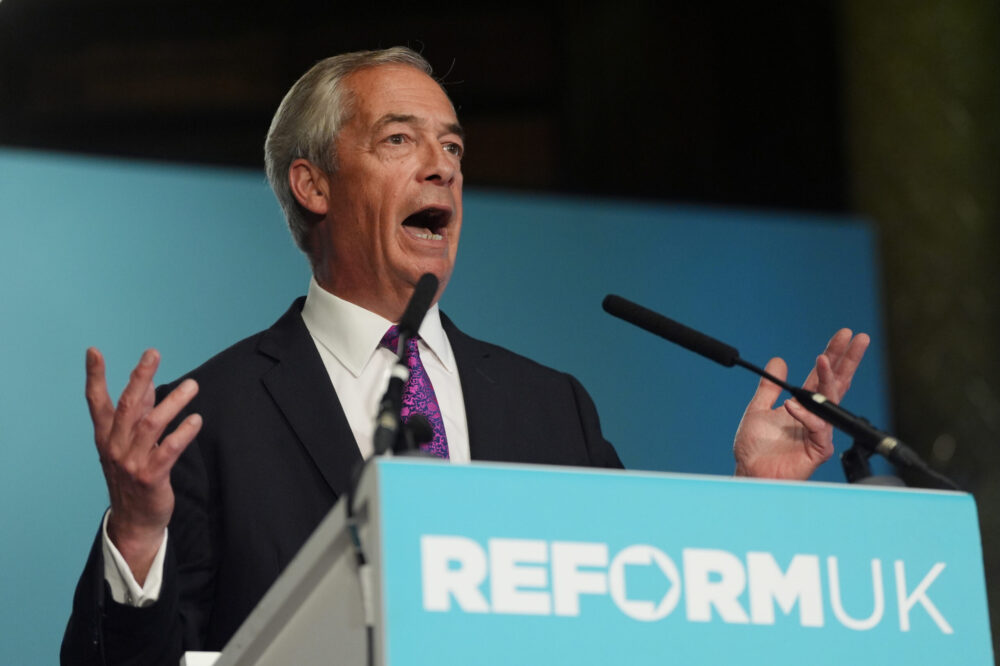
Reform UK leader Nigel Farage speaks during a press conference in Westminster, London. Image: Ben Whitley/PA Wire

Stuart Fox, Senior Lecturer in Politics, University of Exeter

When we look at how people vote in elections and why they choose certain parties, analysis often focuses on age, education, location or socioeconomic status. Less discussed in Britain is religion. But close to two-thirds of its adults are still religious – expressing either a religious identity, holding religious beliefs, or taking part in religious activities.

For the one-in-three adults in Britain who are Christian, this identity remains an important influence on their political behaviour. New polling, published here for the first time, shows how Reform UK is disrupting our previous understanding of how Christians vote in British elections.

The relationship between Britain’s Christian communities and the major political parties goes back centuries. The Conservative party has been very close to English Anglicanism since its emergence in the mid-19th century. Catholics and free-church Protestants (such as Baptists and Methodists) have tended towards the Labour and Liberal/Liberal Democrat parties. Even as Britain has become more secular, these relationships have persisted.

[mid-content-banner]

Anglicans

Anglicans, for example, have tended to vote Conservative even when the party was in dire straits. In the 2024 election, 39% of Anglicans voted Tory even as the party’s national vote share fell to 24%.

Since the 1980s and particularly in elections since 2015, however, we have started to see changes to the Christian vote. The traditional Catholic attachment to Labour has deteriorated, as has Labour’s appeal to other Christian communities such as Baptists, Methodists and Presbyterians.

Instead, driven by the rising salience of social values (attitudes towards immigration, social change and national identity) as a determinant of political support, the socially conservative leanings of some Christians of all stripes has led to increased support for the Conservatives. And those who traditionally did so – the Anglicans – have become even more supportive. The result has been a steady coalescing of the Christian vote behind the Conservatives.

[lower-mid-content-banner]

Realignment

But now, new polling by YouGov (on June 23-24 2025) for the University of Exeter reveals that this realignment is being disrupted by the growing popularity of Reform UK.

Instead of asking who people would vote for tomorrow, a nationally representative sample of 2,284 adults was asked how likely they were to ever vote for each major party, on a scale from zero (very unlikely) to ten (very likely).

While not the same as a direct question about how someone would vote in an election, the likelihood question provides a much richer measure of the strength of their support for all of the major parties.
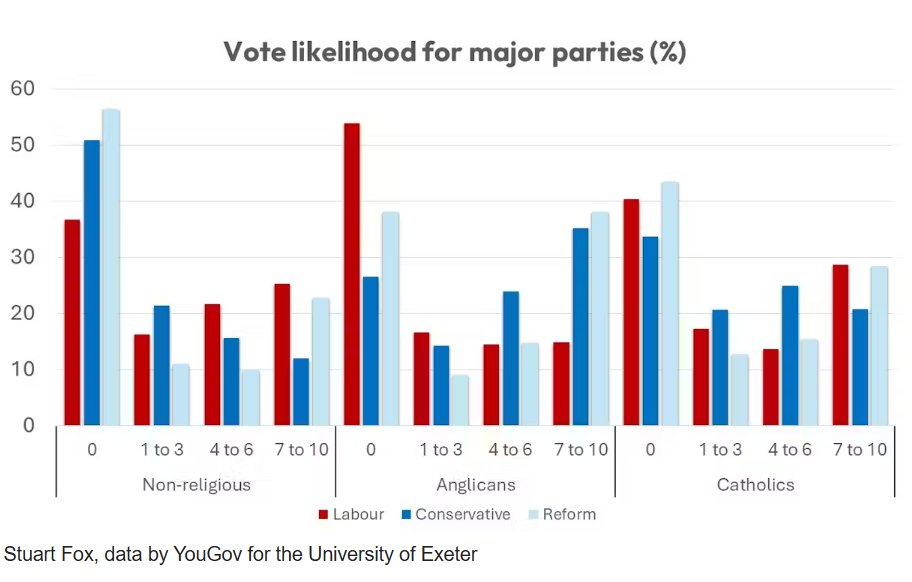
Among Anglicans, Labour remains deeply unpopular: over half gave the party a 0. In contrast, the Conservatives still enjoy strong support among Anglicans, with 35% giving them a vote likelihood of seven or higher – the kind of support associated with voting for the party in an election.

Reform, however, has caught up. Despite only 15% of Anglicans voting Reform in 2024, 38% now rate their likelihood of voting for the party as high. That’s the same as the proportion who are strongly opposed to Reform – showing that while the party polarises Anglicans more than the Conservatives, Reform could win as much Anglican support as the Tories in an election.

Catholics show a similar trend. Labour’s traditional support is eroding: 40% of Catholics said they had zero likelihood of voting Labour, while 29% are strong supporters. As with Conservatives for the Anglican vote, Reform is almost level-pegging with Labour for the Catholic vote at 28%. It has even supplanted the Conservatives, of whom 22% of Catholics are strong supporters.

It is not yet clear why this is happening. The distinction of Christian (and non-Christian) voting patterns is not an artefact of age – there are many studies that prove this is the case.

It may be that Reform’s stances on issues such as immigration resonate with Christians’ concerns to the extent that they are willing to set aside their historic party loyalties. Or it may be that Christians are as prone as other British voters to turn to Reform out of frustration with the performances of Labour and the Conservatives in office.

Swing voters and party competition

This data also shows the extent to which voters’ support for parties overlaps or is exclusive. In other words, which voters have a high vote likelihood for only one party (and so are likely committed to backing that party in an election), which do not have such high likelihoods for any party (and so will probably not vote at all), and which have similarly high likelihoods for more than one party (effectively swing voters, persuadable one way or the other).

Among the religiously unaffiliated, 29% aren’t strong supporters of any party. For Catholics, it’s 26%. Anglicans are more politically anchored, however, with only 20% in this category.

While traditionally, we would have expected this to reflect Anglicans’ greater tendency to support the Tories, only 17% of Anglicans are strong supporters of only that party, compared with 21% who are firmly behind Reform. These aren’t swing voters; they’ve switched sides.

A further 12% of Anglicans have high vote likelihoods for both the Tories and Reform. These are swing voters that the two parties could realistically expect to win over.
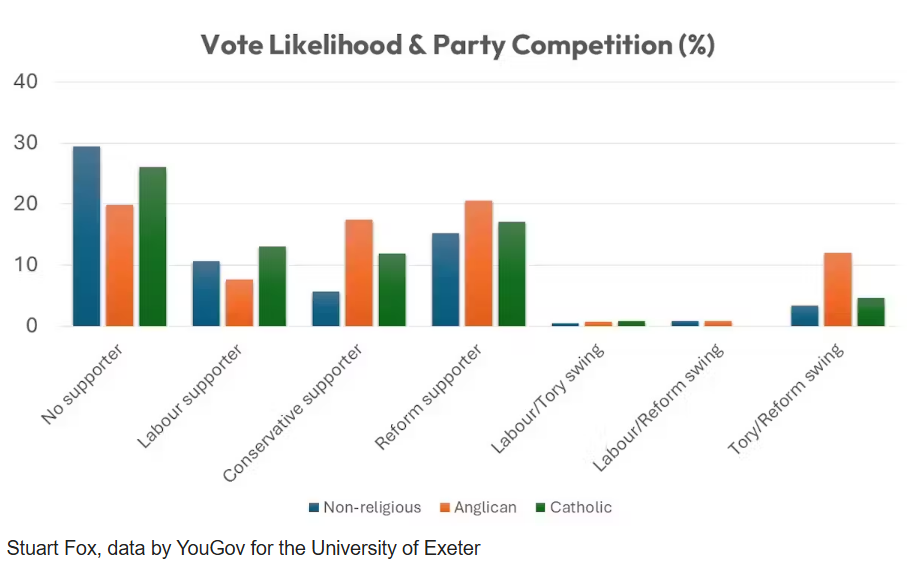
Catholics are even more fragmented. Only 13% are strong supporters of Labour alone, along with 12% and 17% who are strong supporters of the Conservatives and Reform alone, respectively.

Few Catholics are torn between Labour and the other parties, but 5% are swing voters between the Conservatives and Reform: the Tories’ gradual winning over of Catholics over the last 50 years is also being challenged by the appeal of Reform.

The party has provided a socially conservative alternative to the Conservatives, with the result that the Christian vote has become more fragmented. The Tories are no longer the main beneficiaries of Labour’s loss of its traditional Catholic vote.

In addition, Reform is as popular as the Conservatives among Anglicans, and as popular as Labour among Catholics. This suggests it is appealing across the traditional denominational divide more successfully than either of the major parties.

If there is to be a single party that attracts the bulk of Britain’s Christian support, at this point it is far more likely to be Reform than anyone else.

This article was first published on The Conversation
The Conversation

For the price of a cup of coffee a month you can help us create an independent, not-for-profit, national news service for the people of Wales, by the people of Wales.

Get more trusted Welsh news

Choose Nation.Cymru as a preferred source in Google News to see more of our journalism.

Choose Nation.Cymru as a preferred source in Google News

31 comments

Jeff

How did trump get to power, what was one of his tools, oh yeah, mobilise the religious (preferably white). People don't seem to be paying attention.

Reply
Rob

I remember the Monica Lewinsky scandal in the late 90s? Those Christian fundamentalists who were demanding that Clinton be removed from Office today are now bending over backwards to defend Trump's behaviour

Reply
Jeff

Keep an eye on what happens to Maxwell and the files. That is how far the religious right are prepared to forgive in the US (and the convictions of some of those religious recently are quite horrifying). Expect the same support here, tis why fartage courts them. Its why farage and tice rolled out "christian forgiveness" for an MP that gave a girlfriend a kicking but only balked when other issues arose.

Reply
Blodwen

Odd. The (true) Christians I know are all Greens or Plaid Cymru. If you take Christ's message of care for others - for all others - then you could not possibly vote for the Faragists (nor Badenoch's lot)

Reply
TheWoodForTheTrees

I guess pretend Christians might vote for a Party with a pretend politician leading it.

Reply
Y Cymro

This is ironic. Either these are fairweather Christians or they do not know their own scripture. Nigel Farage and Reform UK attack asylum seekers fleeing war and persecution. Is overtly Islamophobic. Also , Reform under another name (s) Brexit Party & UKip were hostile to European Union and those nation states within My I remind them of their own teachings. In fact, they are going against them. Leviticus 19:18: "Love thy neighbour." Deuteronomy 15:11: "'Open your hand to the poor and needy neighbour in your land." Psalm 82:3-4: Calls for the protection of the vulnerable and oppressed. Matthew 7:15: "Beware of false prophets, who come to you in sheep's clothing, but inwardly are ravenous wolves." Matthew 7:15 is applicable to both Trump and Farage don't you think? I do. I rest my case.

Reply
Fanny Hill

How anyone can profess to be a Christian and be a member of Reform is, if you’ll pardon the pun, beyond belief. Christ’s parable of the Good Samaritan should be enough to question Farage’s vilification of asylum seekers and refugees.

Reply
Rob

Church and state should remain separate. If people want to live in a Christian fundamentalist society then go live in the American Bible Belt.

Reply
Peredur Jones

Flawed data, based on the presumption of ‘Britishness’ . ( middle england)

Reply
Amir

Yes they do have any issue with real asylum seekers. Otherwise why don't we have a pathway for the Palestinians like we did for the Ukrainians? And yes we do have a problem with people coming to work through legal methods. The process to extend visas or grant leave to remain is expensive and long winded meaning they can travel while their applications are being processed. So how then can they live here legally?

Reply
Amir

What danger does Islam pose to the UK? How am I, a Muslim, a danger to you?

Reply
Ashley

From my discussions with people, they are worried about how Islam is having more and more of an influence in the UK. Things like the call to prayer being allowed to ring out in the streets, halal meat becoming a norm which is an inhumane way of slaughter, and the way Islam is trying to get itself protection in legislation - we should be able to criticise without repurcussions, and sharia law being practices in the UK (although unenforceable) One thing that consistently comes up as well is that Birmingham MP asking what is the UK doing to help his constituents with an airport in Pakistan. To be honest, I think these are all valid issues, from what I've seen (not in all instances), is a lack of wanting to integrate and live amongst British values but instead seeking to impose their own values.

Reply
lufccymru

Christians are such hypocrits

Reply
Johnny

Not all Christians, there are genuine ones who do have the interests of Humanity at Heart and do allot of good work helping to transform the lives of the less well off in society and those struggling with addictions. Yet I do know where you are coming from, Unfortunately there's a large number of Right Wing even Far Right Evangelical Fundamentalists who detest people who don't have the same mindset as themselves.

Reply
Jeff

What danger. How are you measuring "gone". Last census data does not compare to what you claim. Census has 43.6% Christian for Wales. Have a look at the link. There is even a map you can check results. https://www.ons.gov.uk/peoplepopulationandcommunity/culturalidentity/religion/bulletins/religionenglandandwales/census2021#religion-in-england-and-wales

Reply
Karl

those are fake Christians, don't attend church. The world is full of them

Reply
Jeff

Have to explain how a census works where people have an option to fill in a form that will be anonymised and make up what they are and you can make out they are all fake.

Reply
Bret

Economic migrants won't be granted asylum.

Reply
Bret

Real Christianity all but disappeared when it was abolished by Henry and replaced by a fake version that better suited his libido.

Reply
Fanny Hill

Let's hope that those Christians planning to vote Reform will take note of Farage's latest plan to repeal the Online Safety Act putting our children at risk.

Reply
Amir

They are so blinkered in their hatred for people like me, they won't notice anything else.

Reply
Karl

Economic migrants arrive on planes, because economic migration is those appplying and getting jobs and then moving. Not desperate people on boats

Reply
John Ellis

I suspect that the only really ideologically committed Christians likely to be drawn to Farage's squalid politics are a segment of the fundamentalist protestant evangelical variety, who are dim and credulous enough to buy any glib preacher's ignorant blatherings.

Reply
Jeff

Look up James Orr.

Reply
John Ellis

Hearty thanks for pointing me towards that: I studied theology for my degree back in my idealistic youth; but that was sixty years ago, long before Dr Orr was born, and until you gave me the steer I hadn't heard of him. I see that he's a career academic philosopher, with a particular interest in Heidegger and Edith Stein. My experience of philosophy academics from my university days is admittedly limited, but, such as it is, it's led me to suspect that their commitment to faith is generally and primarily - shall I say? - intellectually speculative, way more than it's indicative of much commitment to, or even interest in, faith and discipleship. And that such religious belief as they have might be unlikely to affect political beliefs which they opt to embrace for reasons entirely unconnected with religion!

Reply
Jeff

Its a start. It most certainly has issues. But quite obviously not all parents parent. The state needs to intervene in the same way it does for drink driving and seat belts. Fine the platform owner or block them is a tool I would also support. Fartage is concerned he will not be allowed to say disgusting things, that is his worry. He is already skating close to the edge trying to ignite riots but just the right side of the law. He is Choudry of the right.

Reply
Fanny Hill

What's disgusting about protecting children when they go online.? Farage labelling Kyle's comments linking him to Savile as disgusting are farcical when you consider what his mate Musk said, without absolutely no evidence, about the guy who rescued that football team from a cave complex in Thailand. Do you also oppose the smacking ban inWales? Just wondering.

Reply
Iago

The online safety bill will do very little to protect children and just consolidate the power of the very tech companies that are causing the problems in the first place. Labelling anyone against a bill you seem to hardly understand as a child abuser is an interesting take considering your comment above.

Reply
Iago

Plenty of comments above you that aren't hard left and have been up for hours. Cry harder 😂

Reply
Jeff

US representatives visiting the Commons have a falling out with Farage. They labelled him "Unhinged" and "like a giant man baby" when farage does his usual when trump was brought up. Farage don't like talking about trump. There was more as well.

Reply

Leave a reply

Replying to Jeff Cancel

How did trump get to power, what was one of his tools, oh yeah, mobilise the religious (preferably white). People don't seem to be paying attention.

Comments are reviewed before they appear.