


Feature
How Greenwashed was My Valley? Part 2: What’s in it for Cymru?
Neil Anderson
This second article discusses some of the political and economic drivers behind the Glyn Taff Solar Farm and other such projects, and their implications for Cymru (You can read part one here).
Economic Perspectives
One might think that there would be benefits to Cymru from the investment proposed at the Glyn Taff Solar Farm, on top of the relatively trivial amounts offered by Nadara for ‘community benefit’ and the small-scale local employment. After all, the Farm would produce significant energy and revenue – but not for Cymru!
The Farm will take our sunshine and create electricity, but because Cymru already produces far more electricity than we consume, that energy will flow along pylon and cable routes (probably expanded as part of the overall masterplan) to England and perhaps, via the Interconnectors, beyond.
That surplus production, effectively duplication, now well is excess of any foreseeable needs for Cymru, including ‘resilience’, represents an inefficient allocation of resources (and unnecessary damage to our environment).
Now we understand climate change a bit better (but still doing very little about it), it has become apparent that economic growth is a two-edged sword. It certainly works for shareholders, but, as in Glyn Taff case, not for us.
[mid-content-banner]
Ffos-y-Fran
As in the extraction of coal, the Ffos-y-Fran pollution disaster-in-waiting and the precarious coal heaps elsewhere, the free water we export from the Elan Valley, and many other examples of exploitation Cymru has suffered, this is simply more colonialism in action, in plain sight! Glyn Taff is an insult. Cofiwch Dryweryn!
Being realistic, our economy, our country and our people are hardly ever considerations in London. Kept on life support, Cymru has depended on the grace and favour of successive miserabilist governments. Their policies are designed to extract and deplete our resource base at minimal cost (the much-criticised Barnett Formula). The unionist parties - Tory, Labour and especially Reform - are determined to suppress any aspirations for independence or even self-reliance. Should we not be grateful?
[lower-mid-content-banner]
‘Planning for Growth’
I deplore the energy fetish being pursued by the UK and Welsh Governments. Yes, there is a need to decarbonise our economies. However, any rush to re-industrialise Cymru would be a mistake that we would come to regret, but one that Reform seems intent upon.
Governmental support for developing large-scale enterprises, which drive an out-of-scale approach to energy generation and transmission (but not to employment), appears as merely another ploy to avoid and delay confronting issues of redistribution that will become more salient as our resource base continues to be depleted.
The large energy plants ordinarily envisaged are inevitably managed and owned by remote businesses, and are not susceptible to local concerns. That governments tend to endorse them simply confirms the formers remoteness from the people they were purportedly elected to serve.
As is typical in government, Trydan Gwyrdd Cymru thinks big – their three wind farms announced so far are up to 162MW (Nation.Cymru 11 July 2025). Though the profits generated will be invested in Welsh communities and public services, such large schemes tend to undermine local enterprise and their often more appropriate response to local needs. With a more balanced approach, Trydan Gwyrdd Cymru could also empower local communities, part-fund, provide economies of scale for procurement, develop micro-grids and reduce transmission distances.
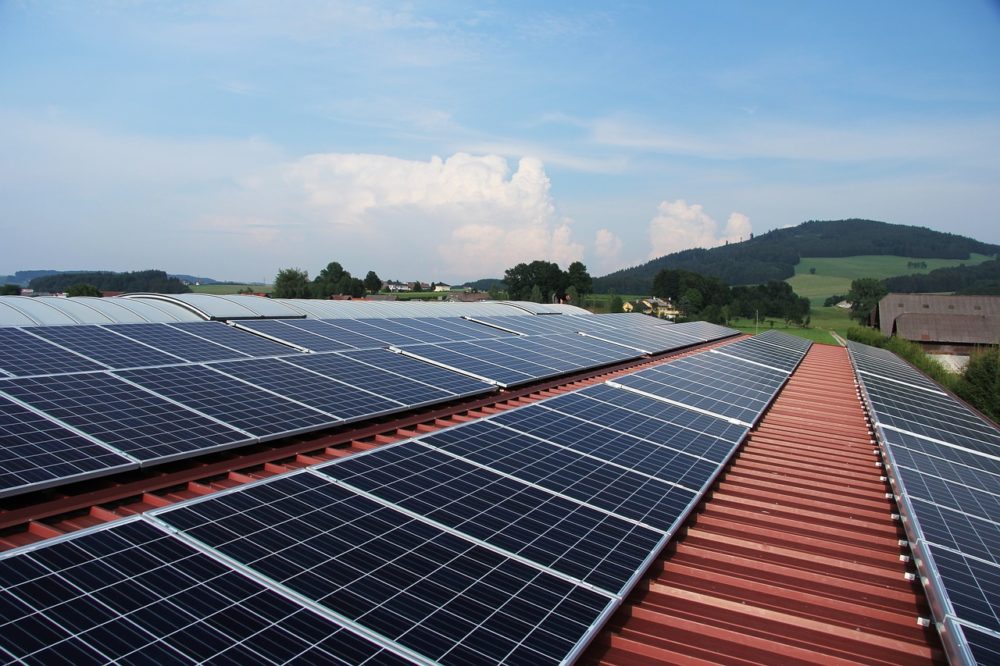
While wind turbines require large open areas, preferably not in-yer-face, the optimal location for solar panels is on the roof of the building where the energy is utilised! Homes, offices, factories and warehouses should be retrofitted before we despoil our natural environment.
New building plots and buildings should be oriented to maximise solar capture (passive and active) with the technology designed in.
The dominant energy paradigm of ‘more is better’ ignores the Second Law of Thermodynamics and the need to reduce energy use (~ heat). Heat is a serious pollutant, surely not easily forgotten in this year’s heat waves.
Reducing energy use can be best, but is not only, achieved by reducing gross generation. Perhaps governments and corporate interests think there is more money to be made from cleaning up the mess than in avoiding it? Good luck with that!
Energy and Employment
The government talks about ‘energy for jobs’. Well, consider a typical datacentre, consuming vast amounts of energy but employing very few people, perhaps 15. At that cost per job (millions?), how much employment will there be offered in a high-tech, high-energy economy?
Consider too, R S Thomas’s poem, Cynddylan on a Tractor. The farm worker regrets the loss of his physical connection with the land, if not the hard graft.
Today, the present writer and many, many others in front of our computers and peripherals, are usually far removed from the outdoor environment, and have too little time to spend in it.
After the investment in mechanisation, automation, computerisation, robotisation and AI, the technologies now deployed in manufacturing are highly productive and the return on capital substantial.
Why would one invest in people when their jobs may disappear in the next round of progress, turned over by the plough of cost savings?
Given that Cymru has experienced the depletion of its coal, tin and other resources, one must question policies, and Welsh Labour Government acquiescence to them, that seek to extend that extractivism and exploitation to other assets.
While there have been benefits to the economy of England (water, holiday homes, now energy), few seem to have flowed back into Cymru to our people.
The disbenefits have become very clear – a housing shortage in part caused by so many unoccupied second homes owned elsewhere, a perennial lack of financial liquidity, a loss of high-value employment and consequential out-migration, a low standard of living for many, cost increases engendered by often foreign (including English) businesses, alienation of our land and disenfranchisement of our people by Westminster-centric policies. And hungry children.
Unforgiveable.
Having witnessed planning conditions established for approved public and private projects being weak, weakened or ‘forgotten’ over time, members of the public may have low expectations of this or any project adhering to them. There are good reasons for the major loss of public confidence in the planning process…
Neither does the public appear to have confidence in the UK Government’s growth agenda. As so often in the past, the strong suspicion is that the benefits will be reserved for shareholders and rentiers, many foreign (including English). The evidence is that they do not ‘trickledown’ locally and do not offer stable employment (Bosch, Hoover, Tata). This disillusionment may prejudice otherwise worthwhile proposals that have clear and unequivocal benefits to the community. And, of course, some need to be resisted strenuously because they don’t. But all need to be understood.
Little employment will be generated by the Nadara proposal. The high-paid jobs will be located abroad. Nadara’s parent company, Renantis, is headquartered in Italy. Profits will be distributed to the most taxation-advantageous locations. The electricity generated will be transmitted across our borders. After a few years, it is likely that the solar farm will be sold to venture capitalists and local benefits decreased further to ensure profitability.
Initial construction is unlikely to require many local workers, while maintenance may employ a few in semi-skilled jobs. Clearly, Cymru will gain little.
Of similar concern is the alienation, for the medium-term at least, of a large area of Welsh land in an environmentally sensitive area. The optimal and sustainable use of the Welsh uplands would probably be a mix of afforestation, grazing for rare breeds, rewilding, water harvesting, micro-hydro, aquaculture and recreation with some solar capture. Reservoirs, also valuable for firefighting, should be covered (by solar panels!) to reduce evaporation as well as contributing to their cost and maintenance.
This more advantageous utilisation of the land would reduce runoff, provide shade, increase water quality and protect local people, housing and infrastructure while contributing towards the amelioration of the climate and future timber supplies.
These activities over similar sites throughout Cymru would employ hundreds in unskilled, semi-skilled and skilled jobs, with options for skills development and career progression while contributing towards the sustainability of the Welsh economy.
I contend that the solar farm proposal is a distinctly sub-optimal and an unfortunate exclusionary land use for this site. I suspect that readers would agree that there is a significant opportunity cost in not utilising this land directly for the benefit of Cymru and our society.
Finally, the reliance on the private sector misunderstands the role it plays in an economy.
Energy and Politics
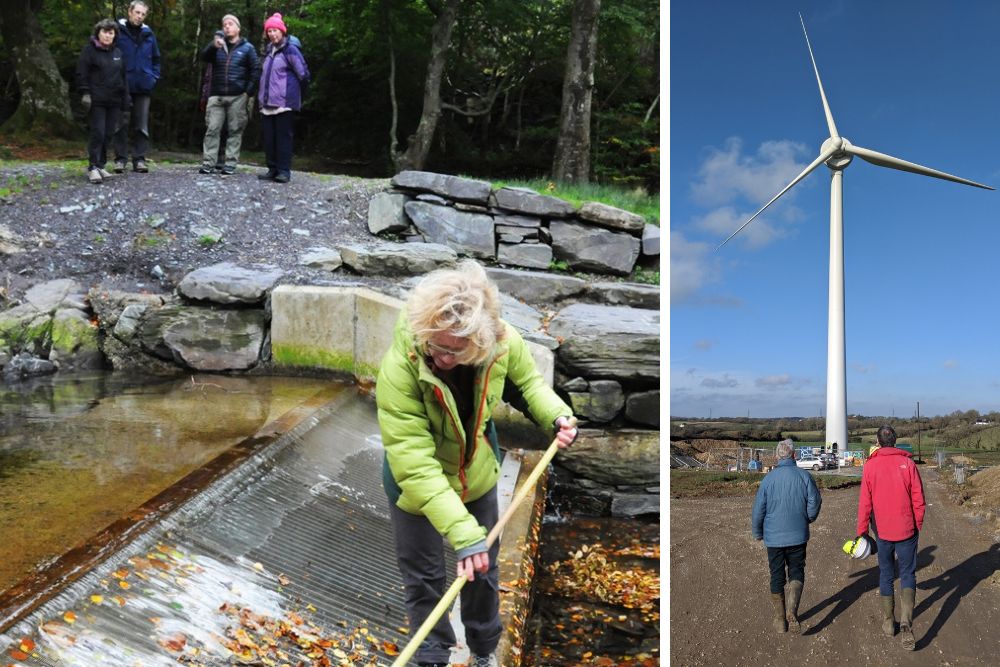
The only viable long-term future for an independent Cymru (and many other countries) implies a small-scale, low-energy approach, a wood and hemp economy, which would be much more amenable to community control and ownership. I warmly applaud Ynni Cymunedol Cymru/Community Energy Wales and similar organisations that promote the community ownership of energy and food production projects.
The debate between these two differences in scale has yet to be had in Cymru. The large-scale government approach represents a wholly extractive view of our environment, while the second respects it and the people who live here.
While the current unsustainable economic growth mentality prevails at government level, without public endorsement, it is pre-ordained that objections from local residents will be ignored.
Whither democracy? Again. Big Government and Big Energy defeat a proud people. Again.
Developments that propose jobs, especially well-paid and sustainable jobs that offer a secure future, gain a high degree of support from the public. However, as many of the promised jobs and other benefits have often not materialised in the past, our communities have become disbelieving and cynical.
It is likely that foreign control of our land and resources will be subjected to much more critical scrutiny in the future, especially post-independence. I hope we do not have to wait long…
The widespread belief that clean and abundant energy is the panacea for social ills is due to a political fallacy, according to which equity and energy consumption can be indefinitely correlated… (Illich Energy and Equity 1973).
Support our Nation today
For the price of a cup of coffee a month you can help us create an independent, not-for-profit, national news service for the people of Wales, by the people of Wales.
Get more trusted Welsh news
Choose Nation.Cymru as a preferred source in Google News to see more of our journalism.
