


Feature
Bombing Iran: has the UN charter failed?
Caleb H. Wheeler, Senior Lecturer in Law, Cardiff University
The recent US attack on Iran’s nuclear sites has prompted renewed questions about whether the UN charter’s prohibition on the use of force is meaningful.
Considered one of the keystones of international law, article 2(4) of the charter specifically forbids member states from using force – or threatening to do so – against the territorial integrity or political independence of another state, or “in any other manner inconsistent with the Purposes of the United Nations”.
A significant amount of commentary exists about what the prohibition entails. This tries to clarify ambiguities around the terms “force”, “threats of force”, “territorial integrity” and “political independence”.
[mid-content-banner]
Consensus
Although no absolute consensus has been reached, it is commonly thought that member states are prohibited from launching armed attacks against other states, or threatening to do so, unless acting in self-defence or with the authorisation of the UN security council.
Other exceptions have been suggested. These include use of force as part of a larger humanitarian intervention operation. There’s also a question of whether it’s permissible when a state is rescuing its nationals abroad. But the legality of either of these situations is contentious and remains unsettled.
Early in its existence, the UN made concerted efforts to protect and respect article 2(4) and to comply with its provisions. In 1950, the security council authorised UN member states to provide South Korea with the assistance necessary to repel the armed attack launched by North Korea, triggering the increased internationalisation of the Korean war.
While article 2(4) was not explicitly mentioned in resolution 83, it was alluded to through repeated references to North Korea’s “armed attack” against South Korea. As such, it can be interpreted as an effort by the security council to use its authority to address a violation of article 2(4), even if it did not clearly frame it in those terms.
The security council also authorised member states in 2011 to take all necessary measures to protect civilians in Libya. Unfortunately, it quickly became apparent that the member states may have exceeded their authority in Libya and carried out acts that could themselves be construed as violations of the UN charter.
Rather than just protecting civilians, as the security council resolution instructed, legal experts were concerned they had effectively intervened in a civil war. Any possible violations went unpunished by the security council.
[lower-mid-content-banner]
Korea
Security council actions taken with regard to Korea were, in many ways, the high watermark for the prohibition of the use of force, given the scale of the conflict. There are two reasons for that. First, a significant proportion of the wars taking place after 1945 have been domestic and not subject to the provisions of article 2(4). The prohibition specifically applies to a member state’s international relations so is not inapplicable when a member state attacks a group within its own borders.
Second, the UN has failed to address many of the acts occurring after 1945 that might fall under the provisions of article 2(4). The reason for this inaction lies primarily in the flawed structure on which the UN is built.
Chapter VII of the charter makes the security council responsible for addressing acts of aggression that would constitute uses of force under article 2(4). But it has repeatedly failed to fill that role, allowing states to commit these acts without meaningful response.
The UN veto problem
UN security council decisions can only be enacted when at least nine members vote in favour. This must also include the affirmative vote or abstention of all five of the permanent members: the US, Russia, China, the UK and France. This essentially gives each of the permanent members the right to veto security council resolutions.
Permanent members have commonly used the threat of their veto in their own political interests. This can be seen in a variety of instances, most notably the 2003 US invasion of Iraq and the 2022 Russian invasion of Ukraine. Both situations clearly involved uses of force prohibited by article 2(4), and in both situations the security council was prevented from acting by some of its permanent members.
This inaction is consistent with the UN’s failure to address many other acts that might fall under the provisions of article 2(4), including US involvement in south-east Asia in the 1960s and the Russian invasion of Afghanistan in the 1980s.
The security council’s failure to adequately perform its role has caused some to try and find a workaround. The Council of Europe, disappointed at the lack of accountability for Russia’s acts of aggression against Ukraine, has entered into an agreement with Ukraine to establish a special tribunal for the crime of aggression against Ukraine.
In the special tribunal’s draft statute, an act of aggression is defined to almost exactly mirror the type of conduct that would constitute a use of force under the UN charter.
Bombing Iran
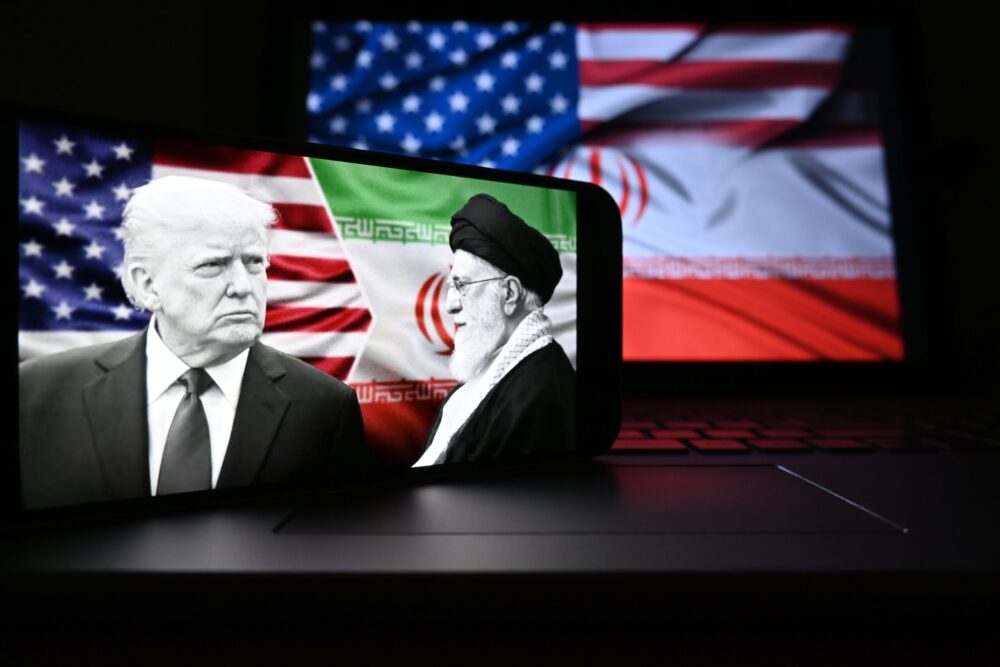
Which brings us to the current situation in Iran. There is little question that the US violated article 2(4) when it bombed Iranian nuclear sites in Fordo, Natanz and Isfahan on the evening of Saturday June 21. This is a clear use of force against the territory of another state.
But even if the attacks themselves were not enough to establish a violation, they were also accompanied by US president Donald Trump’s suggestion that a regime change in Iran might be appropriate. These comments, coming immediately after the initial attack, could be construed as a threat of further force against Iran’s political independence should such a change not occur.
( @realDonaldTrump - Truth Social Post )
( Donald J. Trump - Jun 22, 2025, 4:55 PM ET )It’s not politically correct to use the term, “Regime Change,” but if the current Iranian Regime is unable to MAKE IRAN GREAT AGAIN, why wouldn’t there be a Regime change??? MIGA!!! pic.twitter.com/qFED0eTNzh
— Donald J. Trump 🇺🇸 TRUTH POSTS (@TruthTrumpPosts) June 22, 2025
Under the UN charter, such threats and uses of force should elicit a response from the security council. But just as with Iraq in 2003 and Ukraine in 2022, none will probably be forthcoming as the US will block any efforts to hold it to account.
But equally chilling is the lack of condemnation of the US actions by its allies. German chancellor Friedrich Merz saw “no reason to criticise” the bombings, and Nato secretary general Mark Rutte insisted that the bombings did not violate international law.
As the respected Dutch scholar of international law André Nollkaemper suggests, this refusal to condemn a clear violation of the prohibition of the use of force creates a real danger that the bar for when a state can legally use force will be lowered.
Should that be allowed to happen it could further hollow out the prohibition, effectively making it less likely that states will be held to account for violating international law. Further, it could also lead to the return of a world where “might makes right”. This would undo more than a century of legal evolution.

Support our Nation today
For the price of a cup of coffee a month you can help us create an independent, not-for-profit, national news service for the people of Wales, by the people of Wales.
Get more trusted Welsh news
Choose Nation.Cymru as a preferred source in Google News to see more of our journalism.
