


Culture
Review: The Elan Valley Clearance is a painstakingly detail account of an act of dispossession
Jon Gower
In his politically charged poem “Nightingales” Harri Webb invokes the names of many Welsh rivers, some of which have become polluted, such as the ‘sewered drabs’ of some of the south Wales rivers, while three dammed, or possibly damned rivers are confluenced together as a little triad; ‘Elan, Claerwen/Tryweryn of our shame.’
The fate of Tryweryn, and the inundation of the Welsh speaking community at Capel Celyn to slake the city of Liverpool’s thirst for water is well known and the name reverberates even today. But the dispossessions in the catchments of the rivers Elan and Claerwen in mid Wales are much less known, or remarked upon, or mourned. This is perhaps because, as Mike Parker suggests in his book ‘Real Powys’ that a "paucity of people in great quantity was conflated with the idea that there was barely any community to be disturb. The million gossamer threads binding rural, Welsh-speaking districts were never visible to those who could only see clanking, heavy-duty chains."
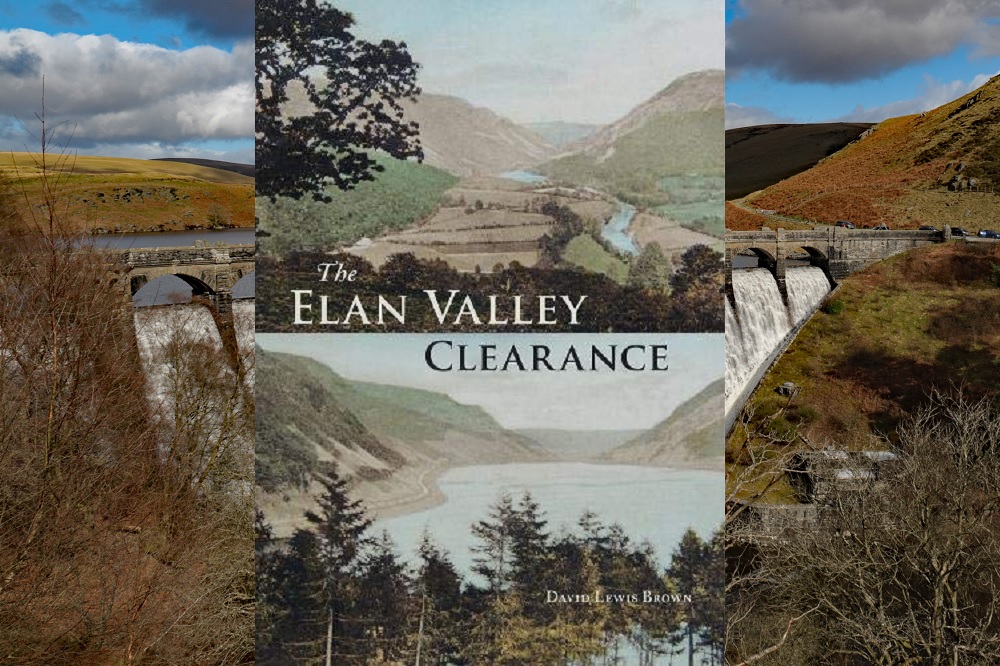
David Lewis Brown in chronicling – as the cover blurb has it – “The fate of the people and places flooded by the 1892 Elan Valley Reservoir Scheme” reveals those tight threads of community which were frazzled or sometimes cut entirely when the rapidly-expanding city of Birmingham managed to get an Act of Parliament passed. It allowed it to tap the waters of the rivers Elan and Claerwen, flooding parts of their watersheds. The city swiftly bought over 45,000 acres of land and set about clearing remote, upland valleys where almost 300 men and women and children lived before the engineers moved in.
The principal architect of the scheme, James Mansergh was given the task of planning a series of reservoirs, along with a railway to deliver materials and supplies as well as a 73 -mile-long aqueduct to take the water to Birmingham There was a school, a chapel and a church and so a churchyard full of graves to exhume. While some lived almost peasant like existences ‘with a fire on the hearth stone in the old fashioned and primitive way with baking and cooking done in iron pots covered with burning turf and hot ashes’ others lived in genteel country houses such as Cwm-Elan House, owned by Robert Lewis Lloyd. A previous owner, Thomas Grove used to host visits by the poet Percy Shelley who penned verse about the place.
[mid-content-banner]
Poor
‘The Elan Valley Clearance’ opens by taking the reader on an imaginative tour around the valley in April 1891, bringing to life the many dusty maps and documents the author had consulted during the course of his research. He takes us past a litany of dwellings whose names joined together make a found poem. Pen-henbren. Blaen-coel. Llanerchi. Ty’n-y-ffald. Tan-y-foel, Ty Bach. And then there are some which are poems in themselves. Lluest-aber-caethon. Troed-rhiw-drain. Pen-glan-Einon. We take in the hedges of blackthorn and hawthorn, white with blossom and the curlews in song. A lone fisherman tries his luck for trout. We chart the changes in the landscape as farmed land yields to moorland but also note lawn tennis courts and summerhouses, and the white-washed walls of Nant-Gwyllt Church, built in 1772 as a chapel of ease. We pass Gro Mill where the valley community brings its crops for grinding and its timber for sawing and there is also a kiln house for drying grain. This is a landscape and way of life that was soon set to change.
Birmingham had been scouting for a supply of water from as early as 1870, when its burgeoning population was growing like Topsy. By the early 1890s over 600,000 people lived in the capital of the English Midlands and with more growth forecast during the following decade here was a thirsty city that would need over 20 million gallons a day. A city that used to depend on five streams and six deep wells for its water was soon going to leave these sources utterly depleted. The pressure was on.
The political process by which permission was sought and obtained is redacted in detail. Opposition came from many quarters with south Wales and London worrying that Birmingham was taking water it might want to draw upon in future. Five counties opposed it, on both sides of the border. Tenants given a brusque time of it, especially small farmers and tenants, who were ‘in the main, very poor men’ who could not afford to appear before committees to please their cases or argue for compensation. As David Lewis Brown notes "These farmers were not commoners. They were tenants of landlords who themselves were commoners, so the tenant farmers had no common rights."
But the Act was passed and a workers’ village was created, which had 1,300 living there, a veritable United Nations with labourers coming from as far afield as America, South Africa and New Zealand. A Doss House was erected to house new arrivals, complete with an Isolation Hospital for any workers who were sick or somehow infected. There was a canteen, selling weak beer; a mission room, a public hall, a police station, hospital and public baths with a water powered generator to produce electricity. Shops opened, along with a fire station. It was like building a small town to provide water for a city.
Hubbub
It’s hard to imagine how many hours have gone into the painstaking research for this book. Its author must have spent so many hours in the Powys County Archives that he must have got an invitation to the staff Christmas party. It is clearly a labour of love and a love of detail at that. To complement the text and its forensic detail, the book has been beautifully designed by Richard Wheeler. He takes full advantage of the photos and maps available, not least the beautiful Terrier Plans drawn up by surveyor Stephen Williams with their pastel washes and Ordnance Survey quality detail, down to the tiny rushing of streams such as Nant Aderyn and Nant Ffos-rhodd, which all, in their own way, feed into the story of these gathered waters.
In a detailed appendix to the book David Lewis Brown charts the fate and movements of those who lived in the twin valleys before the inundation, showing small scale migrations to towns such as Rhayader and out into the farmed lands of Breconshire and Radnorshire, as well as proof of the magnetic pull of the mining valleys of the south of Wales, as agricultural labourers and shepherds became colliers in such places such as Treherbert, Treharris, Mountain Ash and Merthyr, with some dispersing as far afield as Chicago and Western Australia.
His book is the story of great engineering feats and vast amounts of manual labour using pick and shovel, backed up by steam hammers and crushing plants, pneumatic drills and hydraulic jacks to create mighty dams and huge areas of standing water. Among this noisy hubbub and excitement, it is also an account of much quieter acts of dispossession, of people being almost invisibly being moved off the land, before that land itself was drowned.
The Elan Valley Clearance by David Lewis Brown is published by Logaston Press. It can be bought here.

Support our Nation today
For the price of a cup of coffee a month you can help us create an independent, not-for-profit, national news service for the people of Wales, by the people of Wales.
Get more trusted Welsh news
Choose Nation.Cymru as a preferred source in Google News to see more of our journalism.
