

Culture
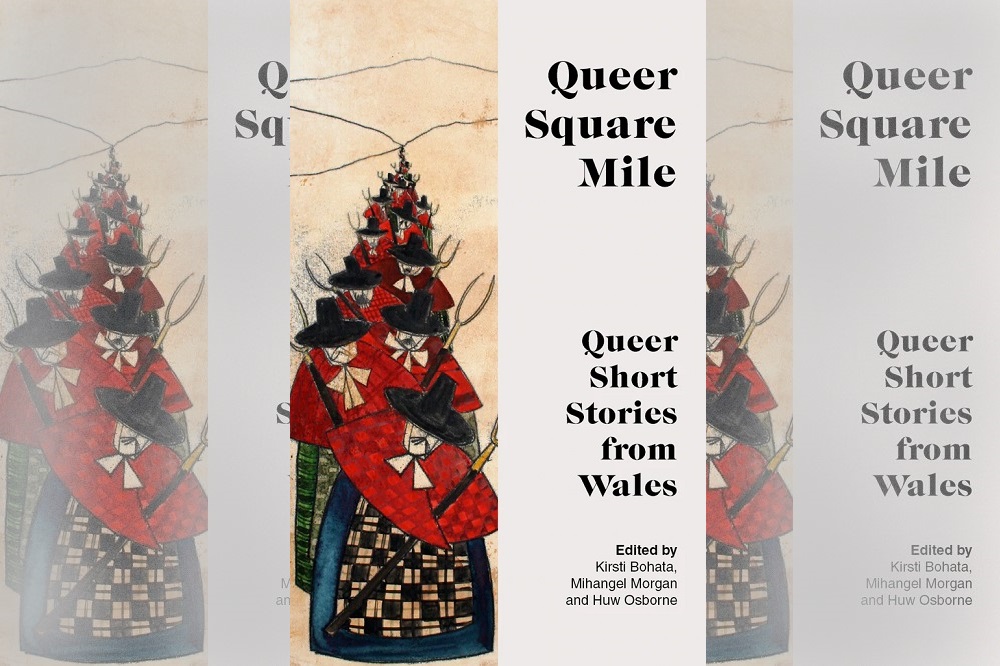
Review: Queer Square Mile: Queer Short Stories from Wales
Sarah Tanburn
Parthian Press have produced an impressive tome here: 46 stories by 25 named authors and three who remain anonymous, spanning nearly two centuries from 1837 to just last year. All the stories are presented in English but don’t be fooled by that: some have been translated from the original Welsh.
It’s a great collection for picking and choosing a tale to fit your mood and ambition, or to follow the sweep of both change and immutability in this particular patch of our histories.
The editors have wisely chosen not to present their choices chronologically, although every story is dated. Rather the book is grouped into five categories, from ‘Love, Loss and the Art of Failure’ to ‘Internationalisms’. Inevitably, and appropriately, the boundaries are blurred. Love, or lust, threads its way throughout the book, and the possibilities of movement or stillness haunt many of the writers. The strategy is further explored in the thought-provoking and detailed Introduction, an essay well worth a read in its own right.
Lesbian, gay, bisexual and transgender writing has often been preoccupied with the loneliness of recognition without role models or approbation. There’s no mystery as to why the ‘coming-out’ story in various forms is one of the founding myths of our communities and of course such tales are here too.
Some are the small recognition that the truest love has not been that which society sanctioned, as Kate Roberts tells us in ‘The Treasure,’ or the perceptive guidance of an older ally offered by Elisa to Oli in Dylan Huw’s ‘The Formations.’ This collection goes a long way beyond that tradition, though, and is richer for it. A particularly fine example is Mihangel Morgan’s ‘Posting A Letter,’ also notable for the rhythms of the language; the narrator, even in translated English, is unmistakably Welsh.
Another motif is the clash of fantasy and hard physicality, not of course restricted to this terrain - think Angela Carter, often echoed in these stories. Crystal Jeans explores the reality of vomit and salad vegetables (‘Go Play with Cucumbers’), so unlike the dangerous fantasy pursued offstage with Kimmy – a woman whose faux-Springsteen glamour is familiar from my own younger days. Yet the fantasy is so real in the moment of longing that it can make the whole neighbourhood quake.
Navigating this clash has many techniques, of which one of the most familiar of the genre is to mine laughter from revenge. Rhys Davies (‘Wigs, Costumes, Masks’) shows how ‘these inhabitants of history, tale and legend, or persons become for an illicit night the creatures of their dreams, spread an atmosphere of enchanted liberation as they fled through shafts of changing tints.’ Performance, escape, beauty and tragedy are all here, alongside the humour, just as they are for Keiron Lye, Jon Gower’s alchemical rugby player (‘A Cut Below’).
[mid-content-banner]
Connection
This relationship of dreamed for connection and an actual life is perhaps most movingly presented by Stevie Davies in ‘Red Earth, Cynrenica.’ She shows a startling juxtaposition of the passion of the caves and the deep tenderness of a long marriage in which neither is precisely devalued and yet neither are quite what they might have been. She leaves us with the question of what ‘should’ have happened and the belated acknowledgement of the unreality of the question itself. Perhaps this is the central demand of the collection: who is to say what ‘should’ be? After all, there are other identities and demands beyond sex or gender or love: religion, nationalism and parenthood to name but three.
Wales has a proud history of dissidence and non-conformism, though it has not always welcomed challenges to sexual conformism. The beautiful homo-eroticism of Glyn Jones’ ‘Shall I Dive’ is haunted by the risks of diving into the narrator’s dreams, the real punishment he has already suffered for exploring the possibilities of his life. That story from 1944 is balanced by David Llewellyn’s lingering 2021 story (‘Without Steve’) of filial love for his father’s partner.
Both stories, like many others, are also deeply rooted in the specificities of Wales, of language, topography, of family, sport and chapel. These too are founding myths, parts of the narrative of what it means to live and write here in the second quarter of the twenty-first century. And, like the notion of ‘queer’, subject to conflict and debate.
The editors explicitly eschew much of fashionable identity politics, refusing for example to restrict the anthology to self-proclaimed ‘LGBTQ+’ writers and recognising that it is possible to write good fiction beyond one’s own direct experience. I welcome this sign of maturity. As Mihangel Morgan reminds us in the Introduction, ‘the term ‘queer theory’ … has been imposed on us through a form of imperialist, American linguistic annexation’. The collective voice of the editorial team accepts that ‘not all have embraced the term’.
For me, the word is still an unacceptable slur, and one which actively excludes many from the lesbian, gay, bisexual and transgender communities. Given this view, I wish they had found another, more inclusive title, and avoided using such language, apparently unquestioningly, twice on the front cover.
If you, like me, are put off by the collection’s title, I urge you to go past it and mine these stories for all their profoundly human variety. The editors comment that they ‘prefer to let the stories themselves trouble and unsettle one’s sense of the sexual past, present and future.’ Their collection laudably achieves this ambition, and I hope we do not wait so long for another one.
Queer Square Mile is published by Parthian. You can buy a copy from good bookshops or you can buy one here…
Support our Nation today
For the price of a cup of coffee a month you can help us create an independent, not-for-profit, national news service for the people of Wales, by the people of Wales.
Get more trusted Welsh news
Choose Nation.Cymru as a preferred source in Google News to see more of our journalism.
