


Culture
Netflix’ portrayal of Wales in the Crown is a lesson for the BBC
Dylan Wyn Williams
Compare and contrast. Earlier this year, a BBC Wales commission was shown to the rest of the UK. Pitching In, a light-hearted drama series (dramedy?) with Larry Gavin & Stacey Lamb, set in ‘Daffodil Dunes’ caravan park on Ynys Mׅôn with a mainly Lancastrian cast and a gaggle of twp locals with a puzzling south Walian accent.
It was rightly lambasted by viewers left right and centre, and hopefully binned forever by Rhodri Talfan Davies to the box labelled ‘Flops starring Prominent English Household Names’.
As the year ends, a Californian streaming and production company has released an epic drama series partly set here in Wales to a worldwide audience of 148 million. The company in question being Netflix, the series, The Crown, which over two episodes, did far more to promote Welsh history and culture to the rest of the world than BBC Wales’s godawful five-parter ever will.
I’m an avid Netflixer, since succumbing to their one-month free trial. Less so a royal watcher. My colleagues tried roping me into following the first two series featuring Emmy award-winner Claire Foy as Her Maj, but to no avail.
Me, a 45-year-old who’ll be posting Christmas cards with upside-down stamps of Mrs Windsor, in conformity with my Cymdeithas yr Iaith teenage self? Someone who bought a “Twll tîn i’r Cwîn” t-shirt one National Eisteddfod, until it mysteriously vanished and subsequently reappeared among my mother’s bundle of dusters? Nefar in Iwrop.
But my workmates stressed that they were mostly enjoying its dramatic interpretation of post-1953 Britain plus the less flattering portrayal of various prime ministers and members of the monarchy. A British Mad Men, with its exquisite attention to detail. Don’t forget that one series of The Crown has a budget of £50 million, more than S4C’s coffers for the whole year.
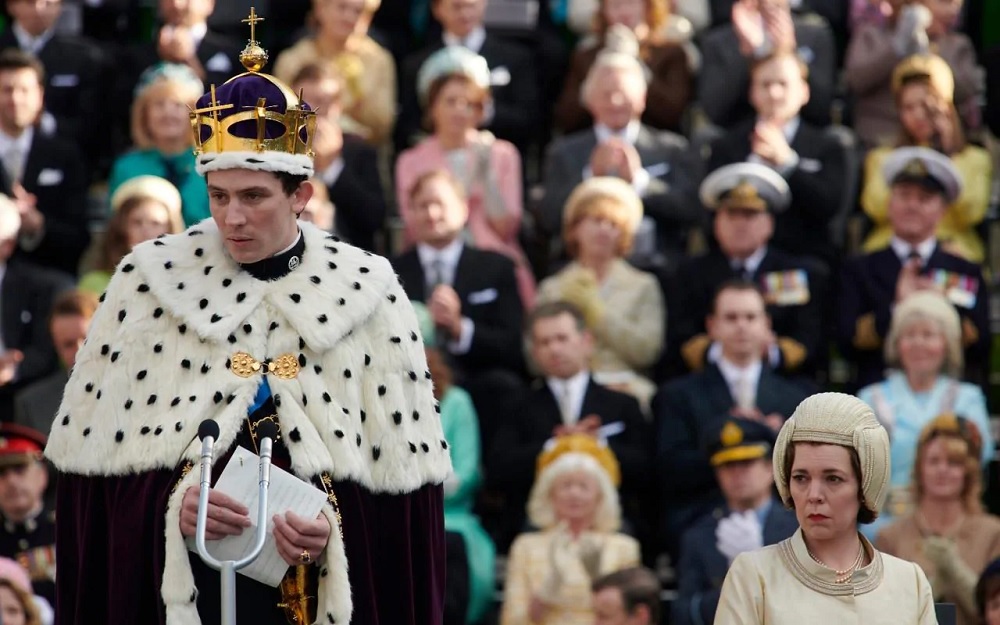
All this, and the fact that one my all-time favourite actresses, Olivia Colman, reigns as the English First Lady for the third series encompassing 1964-1977. But the deal-breaker were praise-laden episodes three and six surrounding the darkest, most tumultuous period in our modern history. Aber-fan and the investiture at Caernarfon.
The latter also highly commended for the Cymraeg only scenes with on-screen subtitles, ably translated by local writer and producer Angharad Elen. I clicked, watched and was hooked. Lord Dafydd Êl would been be so proud.
[mid-content-banner]
Lesson
The original author Peter Morgan (Frost/Nixon, The Audience) has gone out of his way to promote Wales not just as a pesky principality, but a country. In one striking scene of the Aber-fan episode, the Queen’s aide is at pains to stress the differences between the two nations as the royal jet flaunts from London to Cardiff Rhoose:
“Without wishing to prompt, Your Majesty, you may wish to consider that this is Wales, not England. A display of emotion would not just be considered appropriate, it’s expected.”
The opening scenes of episode 6, monolingually titled ‘Tywysog Cymru’, throws us straight into the “separatist stirrings” of the late sixties. The eagle-eyed viewer would’ve immediately noticed the Dim Croeso 69 posters and the Free Wales Army logo adorning Aberystwyth prom shelter, but the anglo-internationals needed further teaching.
Hence the wonderfully awkward scenes between placid young Charles (Josh O’Connor) and fiery Tedi Millward (Mark Lewis Jones), the vice president of Plaid Cymru who reluctantly became his Welsh language tutor for one term. In a later (fictional) scene, Dr Millward takes pity on his lonely student by inviting him over for supper, much to his wife Sylvia’s chagrin (Nia Roberts). This dramatic licence works twofold. Firstly, an opportunity to highlight Charles’ cold fish family as he witnesses the Millwards’ natural warmth towards their young son at bedtime. And later at the dinner table, Charles notices a photograph of the couple from their protesting days, prompting Tedi to share the story of Tryweryn with him and Netflix viewers worldwide:
“The government drowned it... to provide drinking water for Liverpool, England. And so one of the last fully Welsh-speaking villages in the land now rests quietly at the bottom of a lake.”
Of course, there were some rumbles along the way, including Dafydd Iwan whose iconic tongue-in-cheek protest song, Carlo, about the polo-playing prince, plays the final credits.
Example
Yes, the investiture scenes at Caernarfon Castle does feel rather rushed and glosses over the day’s protests amidst the pomp. It also ignores the important fact that two men were killed whilst planting a bomb next to a railway line at Abergele, intended for the royal train that very morning.
A shame, therefore, that Marc Evans’ excellent docu-film shown over the summer, The Prince and the Bomber, isn’t readily available on BBC iPlayer to coincide with the drama series.
Overall, let’s say diolch to Netflix for the respect and audacity of using our native language in such an internationally renowned series.
And diolch for setting an example to other broadcasters much, much closer to home.

Support our Nation today
For the price of a cup of coffee a month you can help us create an independent, not-for-profit, national news service for the people of Wales, by the people of Wales.
Get more trusted Welsh news
Choose Nation.Cymru as a preferred source in Google News to see more of our journalism.
