


Culture
Magnificent Mabinogi 8: Everyday life
Dr Shân Morgain
What was it like living in the world of the Mabinogi? It is a colourful, wealthy, cultured world, but riven by violent wars. Life is about high honour, romances, fighting, great feasts, the joys of hunting, beautiful horses and hounds, powerful enchantments.
This world has been considered a serious historical source since the 18thC (Ellis 1928, Luft 2010, 2012, 2017). It is clear the Mabinogi intends to describe Welsh societies similar but not identical to mediaeval Wales.
Britain was a unified kingdom under a high-king. This is not historically known until much later. As in history Mabinogi 'Wales' divided into princedoms: Dyfed, Gwynedd, Gwent, Powys. The tales centre on kings, princes, and nobles. Ordinary people are merely glimpsed as servants in the great courts, or shepherds and farmers.
Distances can be understood as days of riding or sailing. From Arberth in Dyfed to Teyrnon's Gwent is 100 miles, 5–7 days by horse, 80 sea miles less than 24 hours by sail.
[mid-content-banner]
Growing up
A noble child in this world had a tough life. Young boys faced many 'feats' of skill: strength, running, jumping, swimming, wrestling, riding, archery, fencing (swords, buckler, quarterstaff), hunting with hounds, fishing, shooting birds, poetry, harping, heraldry, reading Welsh, singing, several board games, dice.
The most important training was riding. Nobles were called marchogion, which means 'horse-riders'. Horses meant dominance over those on foot; also fast and far travel. Powys was particularly famed for breeding magnificent horses, hybrid Welsh cob and Spanish strains.
A foal was selected to pair with a child and they were constantly together to train, producing a split-second harmony of reactions for fighting and hunting. Teyrnon's wife suggests the matter was organised by the noble mother.
Given Rhiannon's spectacular appearance on her magnificent horse there is no reason to suppose girls did not also train with a selected horse. Some girls hunted, riding astride, but none trained as fighters. Their main role as well as motherhood was to organise food supplies and the great feasts. Generally ladies rode -on-the-side in a chair-like saddle.
Teenage boys were fostered away to another court of lower status, to learn formal, military discipline in the teulu (house guards). This forged strong alliance between the two courts. Girls stayed at home, closely guarded to preserve virginity for marriage.
Both were controlled by their elders (huh! nothing new). As adults senior men gained more power in later life although senior women wielded much influence as advisers.
[taboola-banner]
Feasts
Feasting is a major part of life in this world. Every day the great halls were filled with trestle tables and massive meals served to hundreds of people. A standard court had about 50 in its teulu; to that add elders, mothers, wives, pages, and servants. An ordinary daily meal served about 200 people.
A special feast like a wedding would gather many more from visiting lords. Rhiannon's weddings hosted her father's court, Gwawl's company, and Pwyll's. Think in terms of the Glastonbury Festival, all organised by women without fridges. Foodstuffs were collected by a kind of tax circuit, the cylch, a gathering and distribution cycle.
A feast had clearly marked stages. First everyone put off dirtied clothes and boots from training, farming or hunting. All must wash before changing into party silks. Such fine fabrics were imported from far Byzantium, or the Welsh craft of cleverly sewing silk thread through the weave of linen.
Numbers of people served could be so large a rota of 'servings' operated, followed by servants eating. The princely or chief family sat at raised seats. Placing who sat where was very important to social status. A favourite food was roast pork. Under the tables the big dogs crouched to chomp up scraps and bones.
Conversation was considered an art form, for there was no TV, film, internet or gaming gadgets. Ymddiddanaf/ converse was a chief entertainment, displaying political and social knowledge, wit, and linguistic intricacy playing on words.
After the food service came 'carousing', the alcohol stage, with entertainers performing stories and poetry. Courts had their own resident bards but others and the storytellers travelled round the courts bringing news as well as entertainments. But nobles too told stories to entertain, as a high courtly art, also playing the harp.
Finally the chief family and their personal servants retired to sleep in private rooms, and the rest bedded down in the hall, dogs and all, or else in the stables, unless standing guard.
Marriage and children
For the high classes marriage (and friendship) was a mixed relationship. Personal affection, romance, played a part, but just as important or more so, was political and economic advantage. However this would also apply to lower classes e.g. two weaving families married to pool resources.
A bride stayed legally part of her birth family for seven years. If her husband treated her badly she had a right to her own family's support (Branwen).
A wife not only bred her own children, but supervised the young fostered boys from other courts. She allocated the vital foal-child pairings, and gave her sons their arms. She held the important authority to name her child from her first words to it.
Wife and husband both had rights to divorce. One delightful ground to divorce a wife was if she insulted her husband's beard. This may be a polite reference to another part of his anatomy.
On divorce goods were shared out but oddly. Tools usually used by the woman were given to the man and vice versa. It is thought that this left each side poorly equipped as a deterrent to divorce.
In mediaeval Welsh society there were no illegitimate children. Different forms of marriage recognised couplings that could produce, a child. Elaborate agreements and consent between families, runaway lovers, casual rape, were all legally recognised in a practical system aimed to provide for every child.
Religion and magic
There is no mention of religious activity in the Mabinogi at all. There are no temples, churches, rituals, or prayers. Native customs cluster to local lakes, pools, groves or hills. There is no 'Celtic pantheon', only hundreds of local deities or spirits.
Llwyd disguises himself as a priest and a bishop, but these could be status names for any religious system. People call on God 'y rof a Duw,' to underline speaking seriously, but no specific deity is named.
Where we are used to thinking of a wedding as a ritual held by a priest, Mabinogi couples marry by holding a feast and publicly sitting together. This means many witnesses who also see the bridal pair go into the privacy of the bedroom to complete the marriage.
Similarly 'baptism' does not appear to be a ritual, but a public naming event. It is not recorded for all Mabinogi babies, but for any with odd parenting such as Gwri, presumably to establish their lineage for inheritance. (Gwri, Dylan, Hyddwn, Hychdwn, Bleidwn, Blodeuedd).
Magicians are a routine part of life. They hold powerful places in Mabinogi plots, different ones in each Branch driving what happens. (Arawn, Rhiannon, Bendigeidfran, Llwyd, Math. Gwydion, Arianrhod)
Their enchantments approximate to 'natural magic', often using plants or mushrooms to shapeshift a glamour i.e. a staged image. They seem like social puppeteers, or powerful politicians, or CEOs today, governing how events occur and how they are understood.
…………………………………………………………………………………………………..
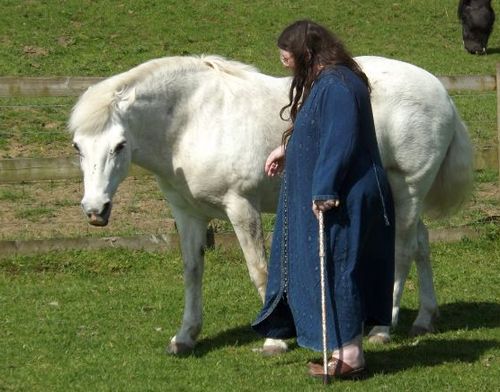
* With no experience of horses I felt I should meet one so I visited Bramble for a conversation. She wasn't much interested in her Mabinogi ancestry. Photo John Davies 3/05/2014.
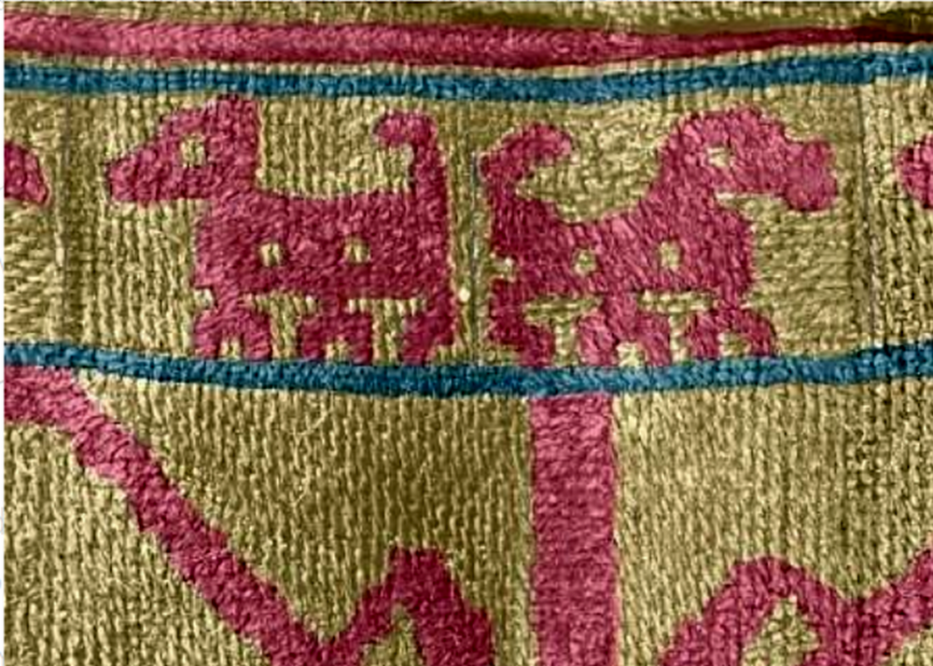
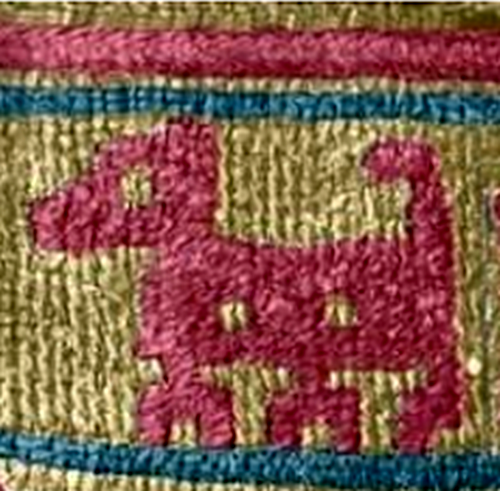
**‘ The Llan-gors textile: an early medieval masterpiece 9thC, discovered 1990 near Brecon, lake village. National Museum of Wales. 3/05/2007. This is not embroidery. The painstaking craft of threading a single silk into the linen weave evidences the astronomical cost of actual silk fabric imported from Byzantium.
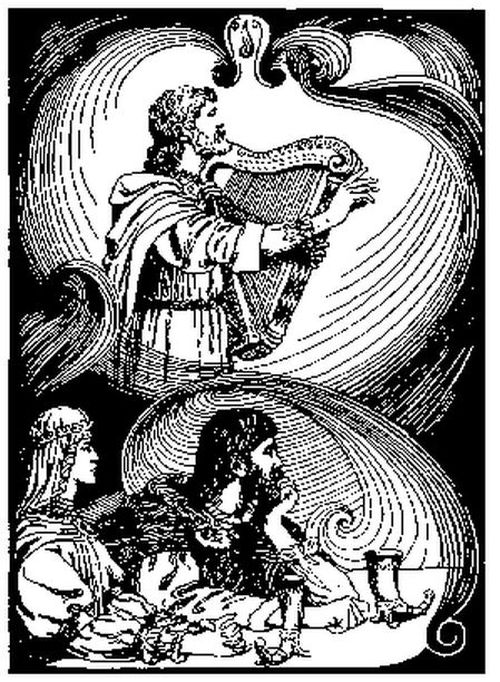
*** Kenneth Morris/ Ceinydd Morus. 1914. The Fates of the Princes of Dyfed (Point Loma, California: Aryan Theosophical Press). Woodcuts illust. by fellow Theosophist, Reginald Machell. The first fictional adaptation from the Mabinogi. Theosophical principles evident in the circular auras of radiant power. Theosophical Society 2000 text, illust.
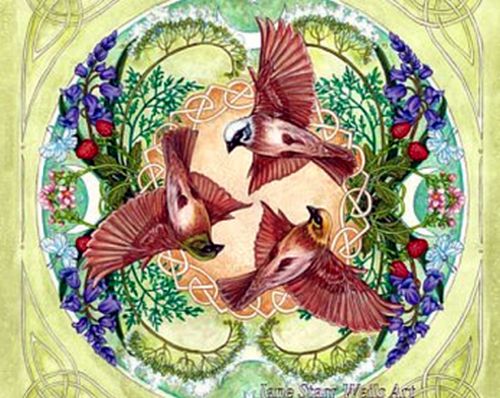
****Jane Starr Weils. 2018. 'Rhiannon's Birds', painting. Permission 25/11/2018. Print available Etsy, and Redbubble; design on poster, Tshirt, mouse mat, laptop bag and cover, cards. Weils envisages sparrows which in outline are similar to my proposed species of skylarks'.
Scholars referenced in this series can be found in my Mabinogi Bibliography; dates given above should be adequate to identify which work is meant. Questions or comments are always welcome. You can contact me via LinkedIn or Academia.edu
The 'Magnificent Mabinogi' title was first used by the playwright director Manon Eames for her famous staging, Aberystwyth Arts 2008; used here with her permission.
'Magnificent Mabinogi' series. 1) Genius 2) Stories 3) Howlers 4) Canon & Construction 5) Places of power 6) Myth/ Literature? 7) Politics 8) Everyday life (above) NEXT 9) Women
Support our Nation today
For the price of a cup of coffee a month you can help us create an independent, not-for-profit, national news service for the people of Wales, by the people of Wales.
Get more trusted Welsh news
Choose Nation.Cymru as a preferred source in Google News to see more of our journalism.
