


Fri, 31st July Cardiff 17°
Nation.Cymru wordmark
Advertisement

Culture

Comedian reconciles parenthood with climate crisis in S4C documentary
By Mark Mansfield
Eleri Morgan.

Lowri Llewelyn

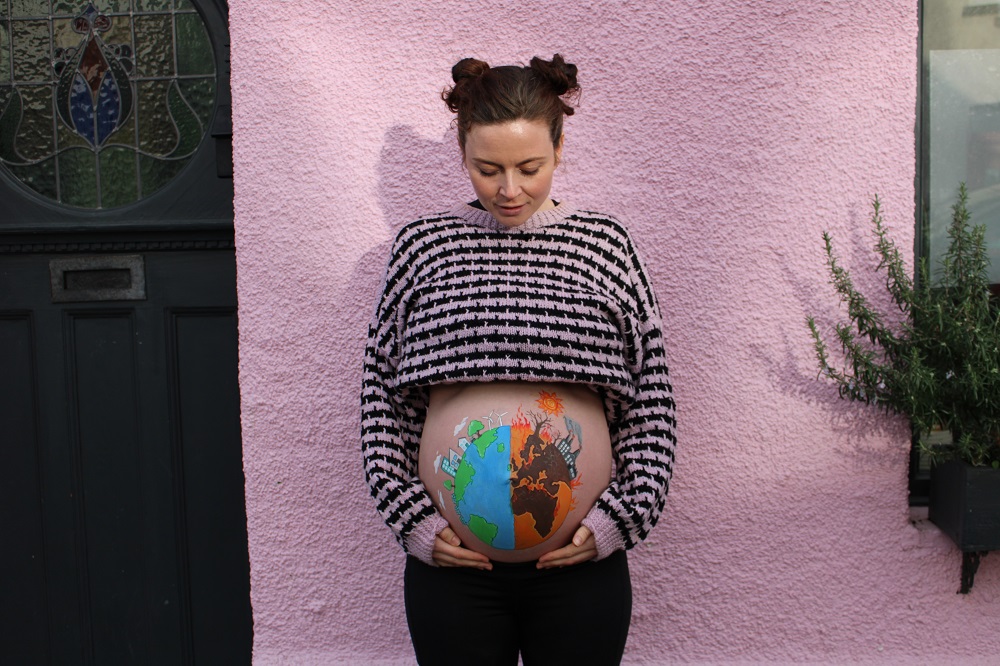
Until recently, a commitment not to birth her own baby was the bread and butter of stand-up comic Eleri Morgan.

However, she now finds herself struggling to reconcile an unexpected pregnancy with the climate crisis which weighs so heavily on her mind.

The program is produced by female-founded and female-focused production company Little Bird Films, and directed by Lindsay Walker of BAFTA winner The Welshman.

In the program, Eleri visits the Green Man festival in the Bannau Brycheiniog—named the UK’s most sustainable summer event 2022—to learn the prognosis for future generations.

She also visits the coastal Ceredigion village of Borth, which experts predict will be underwater by 2050 if sea levels continue to rise at current rates.

Borth isn’t the only Welsh location under threat from global warming, the residents of the Gwynedd village of Fairbourne being dubbed by the media the UK’s very first ‘climate refugees’ following a statement by Gwynedd Council that it would ‘not be safe or sustainable to defend Fairbourne’ following a planned decommission.

However, the tide may be turning following fierce pushback from residents who say they will not leave their homes and demand government action.

[mid-content-banner]

Positive change

Among those having their say in the documentary include the younger generation, who show Eleri the steps they’re already taking towards creating positive change. Others making a difference include a family living off-grid and a pioneering nappy recycling facility ‒ located right here in Wales.

According to the last global study by Eunomia in 2017, Wales is a world leader in recycling, coming in third only behind Germany and Taiwan. Figures released in 2022 also showed Wales was the only UK nation to uphold stellar recycling rates during the pandemic, with other UK nations all seeing a drop in performance.

However, in our culture of consumption, how will the carbon footprint of Eleri’s baby compare to a baby born elsewhere?

In her search for answers she’ll glean expert tips from Dr Prysor Williams of Bangor University, who has been studying the effects that humans are having on the planet. Is the answer as simple as choosing not to have children?

She’ll also explore the options available to new parents in an effort to minimise the carbon footprint of her unborn child, from buying preloved prams to throwing eco-friendly baby showers.

Eleri told Nation.Cymru, "On the one hand it was wonderful and truly life-affirming to meet these people putting so much effort into creating a safe future for us all. On the other hand, it made me so angry to see these individuals, rather than the government— who aren’t doing half enough in my opinion—taking responsibility for the climate emergency.

"I’m so grateful to them but they shouldn’t be the only ones trying to save us!’

Watch Dyfodol i Dewi now on S4C Clic. English subtitles available.

For the price of a cup of coffee a month you can help us create an independent, not-for-profit, national news service for the people of Wales, by the people of Wales.

Get more trusted Welsh news

Choose Nation.Cymru as a preferred source in Google News to see more of our journalism.

Choose Nation.Cymru as a preferred source in Google News

4 comments

Bethan

Very difficult topic to discuss. From the new parent perspective and the abstainer perspective. I've studied environmental issues academically for years and this is by far the most challenging thing to talk about for several reasons. Child rearing under 'normal' circumstances is a private, familial matter. It's not hard-wired into the average person to interfere or voice their opinion in strangers family planning decisions. That would be a good way to feel the brunt of homo sapien at its most primal and ferocious. It's not a topic that typically lends itself to reasonable and impartial discussion. On top of which It's extremely callous to bring newborns or those currently awaiting arrival into the conversation. They have been granted life and questioning their worth as an extra person in an overpopulated world right off the bat is a cruel welcome into society. None-the-less, the fact remains we are alarmingly overpopulated and until a few years ago we as a collective were still encouraging the textbook lifestyle choices to young, impressionable adults. Find a compatible mate, get married, get a mortgage, raise a family. That's about as good as life gets. Not bad enough that we instinctively want to reproduce AND have family members who encourage us to reproduce, we also have wider societal conventions and media propaganda persuading us to reproduce. For women it has been 'Find your soulmate. Find true love'. For men it has been, 'Sow your wild Oats. Go forth and multiply'... and if you don't do these things you're somehow inadequate. Not the best message to be sending out into atmosphere in 2023 when in reality, not everyone even wants children. Some don't want children at all. Some aren't sure and would rather risk FOMO and wait a decade or two before deciding. The fact is that we live in a time where young parents are going to be scrutinised by wider society for making the choice to add another person, or two, or three, or four to the already frightening global population tally. It's not so much about reconciling how your children will cope in a climate crisis. It's more about how society can reconcile that new people will keep coming at a time when we need to be reducing our numbers. Reproduction is a part of nature. However humans are very good at ignoring their instincts in order to comply with social conventions. In nature it is common that during hard mating seasons, if creatures can barely find food to sustain themselves or temperatures are too severe for them to exist comfortably, they won't waste precious energy on mating and reproduction. This is an alien concept in human society. With love songs and rom-coms encouraging unrelenting, irrational devotion between very young adults. We need to rethink expectations, conventions and acceptances to meet the times we live in. Starting a family is going to get harder and harder and we talk about it as though it's a game a lot of the time. We need to change the tone of the conversation during the formative years when young people are still figuring out how the world works.

Reply
CJPh

The reasoning and general logical thrust of your commentary here are exemplary. Commenters on Nation would do well to model their approach on this comment. I'm 100 % with the left-leaning western political sphere when they advocate for many changes to help mitigate or counter anthropogenic climate change. Not on this issue, however. There is a reason why the utilitarian, cold and actuarial approach to birthrates and family still seems a tad ghoulish to many of us - the data simply isn't analysed properly. The issue with what you put forward here, despite being very well formulated, hinges on 1 statement: "the fact remains that we are alarmingly overpopulated...". Every single analysis I've read that uses this line of thinking employs it, as you have here, as a declarative statement, providing no data or compelling reason at all as to the effects of population number. Where data is provided, it's usually a simply upward curve on a graph without due explication or counterpoint. The issue with any applied science, especially when cloaked (rightly or wrongly) in assumed virtue is that conformation bias, consensus-driven approaches and selectivity become the norm. This is the exact opposite of what the scientific method is employed to do. Fewer people die from privation today than at any point in history, all with a population exponentially higher than the past. More people should mean a better chance of mitigation being innovated. Fewer people vs current population, you get population collapse with the resulting wars, mass migration, crime increases etc. Wales is far below population replacement rate, with an aging population (with large numbers of people beyond the age of work settling here too) and a diminishing earning base beneath them. If we (rightly) pat ourselves on the back on realising that Wales is extremely progressive regarding our resource use and management, surely more people born into such a population to manage and innovate this would be a better plan than allowing for degradation of the skilled population/outright collapse? I hope you take my counterpoint in the spirit it's intended and not as a personal attack. This really is one of the better comments I've read on this issue and I'd hate to think that my disagreeing with your position would be taken in such a way. I'r gad.

Reply
Bethan

Sure. I have no issue with your counter argument. It needs to be talked about. I think you have some good points and population control is a very complicated topic. Whole books have been written on the subject. I would like to say that I wasn't being Wales specific or covering the issue on a global scale in my post. I would say I was referencing Western difficulties with population control and my intention was to keep it light (as light as it can be). Obviously it is a global issue and each country has its own prominent points to address. Ie. Lack of consent is a very troubling cause for population growth in many countries. I'm not going to go there today though. The evidence is in the public domain and accessible for further reading if one chooses. I will say straight away why I don't bother with citations and references in comment sections and this is important - because it's just my opinion. Yes it's an opinion based on my own studies around the subject and I don't aim to be either left nor right about it. I prefer straight-up honesty over political editing. It's for readers to interpret based on their own political preference. Yet in comment sections I don't provide references. What's the point? I'm saying I have studied environmental issues academically. I could be lying. I'm not (fyi) and I like to think that Nation Cymru writers and readers are an honest bunch, but in a comment section I can't prove myself so I can only offer my opinion in good conscience. In the UK population is not enormously high. It's still unsustainability high though In Western countries (which we are part of) it is very alarming and one of the main reasons is 'choice' to start a family because of 1) the belief that population isn't an issue and child-bearing will maintain a level of affordability over the next 20 years and 2) social and cultural expectations that brand family expansion as a mark of success in a person's life. Which is often disproportionate to the truth. There are other things in life that people can take pride in but we have been fed fantasies for decades that don't fit the need to reduce population. There have been large swaths of history where we needed population to increase and that's where we get our current ideas about how our lives should play out. The problem is that in Western societies people take these traditonal ideas that have worked for hundreds of years and run with it to the point of absurdity in order to profit from it. Let's take a popular British example. Soap Operas. They really became a big thing about 40 years ago and become more and more outlandish as the decades go by. When Coronation Street began I don't even know how long ago (It was in black and white so that says it all). The market wasn't as hyper-capitalist. There wasn't so much need to hook viewers and the plots and dynamics between characters was a lot more mellow. In the 80s, 90s and 00s the UK market is based very much on US economic models and the plots and pace of these shows reflects that. Birthrates go up and up and up. Babies having babies. It doesn't matter. It's encouraged. Stories that would have shocked audiences 30 years ago people don't even look up now. It's expected. This is just one example. S*X sells (can I say that on here I don't know). More S*X and more people to buy things is great for the free-market. Because it's entirely based on exponential growth and that's our problem. It's just not as great for society.

Reply
CJPh

Questions that come to me from this response: What exactly is your area of expertise and the relevant positions held/institutions represented?Could you provide any rationale behind your position that birthrates/populations in Western nations are too high (no need for any specific data or references, just some deductive reasoning or another form of logical explanation - if 'x' remains unexplained, even poorly, one cannot take seriously any extrapolation from 'x')?Can you name a non-market based/non-capitalist nation that is doing better than "Western"/free-market-oriented/capitalist nations on any metric pertaining to climate change or overall quality of life?Can you posit a 'steel man' as to why s*x may be used for marketing purposes other than to foster a procreative urge in viewers?What, if any, measures other than the rather difficult notion of changing cultural narratives could be used to counter what you perceive as an "unsustainably (think you were autocorrected there) high" birth rate in 'Western' countries that remain within ethical or morally acceptable bounds? With all due deference, appeals to expertise usually come from a position of demonstrable expertise - eg "Don't question me, I'm a doctor". Even then, it's still a logically fallacious approach to discourse. Further, "whole books" have been written on an unquantifiably large range of topics - this doesn't exemplify the relative complexity of any given subject nor does it demand that any subject be exempt from use of deductive reasoning or philosophical scrutiny in discussing it. diolch

Reply

Leave a reply

Replying to Bethan Cancel

Very difficult topic to discuss. From the new parent perspective and the abstainer perspective. I've studied environmental issues academically for years and this is by far the most challenging thing to talk about for several reasons. Ch...

Comments are reviewed before they appear.