


Culture
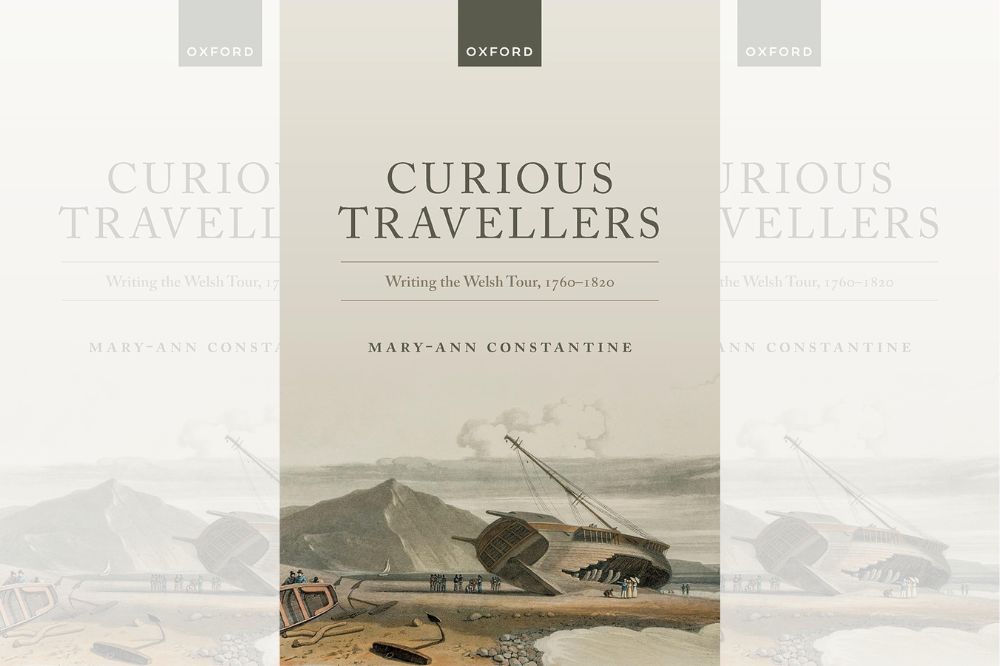
Book review: Curious Travellers, Writing the Welsh Tour, 1760- 1820 by Mary-Ann Constantine
Julie Brominicks
Two centuries ago they came in their multitudes, on horse on foot and by boat. Enquiring, measuring, painting, thinking, writing, drawing, and map-making. Crawling into coal mining huts. Falling off waterfalls. Motivated by scenery or science, they carried sketchbooks or magnifying glasses, scrutinized rocks and plants, and Welsh language and customs too.
Mary-Ann Constantine has unearthed 162 published tours from this period and a further 470 accounts in manuscript form, 17% of which are by women. These writings reanimate the landscape their authors saw, and by turn I see them more clearly; my peers of two centuries ago.
[mid-content-banner]
Travellers
While some of these predominantly English travellers predictably viewed Wales and the Welsh people and language with a superficial or supercilious gaze, a great many did not.
This was a period of radical change. Napoleonic Wars in Europe compelled those with inquisitive minds and feet to tramp around Britain instead. Meanwhile expanding industrialisation was powering the British Empire, resulting in enslaved peoples, poverty and pollution at home and abroad.
History does not exist in isolation, and what makes this book as important as it is interesting is that Constantine
demonstrates how the world described in these 200-year-old accounts inter-relates with our own.
To do so she has organised her own tour of Wales. Each chapter is set in a specific location to explore a particular theme. So for example we explore religious attitudes in Pembrokeshire (Sir Benfro) for ‘Visionary Journeys: Quests, Pilgrimages and Gatherings,’ learning that in tourist literature, portrayal of Welsh Methodists tended generally more to ‘ridicule than respect.’
[lower-mid-content-banner]
Revolution
In the context of the French Revolution, large, ‘emotionally volatile gatherings’ were apt to make particularly the English gentry, jumpy themselves.
The Napoleonic Wars are present throughout. War is explored in ‘Capturing the Castle: Vulnerable Coasts in the Later 1790s’ where we find ourselves in Gwynedd. In 1794, poets Joseph Hucks and Samuel Coleridge, then both students at Cambridge travelled in disguise in case anyone thought they were French.
While castles were a popular destination for those with a thirst for history, Hucks was one of many alert to their
colonial purpose, describing them as ‘monuments of shame.’ Tourism had not yet impacted on house prices and language erosion, but we see some familiar responses.
William Williams, writing in 1800 in ‘Observations on the Snowdon Mountains,’ noted ‘travellers are too apt to abuse the Welsh because they cannot or will not speak English.’
Others like Thomas Pennant had what Constantine calls an ‘insider-outsider perspective’ on one hand enmeshed in Anglophone gentry, on the other employing Welsh-speaking scholars like John Lewis for a broader understanding. Meanwhile others like Catherine Hutton, hired translators, learned some Welsh and explained Welsh place names.
Collapse
Contemporary issues like environmental collapse and exploitation of peoples at home and abroad, found their roots
in this era of radical change. Travellers by turn were admiring or/and appalled at the new industries. Often they encountered furnaces and mines in juxtaposition to beautiful sites like at Hafod, or of historical and/or religious significance like Neath Abbey.
With an unerring ability to interweave centuries, our author wryly notes that ‘industrial heritage forms a significant and growing part of Wales’s modern tourist provision, accounting for three of the country’s four designated UNESCO World Heritage Sites’.
She also points to Andreas Malm’s observation that events from the past have new significance, particularly in terms of industrial emissions and climate change.
A particularly sobering account comes from Sussex-born playwright and essayist Richard Ayton who found the copper-producing town of Amlwch full of ‘smelting houses vomiting forth flames and clouds of black smoke’. ‘This total destruction of all vegetation on the land bordering the sea has been occasioned by the smoke from the furnaces, and the fumes from some immense kilns.’
He concluded that; ‘Of the general good that has been produced on the discovery of these mines I am not prepared to speak, but they have proved a sad curse to this neighbourhood, and having been worked almost to exhaustion, and yielding an enormous amount of wealth, they leave the people in want, and the country a wilderness.’
Ayton was in the company of William Daniell who produced the artwork that accompanied his words. Yet by contrast Daniell’s ‘The Entrance to Amlwch Harbour’ shows a benign and serene scene.
Perspective is paramount.
Impossibility
Mary Anne Eade in 1802 in Oswestry was charmed by the ‘sweet tones of the Welch Harp’. Henrietta Hurrell found Oswestry ‘the dullest of dull places.’ Catherine Hutton, travelling with her Unitarian Minister father, who had lost both her mother and home to ‘Church and King’ riots in England, wrote of the impossibility of giving a ‘true account’ due to everyone’s perspective being different.
Travel-writers then and now, each with their own perspective, also reference work by their contemporaries and predecessors. Still others have written about them. Constantine is a generous academic, giving warmth and weight to her peers, each page heavy with footnotes, the bibliographies running to several pages; yet always her prose is agile and accessible.
Published by the Oxford University Press this is a sumptuous academic book, silky to touch, the text accompanied by colour plates. The price at £100 is prohibitive to say the least, but highly recommended to borrow. Curious Travellers, as the title implies, sparkles with imagination, imagery and insight.
Mary-Ann Constantine is that rare and precious thing; an academic who communicates clearly and brings her subject to life.
I have struggled to write this review, excited by the sheer volume of content, unable to adequately summarise or select, devastated at what I’ve left out; leaving me in thrall of the author’s skill.
You could say this book represents a gigantic tidying-up job, bringing all the agents of and thinking about the ‘Welsh Tour’ into one place. You can imagine the author organising them onto shelves, collecting some from where they have fallen, to polish and put on display. Curious time-traveller Mary-Ann Constantine is a kind of academic Mary Poppins.
Support our Nation today
For the price of a cup of coffee a month you can help us create an independent, not-for-profit, national news service for the people of Wales, by the people of Wales.
Get more trusted Welsh news
Choose Nation.Cymru as a preferred source in Google News to see more of our journalism.
