


Opinion
Whose democracy is it anyway?
John Geraint
As those who know me will attest, like many people brought up in the Valleys, I have some strong political convictions.
But, because for forty years and more I’ve had the privilege of making programmes for public broadcasters, I’ve made it my practice not to comment publicly on current affairs or topical party-political controversies. It was never appropriate. I had a duty of impartiality.
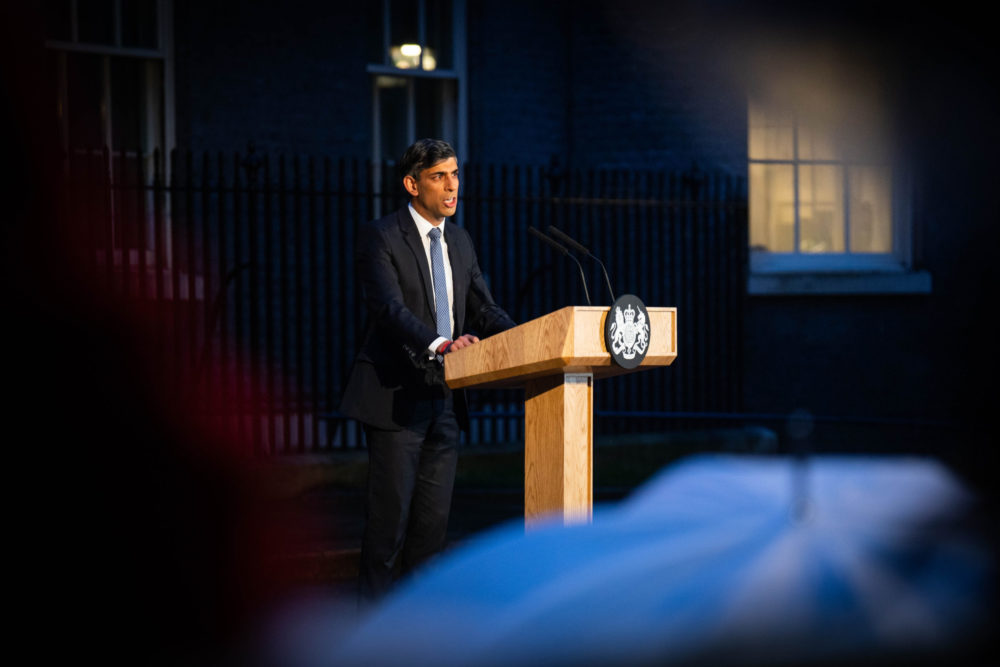
The Prime Minister’s speech in Downing Street last Friday night worries me so deeply that I’m breaking my self-denying ordinance.
I pass over two ironies. That of a hastily arranged statement informing us that “our democracy” is under threat prompted by Mr Sunak’s ‘alarm’ over the result of a democratic election – the vote in Rochdale.
And that of a speech championing the democratic process from a Prime Minister who two days before – with his MPs baying angrily behind him, very like an unruly mob – branded a former Director of Public Prosecutions as devoid of principles, shouting across the Despatch Box that Sir Keir Starmer was “spineless, hopeless and utterly shameless”. So much for decent, tolerant respect for politicians and opposing views.
All that, I suppose, is something we’ve learned to expect from the ‘rough-and-tumble’ of Westminster.
What really concerns me is Mr Sunak’s underlying argument about what we as citizens are now expected to sign up to in order to be allowed into “membership of our society” in Britain.
[mid-content-banner]
Atrocity
For the avoidance of doubt, I think what Hamas visited on the people of Israel on October 7 was an appalling atrocity. I also believe that the Israeli government’s response, self-described as ‘mighty vengeance’, needs to be investigated as potentially in breach of international law.
And – like most people in Britain – I want an immediate ceasefire, and I’m outraged by the shenanigans (in which Mr Sunak’s government was at least complicit) which have frustrated proper parliamentary debate about this.
The suffering and death in Gaza is what is uppermost in all our minds right now. But what Mr Sunak argued from his podium outside No. 10 has – potentially – long-term implications for the state we live in, and our rights to dissent from the establishment’s view of what that state’s “basic values” are.
It may seem like a small pedantic point, but for me the Prime Minister gave the game away when he spoke of Britain’s “great achievements and enduring values” being “all underpinned by… our established Christian church.”
Wales has not had an established church since 1920, precisely because the Anglican church didn’t reflect the beliefs of the majority of our people. Scotland’s established church is of a different denomination and tradition to England’s. Northern Ireland is another matter again.
[lower-mid-content-banner]
Extremism
What Mr Sunak’s address was really preparing the ground for was the UK Government’s plan to “implement a new robust framework for how it deals with” what it regards as extremism. Downing Street, we are told, will set out more details on the new policy in the coming week.
Extremism is already defined in the 2011 Prevent strategy as ‘vocal or active opposition to fundamental British values, including democracy [and] the rule of law…’ How this will presumably be made more “robust” will be interesting, to put it mildly.
If opposition to democracy and the rule of law is extremist, what about the Conservative government (Mr Sunak was a member) which illegally prorogued Parliament to shut down debate in 2019? Were they ‘extremists’?
Let’s take the argument to logical absurdity: are those in favour of a hereditary monarchy (still the majority of British citizens, I believe) and an unelected House of Lords – neither of which is exactly democratic – now to be classed as ‘extremists’ too?
Determining what constitutes ‘our basic values’ is tricky, contested ground. Asking the police to act on such ground is more than problematic; it’s potentially dangerous.
In his speech Mr Sunak takes aim at “Islamist extremists and far right groups” who “are spreading a poison, that poison is extremism… When these groups claim that Britain is and has been on the wrong side of history, we should reject it, and reject it again.”
Well, there are many people who belong to neither group who believe that Britain hasn’t always been on the right side of history. I am one of them.
Mr Sunak demands that we as decent British people should believe that – contrary to the views espoused by “these groups” who stress that race and religion are factors – “what will determine your success [is] just your own hard work and endeavour.”
Now, I don’t believe that your background determines your fate in life. Many people do ‘rise’ above the circumstances of their birth. But, equally, the differentials in wealth and health outcomes correlating to ethnicity and class cannot be denied.
If “membership of our society is contingent” upon agreeing with the notion that if you didn’t prosper it was because you didn’t try hard enough, or that billionaires got their wealth because they worked a billion times harder than my grandparents – then, please, count me out.
Peaceful protest
Mr Sunak was careful to say that peaceful protest remains a fundamental democratic right. We can, it seems, “march and protest with passion.” We “can demand the protection of civilian life.” Such magnanimity!
Respect for the rule of law means respecting that the police are “operationally independent” of government (something Mr Sunak gave a nod to). But it also, surely, means respecting the independence of the judiciary – which some Tory politicians and newspapers seem to find unpalatable.
And legislating, for instance, that there can be no legal challenge to the proposition that Rwanda is a safe country for asylum seekers, irrespective of facts in the real world – is that respect for the rule of law?
I don’t believe that we live in a police state or under an authoritarian regime. But I can’t help thinking that Mr Sunak’s speech may have brought us one small step closer.
What I found sinister in it is the underlying assertion that “our values” are coterminous with the establishment’s belief in Britain’s ‘greatness’, and that those who dissent from this are beyond the pale.
Democracy is best defended by reasoned argument and persuasion, not by fiat. By behavioural example, not by shouting at opponents or knee-jerk reactions to election results. As Michelle Obama says, “when they go low, we go high.”
The pro-Sunak spin on his speech was that it was “sobering warning of the fragility of democracy”. Opponents sensed the desperation of a politician far behind in the polls, and dismissed it as ineffective. I heard it as something much more worrying than either of those assessments.
We may be a long way from fascism yet. But I have to say it: “First, they came for the ‘extremists’…”
John Geraint is one of Wales’ most experienced documentary film-makers and author of ‘Up The Rhondda!’ published by Y Lolfa and ‘The Great Welsh Auntie Novel’ published by Cambria.
Support our Nation today
For the price of a cup of coffee a month you can help us create an independent, not-for-profit, national news service for the people of Wales, by the people of Wales.
Get more trusted Welsh news
Choose Nation.Cymru as a preferred source in Google News to see more of our journalism.
