


Opinion
What will decide the 2021 Senedd election? Probably not what happens at the Senedd

Ifan Morgan Jones
There’s just a year to go until the 2021 Senedd election and it’s fair to say that after four already rather bad-tempered years, Welsh politics is likely to get a little more fractious.
Deliberation will give way to hyper-criticism as both the Conservatives and Plaid Cymru rip Labour apart on their record on health care, education and much more besides.
Ane the defensive attacks have already heated up, with Rhondda Labour MP Chris Bryant taking to Twitter to aim ‘Nazi’ jibes at Plaid Cymru.
With the polls showing that Labour could for the first time lose their crown as the largest party, the opposition will be motivated like never before and Labour keen to defend their last remaining electoral bastion.
However, I’d like to puncture that balloon a little bit with this article and ask whether anything that happens in Senedd politics actually makes much of a difference to Senedd election results.
One way of finding out is to look at the polls. If what happened in the Senedd mattered we would expect to see the polls for Senedd and Westminster elections look quite different.
I.e. events in the Senedd would impact the popularity of Welsh Labour or the Welsh Conservatives independently of UK Labour or the UK Conservatives.
[mid-content-banner]
Synchronised
So I compared Welsh Political Barometer Polls with YouGov’s UK-wide Westminster polls for the same month since the last Senedd election to see how much they diverged. Here’s Labour:
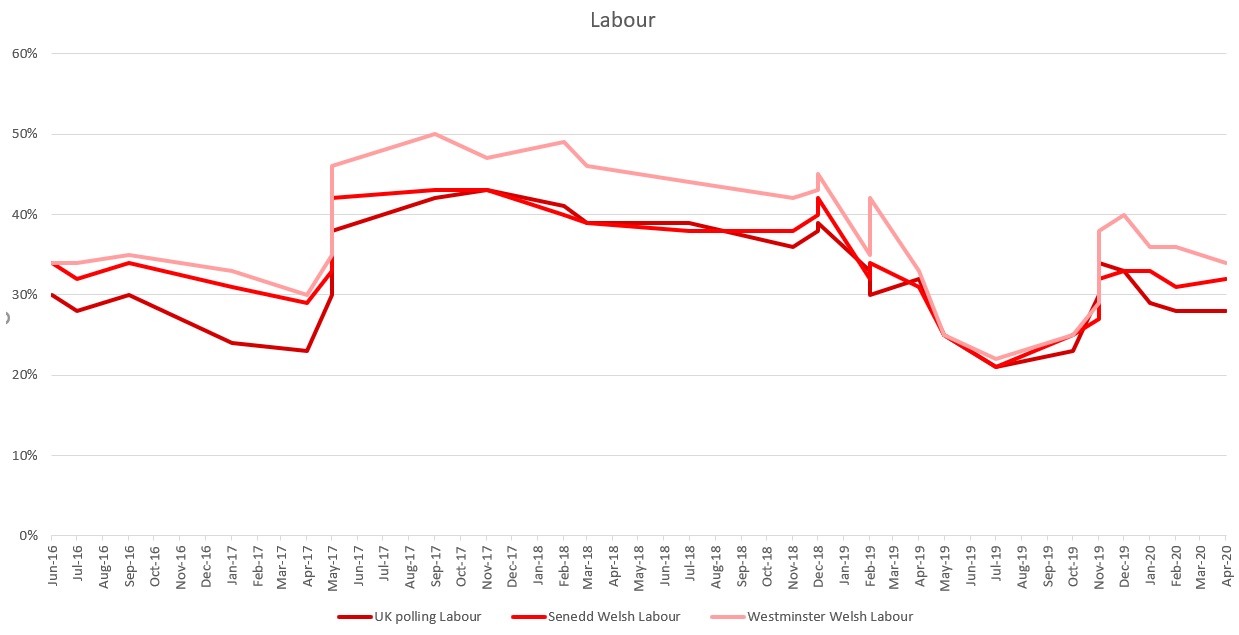
As you can see, there’s no real divergence. Senedd and Westminster polls largely move in unison, as if they are a pair of synchronised swimmers.
If Labour are doing well at Westminster, they do well at Senedd, if they do badly at Westminster, they do badly at Senedd. There are a few kinks but it's quite consistent.
Support is pegged at different levels, largely because of differences in turnout between different elections.
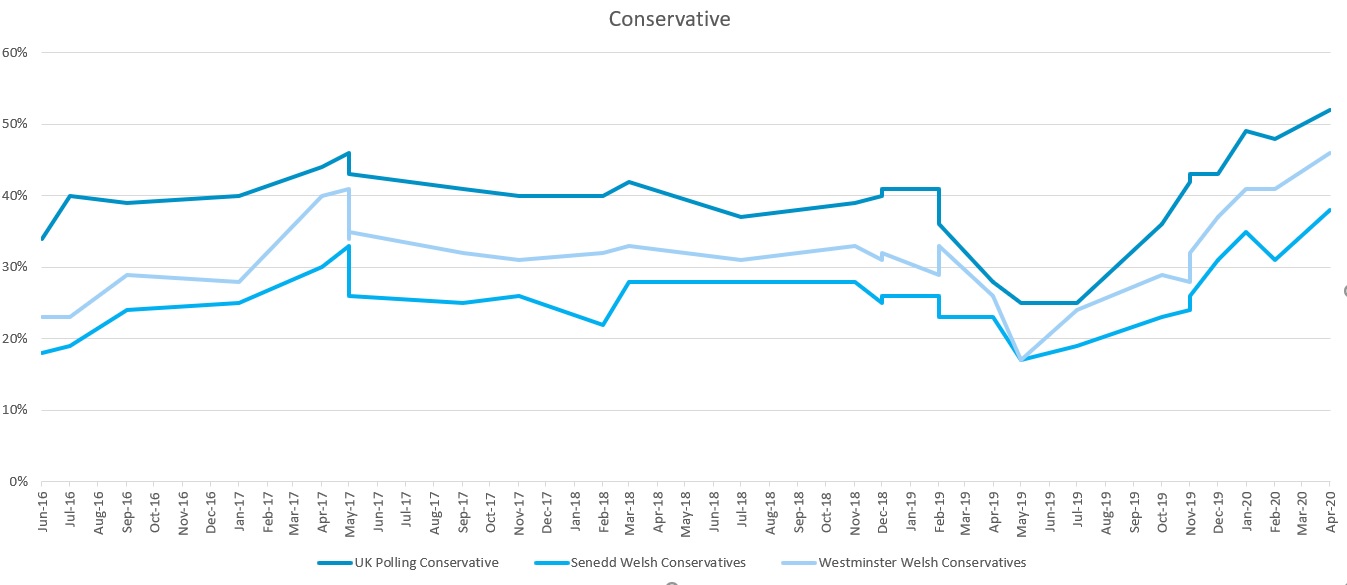
The same thing is true for the Conservatives. Support is clearly pegged at a lower level in Wales than across the UK because of differences in turnout but support goes up and down in a very synchronised manner.
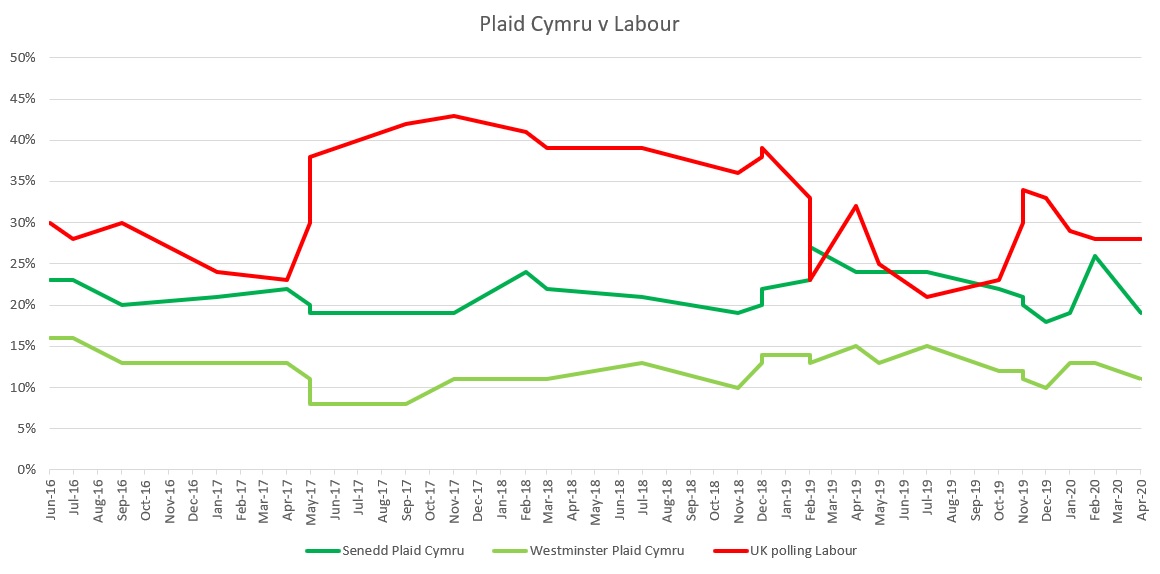
Plaid Cymru don't stand outside Wales so there's no wider UK party to compare with them. But I think this graph provides a rather depressing picture for them.
Essentially, PC's polling numbers don’t shift much, but a slight rise seems to coincide with times when the UK Labour Party are unpopular.
Psephologist Professor Roger Awan-Scully carried out a far, far more rigorous study of the 2011 Welsh and Scottish elections in a paper published in 2013. In conclusion, he wrote that:
“while the drivers of voting in Scotland appear to have been mainly general assessments of the parties and of their Scottish leaders, in Wales Labour Party support in particular was significantly associated with attitudes towards the Labour UK leader and towards assessments of the UK government […] Voting in May 2011 was a rather more distinctively Scottish affair in Scotland than it was Welsh in Wales.”
Resurgent
So what can we summarise from this? It would seem that, rather depressingly, that what actually goes on in the Senedd matters a lot (and increasingly so) to how Wales is governed, but it doesn’t have much knock-on effect on who gets to govern Wales. Senedd politics is just a little paper boat blown around by the political winds of Westminster.
The reason for this, and particularly the contrast with Scotland, seem fairly obvious: we know the people of Wales don't really know much about what goes on in Welsh politics. We have no real Welsh media and therefore no Welsh public sphere, and so people decide how to vote in Wales-specific elections based on Westminster's political news.
Scotland meanwhile has a comparatively strong media and therefore politics there is noticeably 'untethered' from Westminster. The parties follow their own polling patterns not entirely but with a higher degree of independence from the wider UK.
So while we have half of the democratic equation in place in Wales – our political institutions – the other half is missing, which is a media that ensures that the political decisions of those institutions have electoral consequences.
This has obvious ramifications for the political parties. While it takes the heat off both Welsh Labour and the Welsh Conservatives to a large extent, it’s particularly depressing for Plaid Cymru whose entire political strategy is based on winning power at the Senedd by providing effective opposition there.
If no one is paying attention to what they’re up to, are they largely running on the spot like Wile E. Cayote, unaware that their feet aren’t touching the ground?
We also need to factor it into our assessment of the expected winners of the next election too. After 21 years of Labour government, it has been predicted that they are heading for defeat to a resurgent Welsh Conservatives.
But let's consider where the ebb and flow of Westminster politics is likely to have taken our little paper boat by that time. We’re likely to have a mid-term Con government in the middle of a recession, with all the aftermath of Covid, and a possible Starmer bounce.
Under that scenario a ‘give the Tories a bloody nose’ message in a Senedd campaign could be surprisingly effective, even if it is the party of perpetual Welsh government making that argument.
Scrutiny
However, there are a few things that could change this dynamic in time for the Senedd election next year.
The most obvious is clearly the coronavirus pandemic. By diverging from the UK Government the Welsh Government has attained a media profile it has probably never experienced before. Their decision making has been the subject of scrutiny in UK media such as the Sun and the Daily Mail.
It’s hard to believe that a higher percentage of the population would not now be aware that the Welsh Government control the NHS, than the only 48% who knew that to be the case when BBC/ICM polled on the matter in 2014.
There is some evidence of wider UK media scrutiny of Wales specific political decisions having an impact on Senedd elections in the past, specifically the 1999 election when Tony Blair’s decision to select Alun Michael as First Secretary of Wales rebounded on the Labour party.
The other factor could be the increasing reach of Welsh national news sources, both established and upcoming (like this website). Could they ‘break through’ and reach a wider, popular audience beyond the 5% who usually take a bit interest in Senedd politics?
Will these factors be enough to make any difference? Perhaps marginally, yes, although I suspect that what happens at Westminster between now and May 6 2021 may well be a better guide to the Senedd election than what happens at the Senedd itself.

Support our Nation today
For the price of a cup of coffee a month you can help us create an independent, not-for-profit, national news service for the people of Wales, by the people of Wales.
Get more trusted Welsh news
Choose Nation.Cymru as a preferred source in Google News to see more of our journalism.
