


Opinion
What does the latest YouGov poll tell us about support for Welsh independence?

Dafydd Trystan
For some years a variety of polling questions have been asked of the Welsh electorate about independence, with responses ranging from under 5% support for Independence to over 40% of electors being open to independence.
These findings have been widely discussed with supporters and opponents alike welcoming the figures that most closely fit with their views.
However, the latest YouGov poll offers some clarity. It is an important poll as it asks all three versions of the ‘Independence question’ in the same questionnaire, to the same people.
So what does it tell us?
On the referendum question:
If there was a referendum tomorrow on Wales becoming an independent country and this was the question, how would you vote? Should Wales be an independent country?
28% say Yes, 72% No.
(14% Don’t Knows or Refused)
On the Constitutional Preference Question:
Thinking about the National Assembly for Wales, which of these statements comes closest to your view?
There should be no devolved government in Wales 17% The National Assembly for Wales should have fewer powers 6% We should leave things as they are now 27% The National Assembly for Wales should have more powers 21% Wales should become independent, separate from the UK 11%(18% of electors Don’t Know or Refused to answer)
And on the ‘indy-curiosity’ question (an 11 point Independence question):
On a scale of 0 to 10, where 0 is very strongly against and 10 is very strongly in favour, how do you feel about Welsh independence?
Anti-Independence (0-3) 48% Indy-curious (4-6) 30% Indy-confident (7-10) 23%(12% of electors Don’t Know or Refused to answer)
Having the three questions asked in the same poll allows us to consider the inter-relationship between the answers. Asking the same people, at the same time, we find a range of support from 11% to 28%.
We find that the Yes/No Referendum question elicits the highest support for independence, but even that figure potentially underestimates the potential support if one considers the data from the 0-10 scale question, where we find fully 53% of the electorate either indy-confident or indy-curious.
These data clearly suggest that while a majority of the Welsh electorate do not favour iWelsh independence today a significant minority are well disposed towards the idea.
Indy-confident
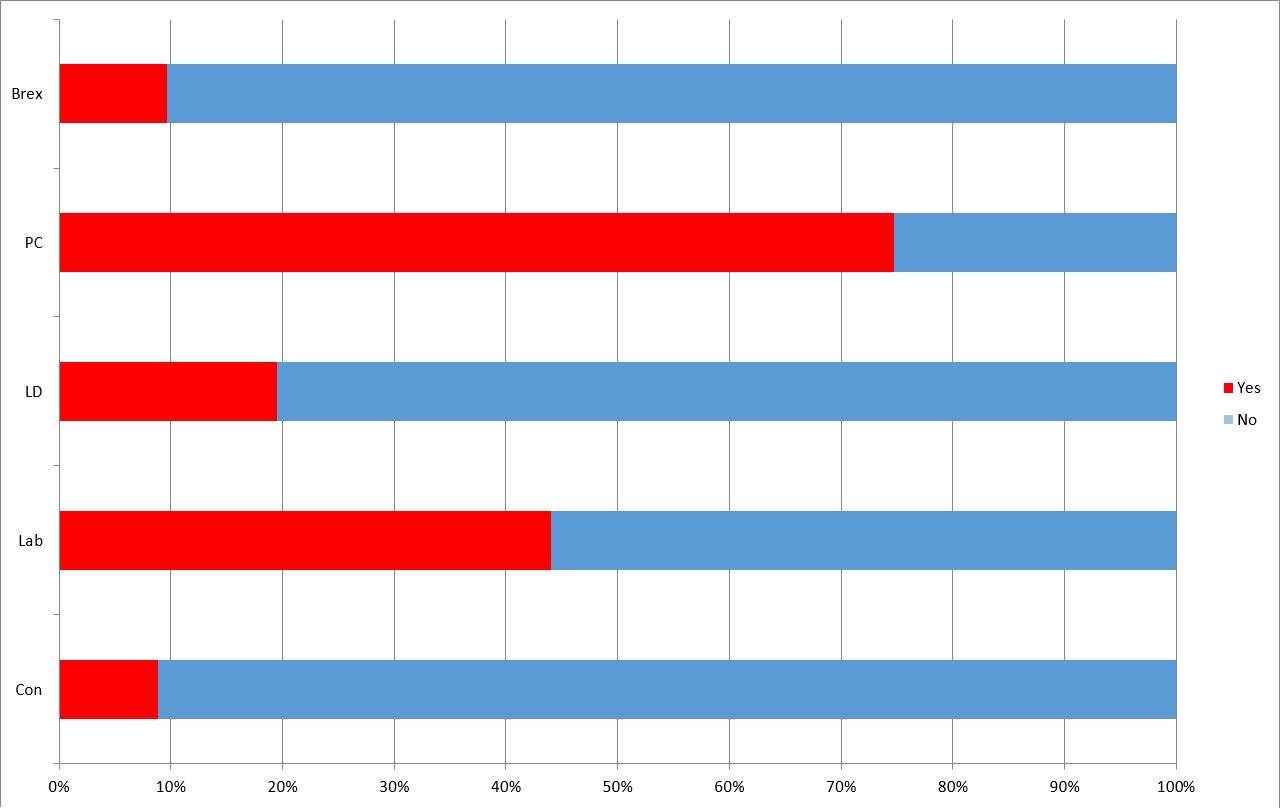
We can also delve deeper into the data by looking at the relationship between other variables and support (or not) for independence. When we consider party affiliation we find a very clear divide. Plaid voters are the most pro-independence (though even here we find almost a third in the ‘no’ camp). Labour voters, consistent with other polling in the past two years are more supportive that one might have imagined, over 40% of Labour voters would vote yes in a referendum. Rather unsurprisingly Conservative and Brexit Party voters are the most hostile.
Table One: Yes/No Independence By General Election 2019 Vote
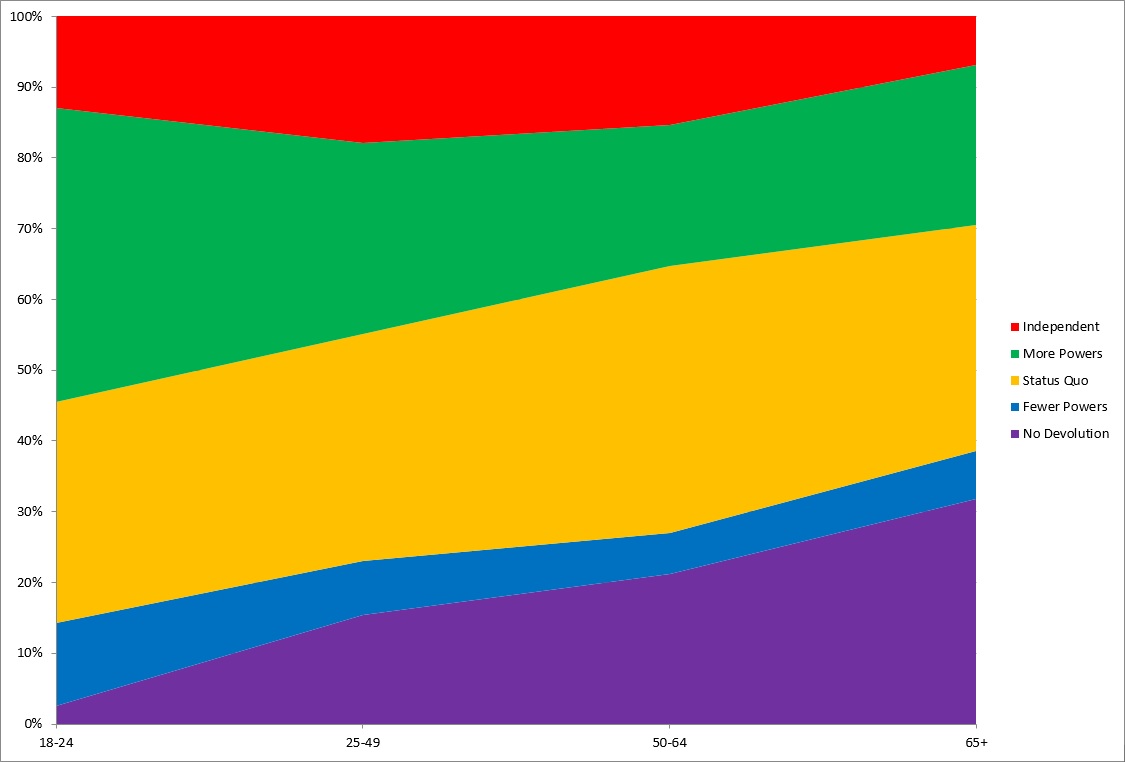
Looking at constitutional preferences and age we find a striking pattern. For those under 50 years of age ‘No Devolution’ is the preference of a very small minority while younger voters clearly favour greater powers (around 50% of the under 50s). Amongst pensioners however ‘no devolution’ is one of the most favoured constitutional options (32%).
Table 2: Constitutional Preference By Age
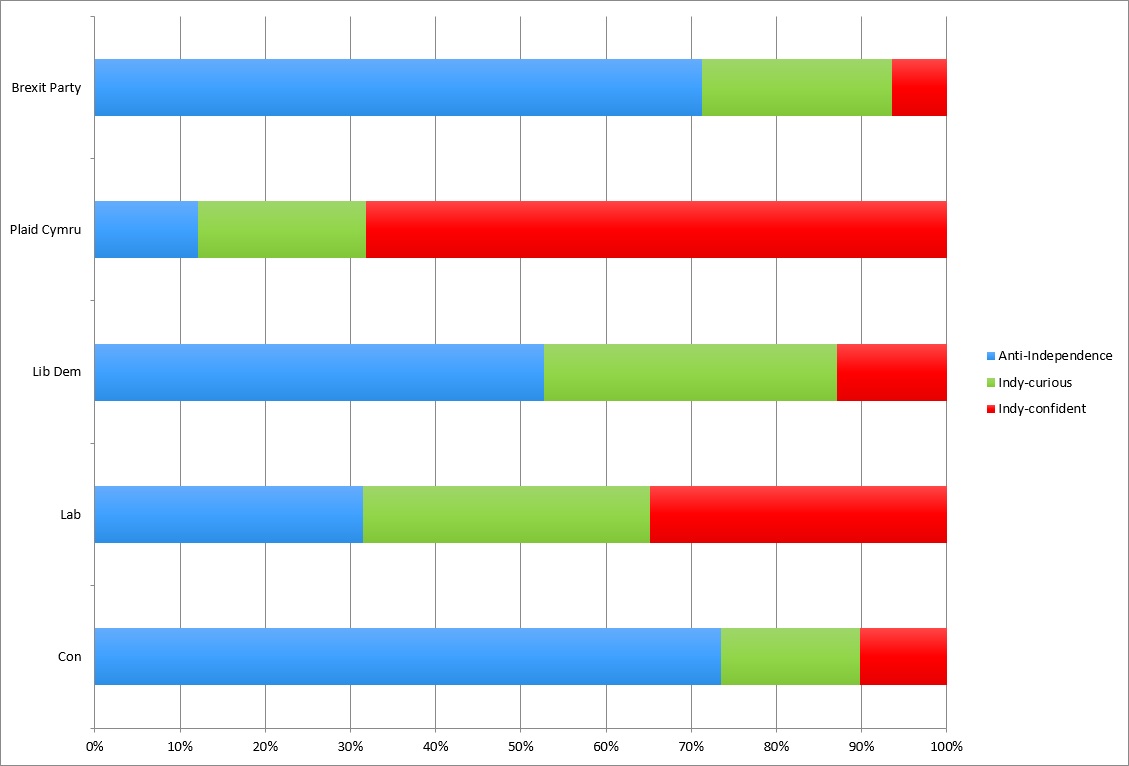
Turning to the 0-10 scale, the picture in terms of party support is developed further. The vast majority of Brexit and Conservative voters are hostile to Independence. Equally unsurprisingly, Plaid voters are particularly indy-confident. Labour voters are possibly the most interesting group here, as they split almost equally three ways, 35% indy-confident, 34% indy-curious and 31% anti-independence.
Such data give greater context to the attention given by senior Labour figures, such as former First Minister, Carwyn Jones, to constitutional matters and the need to reform the United Kingdom. They also serve as a warning to those in Labour who might wish to dismiss support for independence as a fringe issue.
Table 3: Indycuriosity by Party
Impact
One final thought on the data – we can also consider the preferences of Remain and Leave voters. Here, we find a very clear distinction, though one which isn’t reflected, it seems, in the policy positions of Yes Cymru.
Remain voters are open to independence with fully 40% saying they would vote Yes in an Independence referendum. Leave voters are particularly hostile – with only 15% supporting Independence.
The result of the General Election and subsequent decisions on Brexit will have a significant impact on the debate on Welsh Independence, but in their most recent polling yougov, ITV and the Welsh Governance Centre have significantly enhanced our understanding of the views of the welsh electorate on these key debates.
The poll, for ITV-Cymru Wales and Cardiff University, had a sample of 1,136 Welsh adults and was carried out by YouGov from 31 October to 4 November 2019.

Support our Nation today
For the price of a cup of coffee a month you can help us create an independent, not-for-profit, national news service for the people of Wales, by the people of Wales.
Get more trusted Welsh news
Choose Nation.Cymru as a preferred source in Google News to see more of our journalism.
