


Opinion
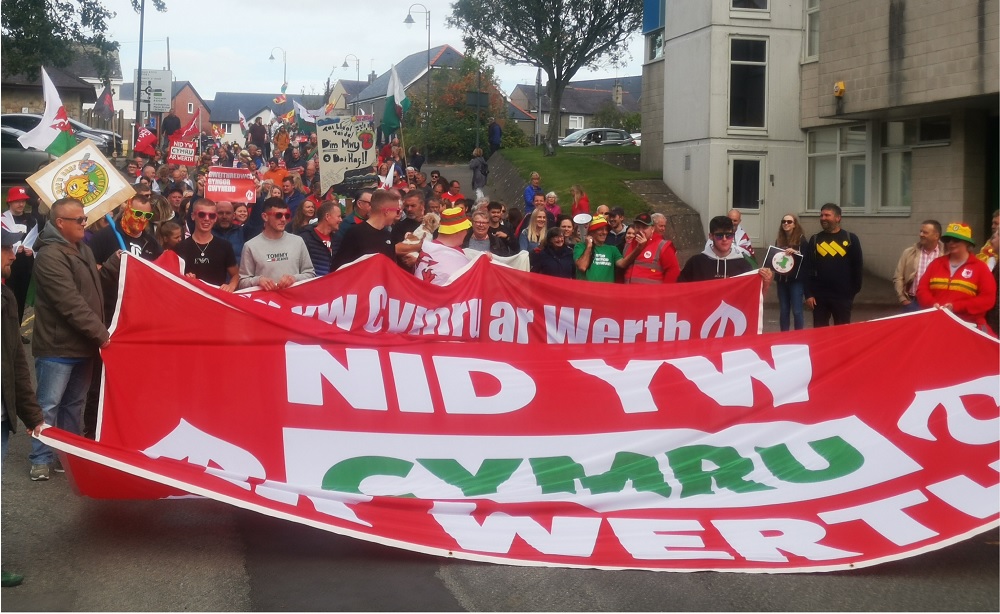
Wales needs to remember the power of protest
Llinos Dafydd
‘Trwy ddulliau chwyldro yn unig mae llwyddo’ - ‘Only by revolutionary means can we succeed.’
Those words, spoken by Saunders Lewis in Tynged yr Iaith in 1962, didn’t just echo across Wales, they sparked something. A national awakening. A wave of protest that would go on to secure the future of our language, our own television channel, and, eventually, a parliament.
I myself spent a night in a cell at the age of 18 for breaking through the window of a radio station to protest their lack of Welsh language broadcasting.
Good times and a rite of passage for many people my age (although my mam and dad weren’t too pleased at the time).
But something has changed. Somewhere between then and now, we lost our nerve. Our boldness. Our sense that protest is not only justified — but necessary.
[mid-content-banner]
Devolution didn’t finish the job
We tell ourselves we’ve moved on. That once we got devolution, there was no need to chain ourselves to railings, block roads or scale buildings. That the ballot box could do all the heavy lifting.
But let’s be honest: the Senedd can only do so much with what it’s been given — and it’s not much.
We get a block grant from Westminster. We can divvy it up between the NHS, education, local government, and pray that something shifts — that waiting lists shrink, PISA scores rise, and morale doesn’t bottom out completely.
But that’s treating the symptoms, not the cause.
The real levers of power — the big economic tools, the ability to invest properly in infrastructure, energy, rail, broadband — are still held in London. And they’re not letting go any time soon.
Last week proved it again. Eluned Morgan threw her political weight behind getting Wales a fair slice of rail funding. And what did we get? £431 million over ten years. A rounding error. An insult dressed up as investment.
The Welsh Government’s own research centre called it “underwhelming.”
“Any suggestion that this funding in any way compensates Wales for the loss incurred from HS2 is obviously unsustainable,” they said.
“It does not substantially change the overall picture of underfunding of Welsh rail infrastructure.”
In bureaucratic language, that’s as close to a punch in the gut as it gets.
[lower-mid-content-banner]
No Power Without Pressure
And honestly? I’ve got a lot of sympathy for Eluned Morgan. What bargaining power does she have? What leverage?
You could swap her out for Rhun ap Iorwerth tomorrow and the outcome would be the same. He might call Westminster out more bluntly — and fair play if he does — but they’d still shrug and move on.
Because Wales doesn’t count. Not in the way that matters to Westminster.
We’ve got 32 MPs out of 650. That’s it. In UK political terms, we’re background noise. A place you visit for a photo op in a hard hat — and forget the moment the camera’s off.
Lyndon B. Johnson once said, “The first rule of politics is to be able to count.” Westminster can count — and Wales doesn’t move the dial. That’s the brutal truth. It’s not about how passionately we argue our case. It’s about power. Numbers. Pressure. And right now, we’ve got precious little of any of them.
‘Wales robbed again: time to stand up or shut up,’ said Owen Williams on these pages two weeks ago. And he’s right — but he didn’t spell out what standing up actually means. It can only mean protest. Because protest works. And unless we’re prepared to make a nuisance of ourselves, nothing will change.
Protest Still Works — Just Ask the Farmers
Look at what’s happened recently. Whether you agree with their cause or not, the farming community has shown exactly how to be heard.
They didn’t sit quietly. They didn’t send strongly worded letters. They organised. They turned up. They made noise — in towns, on roads, in front of cameras. And guess what? It worked.
In Westminster, the UK Government rushed to offer inheritance tax exemptions. In Wales, some of the most damaging targets for farmers were quietly dropped. Why? Not because they’re a huge voting bloc — they’re not. They’re the population of a mid-sized town. Electoral irrelevance, on paper.
But they became impossible to ignore. And that’s the point.
They didn’t block hospitals. They didn’t burn anything down. But they reminded power that it’s still answerable — and that rural Wales won’t sit quietly when its future is on the line. That’s what protest can do. It shifts the power dynamic — not with violence, but with visibility. With presence. With guts.
If They Don’t Care, Make Them Listen
Here’s the thing: Westminster doesn’t care about Wales. That’s the problem — but weirdly, it’s also the opportunity.
Because if they don’t care about us, they’ll do just enough for us to shut us up.
That’s what Gwynfor Evans understood. He didn’t have a landslide behind him. Plaid weren’t sweeping the polls. But when he threatened to go on hunger strike over the lack of a Welsh-language TV channel, Thatcher blinked. Not because she had a sudden burst of cultural empathy — but because protest made ignoring Wales more trouble than it was worth.
That’s how we’ve always won: not with spreadsheets or polite press releases, but by being relentless. Visible. Awkward.
We forget that at our peril.
Yes, the Senedd matters. Yes, we should vote. But let’s not pretend devolution finished the job. It was a stepping stone, not a destination.
If we want anything more — more power, more respect, a future on our own terms — we’ll need to fight for it.
Not with violence. But with guts. With imagination. With the kind of protest that demands attention.
If they won’t listen willingly, it’s time we make them.
Support our Nation today
For the price of a cup of coffee a month you can help us create an independent, not-for-profit, national news service for the people of Wales, by the people of Wales.
Get more trusted Welsh news
Choose Nation.Cymru as a preferred source in Google News to see more of our journalism.
