


Opinion
Wales faces a choice of two futures
Jonathan Edwards
Last week’s YouGov opinion poll was seismic on many fronts, but most importantly it indicates that our country is now split right down the middle on the axis of the national question and on the left – right paradigm.
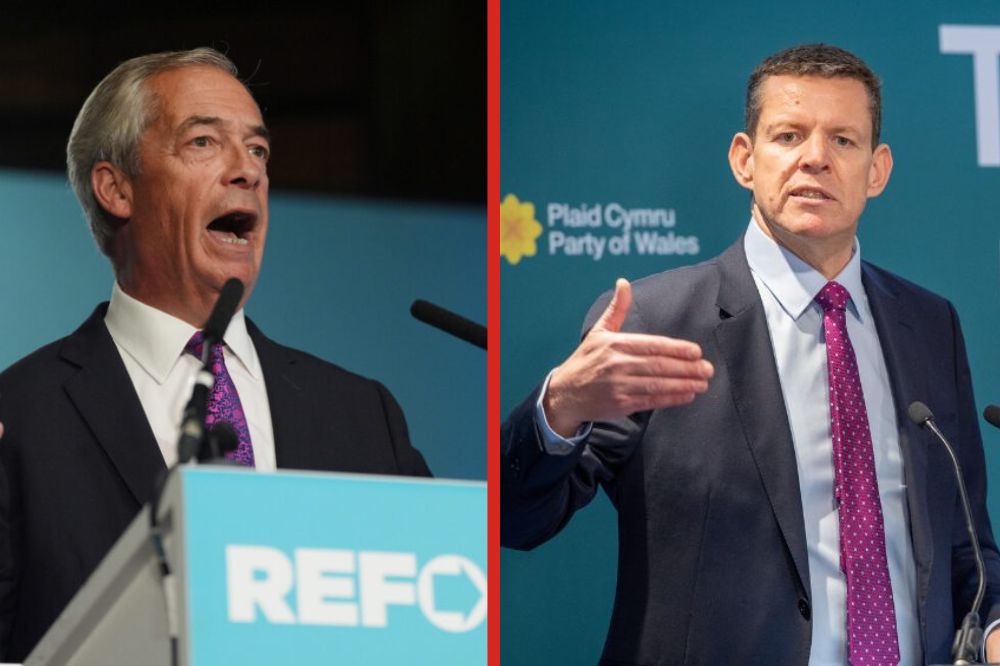
Voters are increasingly coalescing between Plaid Cymru on the one hand and Reform on the other.
Both Labour and the Conservatives, the two most successful parties in Welsh political history, now find themselves languishing in third and fourth, increasingly an irrelevance with a combined vote share of only 25%.
This polarisation is of greater significance as we face a national election in a matter of months which is likely to change Welsh politics as we know it.
More immediately the people of Caerphilly will vote next month in a by-election which looks increasingly as if it will resemble the role of water in the hydration process in cement making, where a moldable liquid transforms to a rigid, solid state.
[mid-content-banner]
Transformational moment
As successive polls have indicated, we are at a transformational moment in Welsh politics but there hasn’t been a formal election yet to set the new political landscape.
After the by-election nothing in Welsh politics will ever be the same again, if as expected the Labour party finish a poor third to Plaid Cymru and Reform.
The by-election will also provide the victors with momentum going into 2026.
It is a genuinely huge moment in Welsh political history as the main challengers are vying for ownership of the all-important change narrative in Welsh politics.
Once the votes are counted in Caerphilly on the morning of October 24, the Senedd 2026 election will be hurtling towards us. Whoever wins Caerphilly is going to receive a terrific boost, especially considering the constituency is a valleys seat.
Plaid Cymru and Reform are diametrically opposed both on the national question and on the left-right axis and it is no wonder therefore that as Labour and Tory support collapses voters are polarising to the extremes.
[lower-mid-content-banner]
Social media debate
In such a context the energy in Welsh politics will concentrate around both poles as we are witnessing in the social media debate.
What was interesting about the YouGov poll but not surprising was the generational divide that now exists in voting intention.
In the 16-24 age group Plaid are polling at 58% compared to only 7% for Reform. In the 65 plus age group, Reform lead Plaid by 38% to 16%.
Plaid Cymru’s immediate election hopes will very much depend on being able to motivate a cohort of voters who are less likely to cast their ballots.
The future of our country hangs in the balance as we speed towards next May but not because it will determine who will form the government. The polls if replicated leave a Plaid – Labour coalition as the only viable option, if Labour play ball.
If Labour don’t, and I am sure there will be many in the party arguing that party comes before country, then all bets are off.
A defining battle
The Senedd election and next month’s by-election however represent only the beginning of a defining battle in our political history as a nation. If Reform win and are shut out from power, opponents of devolution will seek to question its legitimacy. I sense considerable complacency amongst some in the ‘bubble’ about such a scenario.
Those worried about the future of Welsh democracy should be looking at the next UK general election due by 2029 at the latest with increasing anxiety.
The same YouGov poll for a Westminster election puts Reform well ahead in Wales on 29% followed by Plaid Cymru on 23%. A Plaid-led Welsh Government is likely to see a collapse in support if it can’t transform the state of Welsh public services and boost living standards.
How it can achieve that without the fiscal levers to turn around the Welsh economy while being completely reliant on Labour votes to progress its domestic agenda is anyone’s guess. The general election in 2029 could be very difficult for Plaid Cymru to say the least.
More importantly, the latest assessment by Electoral Calculus estimates that Mr Farage is heading to 10 Downing Street with a majority of 86. He would have carte blanche to do as he wishes.
When challenged by Robert Peston at the recent Reform conference on what a Reform UK government would look like he pointed at the experience of Argentina under its maverick President, Javier Milei.
Central to the Milei plan in addition to devaluing the currency has been drastically reducing the size of the state via a process of de-bureaucratisation, slashing public expenditure and cutting government departments by half.
Target
I don’t think it takes a genius to work out that the Senedd will be an obvious target for Farage’s chainsaw if backed up by a stolen election narrative from next May, be it complete abolition or a serious curtailing of its powers.
To secure enough combined seats next May to form an administration is not enough for those that value the existence of devolved government. The current polls place the burden of responsibility on Plaid Cymru to win the election to provide legitimacy for the Senedd and make it more difficult for a Farage- led UK Government to undermine our democracy.
The two diametrically opposed futures that face Wales are getting clearer by the day and the stakes have never been higher.
Jonathan Edwards was the MP for Carmarthen East and Dinefwr 2010-24
Support our Nation today
For the price of a cup of coffee a month you can help us create an independent, not-for-profit, national news service for the people of Wales, by the people of Wales.
Get more trusted Welsh news
Choose Nation.Cymru as a preferred source in Google News to see more of our journalism.
