


Tuesday, 14th July 2026 Cardiff 26° · Clear sky
NationCymru A news service by the people of Wales, for the people of Wales.

Opinion

Unpicking the UK Government's announcement of new Welsh rail stations
By Mark Mansfield
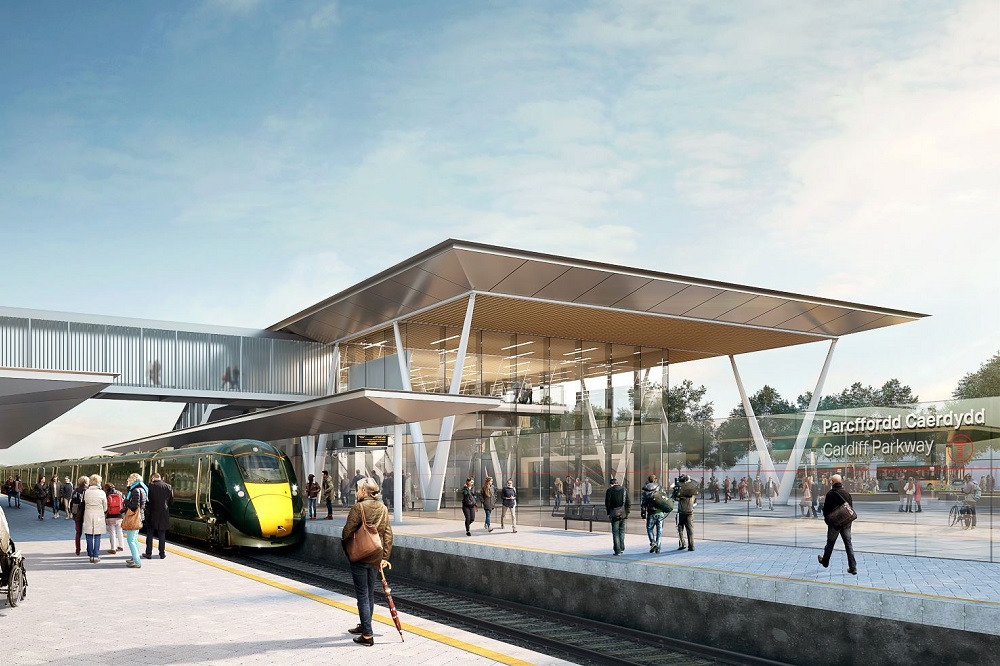
Cardiff Parkway. Photo Wilkinson Eyre

Lyn Eynon

On February 17th, the UK Government announced seven new Welsh rail stations and claimed to be making a major rail funding commitment. In reality, there was little truly new in this announcement.

Transport for Wales currently estimates the total cost of all Welsh rail schemes under consideration to be £14 billion, a figure that will inevitably increase over time.

The UK Government has done no more than endorse the TfW vision, declaring its pipeline to be a ‘generational transformational commitment’, while stating that funding will depend on future Spending Reviews, as it always has.

No new money was provided beyond that already in the 2025 Spending Review, which included £90 million for the long-announced Burns stations (Cardiff East, Newport West, Somerton, Llanwern, Magor and Undy) over the next four years.

As the Burns Delivery Board in 2024 estimated a cost of £335 million to deliver these by 2030, which it assumed would come from the UK Government, there remains a sizeable gap, and no certainty over future Spending Reviews.

The statement promises preparatory work on all these stations this year, but construction of the first two will not start until 2029, so it will be into the 2030s before any are delivered, and only once the funding gap is closed.

Public money

What is new in the announcement is that it now acknowledges that a station at Cardiff Parkway will not be built without public money. Cardiff Civic Society has long argued that this would be necessary, despite denials from Jo Stevens and other supporters.

The announcement summarises the revised position,

A new station will finally get built at Cardiff Parkway to help service an estimated 800,000 passengers every year. This will unlock around 6,000 jobs in the industrial district, which will get revamped thanks to additional UK Government investment and an agreed approach to funding and delivering the station between UK Government, Welsh Government and private investors.

Let’s examine this.

800,000 sounds an impressive number, but it is little over half the pre-covid total for the small station at Cardiff Bay.

It assumes a park-and-ride facility and that the business park will be fully built. P&R might be useful, although Cardiff Council seems to support closing the existing Cardiff East P&R bus service.

The developer’s own travel plan assumes two-thirds of business park journeys would be by private car. Despite claims this site will help a modal shift in travel, its dirty secret is that it is close to the M4.

Greenfield

The site is not an industrial district. It is greenfield, and a business park would destroy the Marshfield Site of Interest for Natural Conservation and damage Sites of Special Scientific Interest on the Gwent Levels, a rare biodiverse part of Wales.

The promise of 6,000 jobs has been touted for a decade, but that number exists only in the imagination of politicians afraid to call out that the developer has no clothes.

When initially proposed, it was assumed that Cardiff had a shortage of office space, and that with new offices jobs would come. But the world has changed. Home working is now a permanent feature.

The 2022 Employment Land and Premises Study for Cardiff’s replacement Local Development Plan did not identify any pressing shortage of office space, and the market has subsequently confirmed that. Offices are being converted to residential use.

While some businesses need the extra land that an edge-of-town location can offer, the plans show that most accommodation would be in towers that would fit more naturally in a city centre, if demand existed.

But what could have been prime employment land south of Cardiff Central has now mainly been allocated for housing, while large office blocks stand empty near Newport station despite renovations.

Both locations have better existing train links than Cardiff Parkway will ever provide.

Decamp

Rolls-Royce is repeatedly mentioned as a possible occupier. It has recently announced a hundred new jobs at the nearby St Mellons Business Park, from where it might one day relocate to newer offices with some extra jobs. But it will not decamp from Derby to fulfil the dream of thousands of jobs.

Hopes of a Memorandum of Understanding prior to last autumn’s Investment Summit came to nothing. No other sizeable employer has ever been identified.

Does talk of the district being ‘revamped thanks to additional UK Government investment’ point to public subsidy to try to turn this around?

Even if an approach to funding and delivering the station between UK Government, Welsh Government and private investors has now been agreed, there is not yet agreement on who pays what or when it would be delivered. Nor is there clarity on the station itself.

The vision of a four-platform station with direct intercity connection to London has always looked hubristic. Who would want to pay for that, or operate such trains?

The UK Government statement talks only of ‘cutting journey times to Cardiff and Newport and connecting them to other areas of Wales and the UK’.

Just over a year ago, the First Minister approved the outline planning application but that is far short of delivering a station.

Conditions

Even when funding and scope have eventually been determined, detailed plans have to be drawn up and approved against the 36 conditions attached to the outline approval, then contracts negotiated and signed. Media speculation about construction starting this year is over-excited.

The eastern side of Cardiff certainly needs improved public transport, including rail. The site for the Cardiff East station, by the junction of Newport Road and Rover Way, looks well chosen.

But if Cardiff Parkway were truly to meet the needs of residents further east, it would be built closer to where they live.

And as for the promised Crossrail from Cardiff Bay through Splott, that is nowhere on the horizon.

Lyn Eynon is planning lead for Cardiff Civic Society


Support our Nation today

For the price of a cup of coffee a month you can help us create an independent, not-for-profit, national news service for the people of Wales, by the people of Wales.

120 comments

Holly

Really interesting, but frustrating to know it will be years until we get any new stations in east Cardiff. We definitely need a train station for St Mellons/Rumney but there is already a business park next to the proposed Parkway site and it doesn't look full. I think Lyn is right, there really isn't a business case for the business park. To be close to where people live a station little further west would make much more sense. Here for example https://maps.app.goo.gl/k7x8E3uivFfNLGN8A

Reply
Ap Kenneth

Considering that they started building the estates down in St Mellons in the early 1980s (I lived there in late 80s) it just proves how little investment there has been in public transport in 45 years.

Reply
S Velin

Count yourselves lucky, Hwntws. We don't get ANYTHING

Reply
Stan

Always nice to hear from Bristol's civic society.

Reply
Ap Kenneth

Unfortunately commuting is now a fact of life, would you like to condemn investment in public transport in N E Wales because so many people in Wrexham travel to Chester, Liverpool or Manchester for work. Having lived in St Mellons it would benefit a huge number who would like to use public transport to get quickly into Cardiff, the buses take an age.

Reply
Y Gwir

Great article Lyn. It’s just another white elephant project with no meaningful benefit to the public.

Reply
Undecided

Great if you live/work in SE Wales or Bristol. Nothing much for anyone else.

Reply
Stan

Half the Welsh population lives in the south east.

Reply
Undecided

And half doesn’t.

Reply
Chris Hale

This was always a dubious project based on uncertain “projections”. Unfortunately, politicians are easily persuaded (Gething) and their support gives projects momentum, and public money. These things always start off with promises of private financing, but that never lasts.

Reply
Glyn

I don't care about going to London 10 mins quicker from whatever 'Cardiff Parkway' is. Just get me a bus system that works for more than going to the center of Cardiff once an hour, up until 8pm.

Reply
Lyn E

Bus services are underrated, but for most locations they will always be more nearer than trains and deserve more investment.

Reply
Lyn E

Plus the time to get to the station, which for most residents of the Trowbridge ward will exceed half-an-hour by public or active travel even when such routes are established.

Reply
Stan

Reliable and predictable unlike a bus fighting through city centre traffic that might not even stop if it has the words "bus full" on it.

Reply
Lyn E

Trains are great but what matters to passengers is the end-to-end journey time not the time for just one leg of it. That's why it would be better to have this station nearer to where people live.

Reply

In reply to Lyn E

Stan

Any station in this area is better than no station because there's nothing between Cardiff and Newport. Blocking this proposal doesn't result in an alternative proposal. It results in a much longer walk, cycle or bus to the Newport Road/Rover Way station.

Reply

In reply to Stan

Lyn E

It's not too late to change this. There are alternative sites nearer to homes if we drop the hubristic notion of an intercity station. This station can no longer be presented as a 'free gift' paid for by private investment, so the public are entitled to a say. Unlike the Arena, construction work has not started. Even if we accept it as a fait accompli, it cannot be presented as solving the public transport people for residents in the east of the city (rather than just mitigating the consequences of a car-based business park) unless the issues around how to get to and from the station are addressed. Google Maps estimates the walking time from the St Mellons Tesco (as a proxy for the centre of the community) at 30 minutes, 35-40 to be sure not to miss the train, plus at least 7 minutes for the train journey. For parts of St Mellons this is not far short of an an hour; an express bus to Cardiff East might well be quicker. What combination of buses, cycleways, e-bikes, etc. is needed to reduce total travel time? That needs some thought and engagement with the local community. Do you care about that, or is this only about developer profits?

Reply

In reply to Lyn E

Stan

If it was that easy to create a "walkway" station for St Mellons it would've happened already. Rejecting this proposal means no station for St Mellons.

Reply

In reply to Stan

Lyn E

Another refusal to address issues, let alone propose solutions. I assume you don't care about how well this works for the people of east Cardiff but then it was never designed with them in mind.

Reply

In reply to Lyn E

Stan

False promises help no-one. Having a realistic understanding of the outcomes and consequences of decisions is essential to make good decisions. All the funding for new publicly funded stations is based on the Burns recommendations to reduce congestion on the M4. A walkway at St Mellons doesn't help with that which is why it won't happen this generation unless you have some spare cash to pay for it. It's Parkway or no station. That's the choice.

Reply

In reply to Stan

Lyn E

The Burns station at Cardiff East will have negligible impact on M4 congestion. But it will help to reduce congestion within Cardiff, as would a St Mellons walkway. There is a credible M4 congestion argument for a Cardiff Parkway station with a large park-and-train. It would be hard to replicate that within the St Mellons area, although expanding parking at Newport West might help. As I said in the article, park-and-train is the best argument for a Cardiff Parkway station. But that is not an argument for the business park. As the developer's documentation acknowledges, a large majority of those working there would travel by private car, which could only worsen M4 congestion. With another major residential development being approved today near Cardiff Central on what could have been prime employment land, we seem to be turning the city inside out with housing at the centre and offices on the edge (if the business park is ever built). Nobody has ever made a coherent argument for that. It will not encourage a shift in travel mode, as nowhere in south Wales is better placed for public commuter transport than the centre of Cardiff, with valley lines as well as mainline. It makes little sense.

Reply

In reply to Lyn E

Stan

"turning the city inside out" According to whose definition of what a city should be?

Reply

In reply to Stan

Lyn E

Since publishing Future Wales in 2020, Welsh Government has had a policy of Town Centre First, reaffirming this in 2023 and supporting it through its Transforming Towns initiative. Welsh Government policy recognises that 'One of the challenges is competition for activity between town centres and out of town development which has seen services and businesses withdraw from the town centre reducing footfall and local spend.' It states, 'Planning policy must first consider town centre development over building new out of town sites.' In approving a large new out of town business park, the First Minister ignored her own government policy. Research has shown that productivity benefits from agglomeration are greatest in concentrated urban cores (like the City of London), particularly for knowledge-based industries, which are where the economic future rests. Central Cardiff has benefitted from a growing population but losing high quality central employment land should cause concern. An out of town business park will not substitute for this, even if demand permits it to grow, which is far from certain. Such a car-based development (which is what it will be even with a station) will also hinder the modal shift to public and active travel.

Reply

In reply to Lyn E

Stan

That doesn't address the specific point about "turning the city inside out". This suggests it's somehow "wrong" to have people living in a city centre and commuting out because a city is "supposed" to be a collection of offices to which people are forced to commute to miserably from dormitory towns because there's no other choice. In terms of footfall and spending in urban centres, having people live there is far better than having folks commute in, especially in the new era of hybrid work where these commuters might only come in two days a week. And just on the point about a walkway station, I would add that should more funding become available for new metro stations, adding additional stations in Splott (mainline) and Rumney (midway between Newport Road and Parkway) should be the next aim, and would be far better than a single station trying to serve St Mellons and Rumney.

Reply

In reply to Stan

Lyn E

The case for development in valley towns rather than central Cardiff is strong. But it hardly applies to Cardiff Parkway which is not an urban centre. For the office towers it proposes, its only locational advantage over the centre of Cardiff or Newport is proximity to the M4. I wish politicians would be honest about that. As you say, with hybrid working, the number of people working in offices has declined, which reduces the need for space. The Cardiff Parkway business park made some sense a decade ago but no longer. I agree Splott should be a priority.

Reply

In reply to Lyn E

Stan

A response that demonstrates objection for the sake of objection. The points in play in this thread were appropriate metro station provision for east Cardiff and the "properness" of city centre living but having exhausted these arguments the never ending list of grievances moves on. In politics this is called filibustering. Rather than objecting outright the opposer simply talks the bill into the long grass. The question of motivation returns. Is it really about nimbyism, Toryism, Bristolism or anti-capitalism.

Reply

In reply to Stan

Lyn E

My objection is to irrelevant arguments. As I’ve agreed, there is a good case for developing urban centres across south east Wales, not just central Cardiff. But that case has nothing to do with Cardiff Parkway, which would be a greenfield M4 development away from any urban centre. Once again, you resort to allegations about motivation to avoid addressing substantive matters. What are your motivations I wonder? When the business park was first proposed, I thought it had merits. I began to have doubts when I became aware of the ecological damage it would do. But it was the surge in home and hybrid working that obliged reconsideration of assumptions about demand for office space, which Cardiff Council itself is actively reducing for its own staff. Out of town developments have ruined town centres across south Wales and now inhibit shifting travel modes. We don’t need another one. The world has changed and so should our assessment of proposals.

Reply

In reply to Lyn E

Stan

Again a number of irrelevant arguments intended to grind the process to a halt. The harmful out of town developments are shopping centres that take shoppers away from town centre shops. No-one has ever suggested business parks do this. And office demands have indeed changed but not in the way you believe. What's gone is the demand for low quality battery cages needed to cheaply house large numbers of low waged call centre workers. The new normal is hybrid working in the social media era. Companies now want smaller but better. In many cases such as tech and finance that's funky buildings in capital cities. While others such as biotechs, creatives, startups, university spin-offs want a Cambridge science park style environment. Somewhere serene where magic can happen, but super well-connected to London so the VC can visit. Just as Parkway offers. My motivation is to see Cardiff become one of the best cities in Europe. Yours apparently differs.

Reply

In reply to Stan

Lyn E

Out of town shopping centres are certainly a big problem. CCS wants road use pricing in Cardiff to include levies on out of town parking both to raise money for transport improvements and to level the playing field for district centres. Do you agree? Business parks reduce footfall in urban centres. Just go into Cardiff centre one lunch time and look at how many people are buying food or picking up essentials. After work spending is also significant for both hospitality and retail, which is why shops stay open for an our or two after offices close. Do you really not know this? Imagining Cardiff Parkway will ever become Wales's answer to Cambridge is fantasy. How many grandiose projects have we had in the last few decades? Like most business parks, the Cambridge Science and Business Parks (closely linked) consist of low-rise buildings, as the 2016 LDP assumed Cardiff Parkway would be. Instead it proposes towers up to 15 storeys high, which belong in city centres. It has taken over half a century for these business parks to grow to a size not much bigger than is proposed for Cardiff Parkway, over decades when demand for office space was growing. Most importantly, from the outset business development at Cambridge has been linked to and driven by the university. The demand for space came first. Cardiff Parkway has it backwards. Planning approval doesn't create demand. As I argued several posts ago, Welsh Government should fix our universities, and Cardiff should develop and use our large educational base to build capacity in the science, research and information industries of the future. That's what Cambridge did and what gave its business parks a clear purpose. Cardiff Parkway has no idea what it is for other than developer profit.

Reply

In reply to Lyn E

Stan

With respect it's not the job of a civic society to assess the viability of a business plan because that's the job of the investors, just as it's not the job of a civic society to assess the appropriateness and risk of any public money involved because that's the job of Audit Wales on behalf of the democratically elected Senedd, just as it's not the job of the civic society to set economic or educational policy for the nation. The most useful thing a civic society can do is review the proposals and work out how to improve them for everyone's benefit. And suggesting that Wales can grow the sectors I mentioned as a "fantasy" demonstrates toxic levels of low ambition.

Reply

In reply to Stan

Lyn E

No wonder people are losing confidence in democratic institutions when those in power just want to exclude citizens from any view of their own future. Cardiff Civic Society is a registered charity whose aims include protecting and enhancing the natural, historic and social environment of our city. We have every right to comment on proposals that affect that. And as citizens, I and everyone else have every right to comment on the performance of those we elect and the bodies they create. In many cases the investors are, partly or wholly public bodies subject to scrutiny. You may not like democracy but that's how it works.

Reply

In reply to Lyn E

Stan

A civic society has no democratic mandate and no democratic accountability. It's a social club for bored opinionated retirees. That's fine if they are passionate, positive, visionary and dedicated to improving society for everyone's benefit. It's not fine if they are dedicating the time and influence to trashing the hopes and dreams of a nation's young people by standing in the way of progress in a capital city that should be reaching for the stars, not vying for UNESCO heritage village status. The only development you've been supportive of is social housing. And I'm all for that even adopting Singapore model where the state owns 80% of residential property and it's possible to rent a social home for £15 a month if you have a very low income. Because their hybrid capitalism model understands the need to support the people and the need to have a robust private sector to fund it. It's the only future that can work. Unbridled capitalism has failed just as communism has failed. We need both sectors to survive and thrive.

Reply

In reply to Stan

Lyn E

There is a lot to be said for the Singapore housing model. They are also world leaders in integrating urban development with the natural environment. Cardiff could certainly learn from that. It would be good if some of the proposed housing-led regeneration areas were built on that principle. Cardiff has an opportunity here to be a European leader.

Reply

In reply to Lyn E

Stan

Not without recognising and celebrating the hybrid capitalism model that makes it possible.

Reply

In reply to Stan

Lyn E

You seem more interested in ideology than in improving our city.

Reply

In reply to Stan

Lyn E

I have proposed developing the industries of the future around science and knowledge, with an emphasis on health, environment, leveraging our educational assets. You seem interested only in low paid hospitality jobs and speculative building. Mine is the more rounded view. So yes I am doubtful if the money invested in the Arena is the best way we could have spent it. Imagine instead if that had gone into cultural and musical investment in our schools and smaller venues. Wales is supposed to be a land of song based on the participation and creativity of our own people. Isn't that a more positive vision than one of just waiting for stars from elsewhere so that our young people can service the crowds?

Reply

In reply to Lyn E

Stan

That's not for you to decide. An arena doesn't stop these other activities. And it takes more than simply saying that you "have proposed developing the industries of the future around science and knowledge" to actually do this. Platitudes and warm words achieve nothing. Building spaces for them, marketing it widely and offering support to early occupiers is how you kick start these sectors.

Reply

In reply to Stan

Lyn E

Do you believe in public scrutiny? You sound as if you’d like to scrap any consultation. The private sector is not going to invest in speculative building without clear demand, and public money should not be wasted doing so either. Look at the real world experiences of the WDA or Cambridge to learn how to connect supply and demand.

Reply

In reply to Lyn E

Stan

Duplication of function wastes everyone's time.

Reply

In reply to Stan

Lyn E

Do you want to close down newspapers and imprison journalists? As it says on the side of Cardiff’s School of Journalism, Media and Culture, “A yes press is fatal to good government.” Your desire to deny residents (aka the electorate) the right to challenge those in power is deeply disturbing.

Reply

In reply to Lyn E

Stan

We elect representatives for a reason. Those representatives oversee institutions that are supposed to ensure to ensure our interests are protected. Journalism is intended to hold these institutions to account, not duplicate them. If you want to be a journalist become a journalist.

Reply

In reply to Stan

Lyn E

I don't understand your duplication point which you have made a few times. A charity like CSS has no decision-making power or veto. We can only influence public opinion, to which representatives may respond, in that sense acting like journalists although through a wider range of real-world and online.

Reply

In reply to Stan

Lyn E

My 'fantasy' statement was specifically related to the 'build it and they will come' philosophy behind Cardiff Parkway. As I argued, we should first be looking to grow the sectors of the future that will then need office or other space. Think back to the experience of the WDA: building advance factories worked well when manufacturing was growing and companies were looking for those but it had nothing to offer once that sector retreated. Cardiff does not at present have a shortage of office space; it has a shortage of business and services that want such space. That's where we should put our attention.

Reply

In reply to Lyn E

Stan

There's a shortage of grade A office space. It's the old battery cages that are being converted to housing. Waiting for businesses to appear before providing them space is like waiting for the grass to grow before watering it.

Reply

In reply to Stan

Lyn E

Again, look back at the WDA experience. Building factories only worked when manufacturers were looking for them. I don't think developers (and CPDL has said this) are going to invest billions in speculative development in the hope that someone will come. Cardiff City Region had to lend JR Smart £15mn to complete its John Street office. The Cambridge experience deserves examination. There building offices and businesses have gone hand in hand led by one of the world's great universities. I don't see any of that integrated approach in the Cardiff Parkway proposals.

Reply

In reply to Lyn E

Stan

The John Street development has occupants (Lloyds Bank) moving in this summer.

Reply

In reply to Stan

Lyn E

Lloyds Bank moving to John Street has left their old office on Dumballs Road empty. There doesn’t seem to be commercial demand. Fortunately, Cardiff and Vale College want it, which is a use I support.

Reply

In reply to Lyn E

Stan

It proves my point that the demand is for better.

Reply

In reply to Stan

Lyn E

Better does not mean increasing traffic on the M4 as the Parkway business park will do.

Reply

In reply to Lyn E

Stan

This point is about the post covid move towards better office space and the "speculative" development you dismiss probably kept Lloyds in Cardiff.

Reply

In reply to Stan

Lyn E

The John Street application was submitted in 2017 when it was still assumed that there was enough demand for office space to justify that investment. Work stopped for a couple of years during covid. There have not been any speculative applications of that size since the pandemic. We had no reason to oppose the John Street office. It was on poor quality brownfield and close to the city centre. It's good it's been filled and that the public sector has a use for the old Lloyds office.

Reply

In reply to Lyn E

Stan

Still missing the point. It's an example of a speculative "build it and they will come" development that you oppose. But someone like Lloyds isn't going to build a regional office from scratch. When they decide to upgrade and consolidate they'll pick from what's available. So someone has to speculate and hope that someone like Lloyds will come. Had there been nothing in Cardiff because you successfully opposed speculative developments they may have moved the 3000 jobs to Bristol where speculative developments are a dime a dozen because they're not frightened of the private sector.

Reply

In reply to Stan

Lyn E

As I said, CCS did not oppose the John Street development. If the private sector wants to invest in speculative building that’s up to them. CCS is only concerned about whether the land use is appropriate, given our objective of protecting and enhancing the environment of the city, which includes supporting declared policies such as One Planet Cardiff or Town Centres First. I have observed that low office demand means that there is now less investor enthusiasm for speculative office building. I do not think it would be a good use of public money to subsidise developers to build offices that then stand empty or for which the public sector gets little return. I suspect that might be coming.

Reply

In reply to Lyn E

Stan

The point once again is simply that Lloyds moving in to John Street demonstrates that speculative development is necessary.

Reply

In reply to Stan

Lyn E

Speculative building has its place but investors will only do that if they believe that demand exists. The initial proposals for the Brains brewery site revolved around speculative office building but came to nothing because investors concluded they might not be able to find tenants willing to pay the rents they required to achieve a return. You are strangely uninterested in the actual state of the world, offering only timeless formulas. Nobody (I trust) would propose returning to the early WDA approach of building advance factories because we know most would stay empty today. Similarly we need to think about whether it is worthwhile, here and now, investing public money to subsidise building offices when demand is highly uncertain. Private investors can make their own choices but should not expect to be bailed out if they get it wrong.

Reply

In reply to Lyn E

Stan

You're either opposed to speculative development or you're not. Just using it as a stick to beat projects you don't like for other reasons is bad faith. Clearly there's demand for this type of development otherwise the proposal wouldn't be moving forward. Like Lloyds in John Street most tenants won't sign up to an artist's impression. They need to see the result before committing their business future to it. Any public support isn't replacing all the risk for Investors. If they build something no-one wants as you seem to believe they will see no returns. Why would they do that?

Reply

In reply to Stan

Lyn E

Big property companies are showing time after time that they are unwilling to take the risk on large speculative development at present. That's why the Brains site has become housing and why Cardiff Parkway has not yet built anything. It's not about some moral choice about being for or against speculative development but about recognising current economic reality. Try looking at the world around you.

Reply

In reply to Stan

Lyn E

The planning application for John Street was submitted in 2017. As I keep saying, the world has changed. Nigel Roberts of Cardiff Parkway made this point at a briefing I attended this morning: 15 years ago he could build a large development confident it would find tenants; now he cannot. This is why CPDL is focusing on finding potential tenants rather than on construction. The public sector should not engage in or subsidise speculative building at a time of market uncertainty and ongoing austerity. The one exception might be to fill a gap for start-ups.

Reply

In reply to Stan

Lyn E

If there are more speculative office developments at present in Bristol (I haven't checked), it's not because of hostility here to the private sector. If any developer had applied to build offices at Central Quay the Planning Committee would have approved it with enthusiasm. But there was no interest. I have heard it said commercial rents are higher in Bristol which encourages developers to build there. If so, that would confirm my argument that the problem for Cardiff (and Wales more widely) is not shortage of supply but a lack of demand. The solution is not to build office blocks that stand empty but to stimulate the growth of services and businesses that would need that space. In today's world, that is first and foremost about skills, leveraging and developing our educational and cultural resources, plus building the transport and other infrastructure that businesses require. Wales needs more home-grown businesses with a longer term commitment rather than desperately chasing outside investment, which certainly has its place but which can depart as quickly as it arrives.

Reply

In reply to Lyn E

Ted

Except Lloyds just took a speculatively built publicly supported office development that kept 3000 jobs in Cardiff.

Reply

In reply to Ted

Lyn E

Cardiff has seen no applications comparable to John Street since 2017. I think that is best explained by uncertain demand. How would you explain it?

Reply

In reply to Stan

Julia

Or is it possibly - just possibly - about wanting a city that is forward looking and providing really good services for the population? Rather than second rate stuff that isn't much cop? Just a thought.......

Reply

In reply to Julia

Stan

Improving public services and development aren't mutually exclusive. It's not a choice. Stopping development doesn't improve public services. It just harms the younger generation by depriving them of more jobs and opportunities and makes them more likely to leave for somewhere forward looking and with a bigger budget for public services thanks to all the development.

Reply

In reply to Stan

Julia

Eh? Who, apart from you, has mentioned 'no development'?

Reply

In reply to Julia

Stan

This debate you've weighed in on is all about opposing development.

Reply

In reply to Stan

Lyn E

No it isn’t. It’s about doing development properly so that it meets the needs of our future generations rather than just lining the pockets of landowners.

Reply

In reply to Lyn E

Stan

"lining the pockets" Are you an anti-capitalist?

Reply

In reply to Stan

Lyn E

Who is trying to stop development? Cardiff Council knows that CCS is not doing this. As it says in its response to the LDP consultation, 'Many respondents, including the House Builders Federation and Cardiff Civic Society, argue that the proposed delivery of 5,000–6,000 affordable homes is significantly below the identified need.' On both housing and jobs, what we argue for are sustainable developments that meet the needs of our future generations, rather than making those subservient to increasing land values. Much recent development in Cardiff has been poor quality. Many homes in Cardiff Bay were shoddily built with developers, builders, and landlords more interested in avoiding blame than fixing problems. Plasdwr was approved without ensuing that basic infrastructure like sewerage and transport would suffice. If we want a great city, we shouldn't just accept whatever developers want to foist on us in their own interests. Let's build properly.

Reply

In reply to Lyn E

Stan

A list of complaints without a good faith proposals to resolve them that doesn't undermine the actual purpose of the development is outright opposition to development. If your neighbour submits a proposal for a garage and you object but say it'd be fine as a porch you are not engaging constructively because you're not trying to help your neighbour meet their automotive storage needs in a way that suits everyone. There are some shocking examples of development in the bay but that's down to the quality of opposition. By opposing destructively rather than constructively the contribution gets ignored, and the cheapest proposal pushed through just to get it done. Had locals engaged with the plans in a way that welcomed them in principle but full of ideas to improve them, perhaps by presenting examples of similar developments from around the world with better quality, sustainability and community focus, the results would've been world beating. Next time you enjoy a stroll around the bay remember the efforts put in to stop it because it was a "yuppie lake". Imagine if that effort had instead been directed to insisting on half the properties being community-led social housing. Rather than say "how can we stop these people making money", say "how can we help these people make even more money in a way that works better for everyone".

Reply

In reply to Stan

Lyn E

CCS has long argued that the pre-application process is flawed because it excludes residents until plans are all but complete, giving no opportunity to improve them. If residents were involved earlier they might not be forced into opposition. We have engaged constructively with the new LDP, as the city’s planners acknowledge. We were recently invited to comment on the latest regeneration strategy and our comments were welcomed, as were those we submitted on how best to use visitor levy revenues. Your view of CCS exists only in your own head. Blaming local people for the quality of building in the Bay is pathetic. They had zero control over that. There has been very little opposition locally to building more homes, but there has been and is a strong demand for more affordable homes. CCS has argued for community-led social housing in our LDP submissions and elsewhere. Do try to base your comments on facts.

Reply

In reply to Lyn E

Stan

It's important to recognise that the wrong type of engagement isn't just ignored. It can make outcomes worse.

Reply

In reply to Stan

Lyn E

That’s exactly why we support the Design Commission for Wales Placemaking Charter, which says placemaking must start with community engagement. Welsh Government supports that Charter but Cardiff Council has yet to sign up to it.

Reply

In reply to Lyn E

Stan

Placemaking is absolutely the missing piece of the jigsaw and what they do so well in other jurisdictions such as Singapore. It's not about whether to build an arena or not. It's about what to do with the space in between, how to connect it all together to make it livable, function well and make it an enjoyable place to be proud of. And I'm astonished that so many focus their energies on keeping building sites undeveloped rather than using new investment proposals as a developer funded opportunity to placemake something better that works for everyone. That's sort of the point of S106 cash that only ends up paying for a new pedestrian crossing and never turning a desolate corner into a pocket park.

Reply

In reply to Stan

Lyn E

I’ve just been told by a friend of mine in CCS that the latest Atlantic Wharf (Red Dragon Centre) application makes proposals on biodiversity that respond positively to many of the objections that we made to the original hybrid application. That is the point of critical engagement. You believe we should know our place and keep quiet. I believe in changing the world for the better.

Reply

In reply to Lyn E

Stan

I've never suggested CCS isn't doing valuable work, but they are doing more harm than good with the anti-capitalist stance. The problem isn't developers, it's bad developers. The problem isn't investors, it's fast buck investors with no long-term interest in what they build unlike pension funds building build to rent apartments they want to pay pensions for half a century. And the problem isn't profit (most people expect to profit from their day job) it's exploitative, short-termist and unfair profit that relies on schemes and connections the rest of us can't access. Because there's no developers without investors, no development without developers and no progress without development. A city that isn't constantly improving is getting worse. That's what a rejection of all private enterprise is doing for the capital city of Wales. It makes everything worse. It's hating on the next generation who'll still have to leave to seek the opportunities they want

Reply

In reply to Stan

Lyn E

Who's rejecting all private enterprise? You keep falling back on that strawman argument to avoid dealing with matters of substance. You are also ignoring the fact that much private investment depends on public subsidy, as has now been admitted for Cardiff Parkway station. Build-to-rent may indeed have advantages in terms of quality over build-then-bolt which has been the model in recent decades, although the rents can be eye-watering. At least purchasers won't be trapped in mis-sold properties that can't be sold on because potential buyers can't get a mortgage. But history suggests that the interaction between finance capital and property development is probably hiding some fault lines that won't become apparent until the next crash.

Reply

In reply to Lyn E

Stan

I can only go by the contributions to this debate which have been in favour of state funded projects like social housing and less than enthusiastic about privately funded projects but feel free to correct the imbalance. But let's talk about the role of public subsidy. Developments can either be all public, all private or a public-private partnership of some sort. All types are needed in a healthy developing economy. Public investments are usually reserved for public services infrastructure, and potentially in areas where the market has failed to deliver such as housing. Private investments appropriately regulated are necessary because the state can't be involved in everything and there are some things the private sector does better, in particular identifying and responding to new trends and opportunities. The interesting one is the public-private partnerships. And I don't mean Blair's trick to get public services infrastructure off the book. I mean both sectors working together to achieve what either couldn't achieve alone. The first issue this addresses is the distortion of the UK economy. The GDP gulf between London and the rest of the UK is so large that most investors are too busy making all their money in or near London as opportunities outside London will never be as profitable. So economic development activities must correct that imbalance with support or derisking to lure some investment away from the UK capital. There are different ways it can be done, from building premises and renting it cheap to just handing out cash as the WDA did by throwing £1m at a young Admiral, now Wales' only FTSE 100 company. But viability isn't the only reason businesses seek government support. For larger and less usual ventures government support is a measure of how welcoming they are to the project, which can be sunk by government machinery and red tape that isn't in a rush. Imagine the difficulties building an arena in the centre of a city without government help. It just wouldn't be practical which is why so many of the private ones are in the middle of nowhere. But there's a third factor to consider about public subsidy. And that's the benefit for us - influence and control. An arena that's 100% privately owned puts on whatever shows it wants within the law. If it was sold to a Spanish owner who decided to hold bull fights (animal cruelty laws aside) against the wishes of locals it would be difficult to block this. But as co-owner the council as a democratic institution can on behalf of their citizens pick up the phone and say it's not happening. So subsidy is often necessary to develop the economy in new directions when London is hogging most of the investment. It's necessary to show support for bolder riskier ventures that have to happen if the economy is to grow and develop. And it's useful to have control over assets that are too important to the economy to leave in private control.

Reply

In reply to Stan

Lyn E

Who’s focusing energy on keeping building sites empty? I wish they get on with building on Curran Embankment which first had a masterplan 20 years ago. The point about Cardiff Parkway is that it shouldn’t be a building site because it’s on ecologically sensitive land and that the rail station only partly mitigates its character as an out of town car based development.

Reply

In reply to Lyn E

Stan

The vocal opposition to the spectacular Guildford Cresent development would've kept that plot vacant for 20 years had it been successful. Watching them now recreating the villas is a joy and an example of what can be achieved when developers work with the public because the easy route would've been to ignore everyone and force through a generic block that could've been anywhere but now they created something unique that has embraced the unprotected heritage.

Reply

In reply to Stan

Lyn E

The Guilford Crescent developers did not embrace the site's heritage but destroy it, knocking down the facades that a planning condition required them to maintain then presenting the Planning Committee with a fait accompli. For many people, that confirmed that developers cannot be trusted. Perhaps the end result will look fine, but they should have obtained permission first. Why do so many developers act as if they are above the law? Most of those who marched against the proposals wanted to defend small music venues. These were a central concern of the Music City report Council commissioned several years ago. That report was less interested in an arena. Small venues provide not only a way for musicians to earn a living and perfect their art but also act as a social hub in an increasingly isolating time. Council has invested only miniscule amounts in supporting them compared to what it spends on big events.

Reply

In reply to Lyn E

Stan

Heritage isn't just preserving lumps of stone in aspic. It's preserving the human story. And the blend of old and new in this design tells the local story in a way that wouldn't happen if the old façade was completely replaced with a generic building straight out of a tall building catalogue. Narrowly defining heritage as keeping things as they were disrespects the human story which is never ending, not some snapshot of a moment in olde worlde time. And that's the problem so often. People react to change by trying to stop time and wonder why they fail so often. The process was indeed a disaster. But outcomes matter and if the result by following the process would've been another generic building that erased all traces of what came before then the process isn't working. It's the same with John Street. It took 9 years of pain but the end result of keeping Lloyds in Cardiff in a well designed building is a great result. If the process couldn't have delivered this outcome then the process isn't working. In 20 years what will people remember. Someone who jumped through the through hoops to make every stakeholder as least unhappy as possible but pleasing no-one, or a fantastic building that celebrates the past.

Reply

In reply to Stan

Lyn E

So you believe developers are under no obligation to obey the law if they think the end result will justify it? Who is arguing for history in aspic? You have some strange ideas. As I said, and you ignored, the main concern of those marching was the loss of small music venues. Do you care about that?

Reply
Lyn E

Public scrutiny performs a vital role in a democracy. Cardiff Civic Society is right to ask hard questions. CCS correctly opposed the original Arena application, which was badly designed. A hulking black box with gas boilers (despite climate change policy), and absurdities like an illuminated advertisement on top of the roof to let passing seagulls know what was on. The revised design is an improvement. At the time there was no commitment to a Metro link to Cardiff Central. There are still problems. Local residents are enduring years of disruption with no explanation why the Arena could not be built on the Red Dragon carpark instead of so close to their homes. There has been significant loss of trees and biodiversity, and little movement towards the promised Lloyd George Avenue park. We were also right to query Arena financing. The total cost is much higher than the published figure when enabling factors like land accumulation and clearance, car park purchase, or the Metro extension, are included. None of those will be covered by lease revenue. Confidentiality makes it hard to get to the bottom of this, but it seems to have stretched Council’s borrowing capacity. Those resources could have been used elsewhere. The claimed economic benefit also looks exaggerated, with optimistic assumptions on how long visitors will stay in the city. The market for music events is finite, particularly when personal finances are strained, and it is not obvious that sufficient demand exists to support two new arenas within an hour’s drive. Meanwhile, small venues across the city struggle to survive. There is little evidence of benefits for Butetown people. It is anyone’s guess when Crossrail will reach east Cardiff. We are also worried by how close Cardiff Council has become to Live Nation and its subsidiaries, such as Ticketmaster and AMG. As well as the Arena, it will run St David’s Hall, is involved in Blackweir Live and Depot at the Castle, and controls ticket sales for Principality Stadium and other events. Council financing for the Arena (including borrowing at public sector rates) subsidises this company. Trump’s Justice Department has withdrawn its anti-monopoly case, but other jurisdictions will pursue legal action against it. Is it wise to have become so embroiled with Live Nation? It is far healthier for democracy for such questions to be brought into the bracing air of public debate rather than to be smothered by uncritical cheerleading.

Reply
Stan

Much better to have it in Bristol then.

Reply
Lyn E

Try providing evidence to refute the points I have made.

Reply

In reply to Lyn E

Stan

As with this article you made a case for cancellation not a case for improvement. I could respond to each point but it's clear you oppose for the sake of opposition.

Reply

In reply to Stan

Lyn E

I don't believe you could respond to every point or you would do so. Our choice is between blindly supporting anything that is proposed or asking serious questions that deserve answers. No wonder people have lost confidence in public bodies that evade scrutiny. So answer the questions.

Reply

In reply to Lyn E

Stan

We need to discuss motivation before detail. There are a lot of reasons why some start with the conclusion that they will reject the proposal before confecting an argument to justify it. There's no point discussing the detail if the decision is already made. First there are the famous nimbys. It doesn't matter how good the development is they just don't want it next door. Second there are the Tories. A subculture of the UK Conservative party that is ideologically opposed to Wales having nice things. Third there are the Bristol vested interests who know that every development blocked in Cardiff increases Bristol's attractiveness. And finally there are the anti-capitalists who oppose private enterprise in any form and want to chase it all out of Wales in hope of keeping creating a post-capitalist nirvana no matter what harm that causes. I'm not going to speculate on your motivation but the diatribe against Live Nation provides some insight. Because I agree that Live Nation's dominance of the entertainment industry is a huge problem. But sending all the biggest and best live music acts to Bristol doesn't fix that. The Competition and Markets Authority is the way that gets sorted.

Reply

In reply to Stan

Lyn E

Yet another evasion. I could as easily ask whether you work for a developer or why you hate Bristol, but I'm interested in ensuring that development benefits the city's residents rather than speculating about 'motivation'. Why do you not want to address practical issues? Do you find dealing with detail too difficult? The Arena is going to be built to the now approved design. That doesn't mean that its design should never have been discussed. There is still much to be worked through in its operation, such as the effect on local residents of noise and waste, the promised LGA park to compensate what has been lost, traffic management, etc. Why do you have no interest in how development impacts lives? Why should Butetown residents not want to benefit from this? It is entirely reasonable to ask why Council has chosen to subsidise Live Nation rather than our many local music venues, or do you not care about those either? Similarly on Cardiff Parkway. The outline plan has been approved but with 36 conditions, some of which look quite demanding. There is a long way to go before the station receives full approval. Detail matters.

Reply

In reply to Lyn E

Stan

It's clear I'm not a developer because there's no developer in common between the two projects as far as I'm aware. I have no beef with Bristol other than being a competitor for investment that keeps on winning. Investment in Bristol that comes at the expense of Cardiff diminishes Cardiff and Wales, and I want to see Cardiff grow into a modern vibrant global capital city that Wales can be proud of. The Auckland of Europe is my ambition. Your turn.

Reply

In reply to Stan

Lyn E

That's fine. I've no wish to discuss motivations as ad hominem arguments are a classic logical fallacy. So will you now address the empirical and pragmatic details?

Reply

In reply to Lyn E

Stan

What's your vision for the capital city of Wales? Will kids born today still have to leave Wales to achieve what they want to achieve in the future you're trying to build?

Reply

In reply to Stan

Lyn E

We need to think what a 21st century city should offer. Cardiff's planners and developers seem stuck in a 20th century vision of urban success measured in steel, glass and concrete. Successful modern cities look rather different. Top of global liveability rankings come medium-sized cities like Copenhagen, Vienna, Zurich or Geneva, better known for the quality of their public and active travel infrastructure, their green spaces, or their public housing, than for the height of their towers. Cardiff would do better to emulate such cities than boast about how a 50-storey residential block will look like something out of New York. Who cares? Residents want safe, clean streets with no potholes, and quick easy access to good services or parks. The city is betting too heavily on being a 'destination city' around events that bring ephemeral benefits with few visitors staying long. The entertainment and hospitality sectors gain but their jobs are low-paid and intermittent, and much of the profit is extracted by corporations headquartered outside Wales. With congestion and travel restrictions on over 70 days last year, other businesses suffer and may be deterred from coming here. Big events bring excitement but we need to keep a balance. Young people want a better future than working in a bar or as a security guard. Cardiff already has a presence in growing sectors like IT or fintech, plus a large public sector. More should be done to solve the university crisis, and to leverage our large education sector (higher and vocational) to develop business services in areas like health or environment. We should reverse the decay in our cultural sector from schools to local music venues, a notable failure of the first quarter century of devolution. Cardiff also needs to rethink its unbalanced relationship with the wider city region, with too many people commuting to the city as there are too few jobs elsewhere. We need a thriving city centre but an out of town business park on the M4 is not a regional priority. Needless to say, none of this will be easy, but our current choices are not setting course towards a sustainable prosperous future.

Reply

In reply to Lyn E

Stan

All fair points, but they are not mutually exclusive. Blocking a tall residential development doesn't improve the quality of the public realm, active travel infrastructure, green spaces or public housing. All it does is reduce the supply of housing which increases rents, and reduces the council's ctax income that could be used to improve public spaces, active travel infrastructure, green spaces, and public housing, and deliver safe, clean streets with no potholes, and quick easy access to good services. Efforts instead should be focused on delivering the best tall residential development by global standards if that's what is on the table. And being a destination city doesn't solve the economic problem, but not being a destination city makes it worse. The visitor economy is an export industry that brings money into the local economy. As with all tourism, it's irregularity and exploitative businesses that cause the harm, not a fundamental problem with the sector which should be part of a diverse economy rather than the only source of opportunity. More regular events is important to grow and improve this sector which is why the arena is important. The city only grinds to a halt when 70,000 ticket stadium events are on. No-one notices when 30,000 fill Cardiff City stadium so they won't notice when 18,000 fill the arena every few days. Public transport improvements will keep improving this experience, funded in part from a visitor levy on many of those visitors. Certainly there is more to be done to diversify the economy but first and foremost Cardiff must be seen as welcoming to investment. Because chasing away one investment you don't like but could be made to work sends a corrosive message to other potential investors who might be considering projects you would welcome. That doesn't mean just accepting everything without question, but every potential opportunity for the city must approached constructively because no-one can say what it might lead to.

Reply

In reply to Stan

Lyn E

Increased supply at the top end of the housing market has negligible effect on rents at the bottom. I support more homes, but the type matters. The city needs more affordable housing, which most of that going up around the city centre is not. It's good that Council wants to buy some Central Quay land to help address that. I don't oppose tall buildings in suitable locations, although they are nothing to boast about either, and often less environmentally efficient than medium-rise. Let's hope the engineers for the 50-storey tower have done their calculations properly: this is a small piece of land once on the Taff estuary. We don't want to be at the leaning edge of architecture, like One Seaport in New York. But we should recognise that the lack of investors wishing to build offices on prime employment land confirms that the latent demand assumed by the Parkway business park proposal is weak. A destination city should offer more than events but there is little Council interest in what might encourage visitors to stay longer. We have top class museums, heritage buildings, parks and waterfront, but few who come here for events are ever told that. Why is that? 'We must welcome any investment' surrenders democratic accountability for our city's future. Big developments like the Arena or Parkway depend on large public subsidies. It is quite right to query whether those are the best use of our money.

Reply

In reply to Lyn E

Stan

Affordability is important for all renters, not just those in social housing. The effects of supply and demand on price apply to the private rental market just as they do in the global oil market. And it's important for the economy because the more people pay in rent the less they spend in local businesses. And on democratic accountability, the council isn't just accountable to the city. As a capital city it's accountable to the nation. And that nation has every right to be unhappy if the best music acts bypass Wales. Unlike any other council, Cardiff has a special obligation to balance national needs in terms of what people want and expect from their capital against the needs of Cardiff's citizens. The decision in 1955 was far more than just a badge of honour.

Reply

In reply to Stan

Lyn E

I agree supply and demand matters. The opening of Anchor Works and Central Quay now requesting expressions of interest, build-to-rent landlords are having to advertise more and are hitting a ceiling to rents, which may even have fallen slightly. Demand also matters: there is a limit to how many residents can afford to pay the rents they ask. Will the 50-storey tower ever be built? Planning approval is just one step. It is estimated that across the UK there are close to a million empty plots with approval. We see that in Cardiff. Plasdwr is progressing at half expected pace; a 42-storey tower on Custom House Street approved in 2016 was never built. Empty land next to the Senedd has had permission for 20 years. Given current global uncertainty, I doubt they will rush ahead with this £200mn or so investment. The best music acts are hardly bypassing Wales as a quick glance back at the music calendar shows. The market for live music does not respect devolution. Fans in Wrexham are more likely to travel to Manchester than to Cardiff. Public spending for badges of honour rarely goes well. The Arena is going to be built, so the question now is to ensure the city gets the promised benefits. After the Cardiff Bay Development Corporation, Butetown residents want evidence that this time they will benefit.

Reply

In reply to Lyn E

Stan

If rent is dropping with increased supply that demonstrates the value of increasing supply. If affordability is a problem that leaves newer apartments empty they'll drop their prices rather than have no income. That's how it works. No potential tenant sitting in an estate agency looking at a large number of available properties pays more needlessly. So blocking these developments pushes up private rents which pushes more folks into the social rent sector growing the waiting list faster than councils can build new homes. Those objecting to these developments are contributing to homelessness. There are many reasons why projects are proposed, approved and never happen but a bruising and protracted planning battle with a lot of apparent local opposition might leave developers, who likely have many projects on the go, choosing to prioritise more welcoming destinations. Best music is subjective but the point is about the international acts that play in mid size 15-20k venues. They bypass Wales. Where's the democratic mandate that says a young girl in west Wales who's had a tough time and would love to see her favourite pop idol play in her capital city on her birthday should be denied this chance. I certainly didn't vote for that. The arena is being built but this isn't what the civic society wanted, despite the lack of a democratic mandate for this position.

Reply

In reply to Stan

Lyn E

I haven't argued for blocking housing. As I demonstrated in a comment you ignored, Cardiff Council recognises that CCS is one of the bodies pushing for more affordable housing to be built. Who do you have in mind when you are accusing people of blocking housing? It can't be CCS. We have objected to certain proposals (as sometimes has the planning committee), but we have never objected to more homes. Read our submissions on the LDP.

Reply

In reply to Lyn E

Stan

In this discussion you opposed the 50 storey development.

Reply

In reply to Stan

Lyn E

It would be more accurate to say that I have queried the 50-storey tower rather than opposed it. I don't share the juvenile excitement about being taller than others. I agree with the Planning Committee that Cadw's arguments about the skyline were exaggerated (oddly Cadw have not opposed worse proposals). I think we might regret the loss of employment land near Cardiff Central (so do some in Council's Investment and Development department). Given the quality of much that has been built in Cardiff, qualms about a building that will require precision engineering to succeed are justified. And as always, the developer is paying only a small fraction of the section 106 contributions Council requested (although it has done better than on some developments). None of that is 'opposing for the sake of opposing'. They are all reasonable considerations. As I've said, I'm not yet convinced the developer will go through with this, but if they do then I hope it works.

Reply

In reply to Lyn E

Stan

Maybe you just have a communication problem. Perhaps preface feedback with the words "I broadly welcome this investment in principle and how it will contribute to the city and the nation, and would like to propose the following points to improve its quality and ambition, its interaction with the local area, its sustainability, and its profitability for the developer because that's what this capital city demands for its residents, the wider nation and folks who have the confidence to back our growth".

Reply

In reply to Stan

Lyn E

Our most recent consultation submissions have been on the Visitor Levy and the Regeneration Strategy. In both cases, we welcomed the initiative and proposed improvements. On the Visitor Levy we argued for the importance of spending some of the revenue on improving the city for both visitors and residents. Many European cities are seeing resistance to mass tourism because authorities have not considered how that impacts local people. Our suggestions included more public toilets, bigger waste bins, more frequent bus services to destinations like St Fagan’s museum, better maintenance of heritage buildings, a permanent home for The Cardiff Story, and so on. We also proposed doing more to help local businesses benefit from visitor revenue, perhaps through a shipping container development like those in Caerphilly, Barry or Bristol, all of which seem to be successful. Of course there will be other demands on the revenue, but none of those proposals could be described as destructive.

Reply

In reply to Lyn E

Stan

No objections to any of that but this point is about responding to private investment opportunities. Once again you imply a total opposition to all private sector involvement. And, by the way, the "greedy investors lining their pockets" you seem to universally despise probably includes yourself if you have a private or occupational pension that you are hoping will keep pace with or outperform inflation so you can enjoy a comfortable retirement. Of course it's possible you're donating it all to charity and surviving on the state pension in which case I salute your integrity.

Reply

In reply to Stan

Lyn E

My 'lining their pockets' comment was specifically directed at large landowners making fortunes by literally doing nothing while land values soar. Planning permission is a public good so the public should gain the benefit from granting it, which is what the Town and Country Planning Act 1947 sought to achieve. In the right location, permission to build homes can increase the value of previously agricultural land by a hundred fold or more. If that gain accrued to the community, people would be far more sympathetic to development.

Reply

In reply to Lyn E

Stan

What does the public gain from granting you permission to build a kitchen extension? That seems a very contrived argument.

Reply

In reply to Stan

Lyn E

You really can't see the difference between a kitchen extension and a major housing development? The first is private; the second is social. Land is rarely created by human effort. Rising values of land, often inherited and sometimes with links back to a henchman for the King of England (check out the Bute family tree), are a major cause of rising and unearned inequality.

Reply

In reply to Stan

Lyn E

You really are living in a world of your own imagination. Who has declared opposition to all private sector involvement? I worked for 30 years for a large private corporation.

Reply

In reply to Stan

Lyn E

You seem to wish to exclude all opinions that dissent from those of whoever happens to be in power. The argument that residents should stay silent in case we frighten off developers is a dangerous assault on civic and democratic rights. I have never been opposed in principle to an Arena, but it was quite legitimate to question what was proposed. The original design had many failings, including reliance on fossil fuels contrary to One Planet Cardiff. Local residents are quite within their rights to demand that the impact of construction and operations is mitigated. It is also quite legitimate for voters to ask whether the best use is being made of our money. The economic case was not high quality. It did not even consider whether the market existed for two new arenas. We shall see. As I've said, my primary concern now is ensuring that the promised benefits to the local community are realised.

Reply

In reply to Lyn E

Stan

Not sure how it was planning to use fossil fuels when there's a heat network being developed in the area. And are you claiming responsibility for the design change because that's highly disappointing as the original lump of coal crossed with Tron was iconic and would've been highly globally recognisable in the same vein as the Eiffel tower or Sydney Opera house. What we ended up with, for reasons of unavoidable value engineering I hope, is still decent but unmemorable and will never capture people's imagination. No-one will make a special trip to see it and share it on their socials as they would've done with the original plan.

Reply

In reply to Stan

Lyn E

You obviously haven't read the original Arena design documentation. The intention was indeed to connect to the heat network but the fallback was gas boilers. In contrast, the Bristol Arena was promising from the outset to be fossil fuel free. Maybe the original design would have been iconic but it felt oppressive to those who would have to live near it. You seem more interested in visitors taking selfies than in our city's residents.

Reply

In reply to Lyn E

Stan

Locals initially hated the Eiffel tower and Sydney Opera house plans which eventually came to define those cities. Imagine their civic societies taking credit for demanding generic designs. Today's residents wouldn't be grateful.

Reply

In reply to Stan

Lyn E

That’s a fair criticism of the rejection of Zara Hadid’s design for the Welsh Millennium Centre, and one I’ve made myself. Cardiff Council has not been very ambitious or imaginative. But the original Arena design was just ugly, and we should no longer be building with large dark surfaces that absorb heat.

Reply

In reply to Lyn E

Stan

Actually a visionary would've turned two of the concerns you raised into an opportunity by covering the arena in the blackest solar panels to achieve the look while using the absorbion properties of a dark colour choice to improve its environmental credentials while also serendipitously introducing a new view where the arena looked like coal under cloud and glinted like a precious jewel in the sunshine. But were you too busy trying to make it more like a Toys'r'us because that's what locals were apparently more comfortable with? At the very least a choice of designs should've been displayed in St David's 2 with an informal voting system. What public engagement did CCS insist on?

Reply

In reply to Stan

Lyn E

We proposed replacing the LED rooftop advert with solar panels. We queried the aesthetics but our bigger concern was that it was too big to be so close to homes. CCS participates in as many consultations as we can. As I said, if Cardiff adopted the principles of the Placemaking Charter then residents would have an early chance to engage before large sums have been spent on detailed design.

Reply

In reply to Lyn E

Stan

That's not good enough. The bay was converted from active docks for the purpose of economic regeneration of south Wales to replace the mines. That was what Thatcher signed off on. It wasn't ever intended to be a quiet village. And the regeneration has barely started. Anyone moving there knew the deal. As long as the minimum legal requirements of light, noise and overlooking are met there should be no further restrictions on any new economic infrastructure. If people want a village life they move to a village. They don't sit in the middle of a capital city and get upset when stuff changes. And consultations are a massive problem. The online versions are self-selective and easily gamed by vested interests promoting it in their private Facebook groups. There's absolutely no substitute for representatives of the council, developers and the CCS if they want taking a whole Saturday out to sit in a corner of a shopping centre in front of a bunch of models and pictures and talk to real people, all promoted widely in social and traditional media. It's a democratic outrage that the people weren't asked to decide between a futuristic lump of coal and a new ToyRUs and this decision was made for them behind closed doors.

Reply

In reply to Stan

Lyn E

Those who bought properties near what will now be the Arena site were never warned that could happen. They were told it would be a new quiet inner suburb. There has been massive mis-selling of properties in the Bay. Residents who bought in good faith in Celestia, Victoria Wharf, and now Adventurer's Quay, found they had been sold properties that not only had dangerous cladding but were in some respects structurally unsound. Rather than accept responsibility, developers, builders and landlords have spent years arguing amongst themselves over who was to blame. Now residents face years of disruption as the problems are fixed. The consultation process is certainly unsound. CCS usually emails our comments rather that use the online system. We try to go to any in-person events. I attended a large meeting at which the redesign of the Arena (motivated mainly by cost cutting) was presented. Local people were not that concerned about appearance but much more about the years of noise, congestion and disruption that they faced during construction and, they fear, in its future operation. Have you complained to Cardiff Council about what you see as a democratic outrage? CCS had nothing to do with deciding the consultation process.

Reply

In reply to Lyn E

Ted

You say CCS has nothing to do this the process yet claim responsibility for turning Cardiff's Eiffel tower (a futuristic lump of coal) into a glorified warehouse. I assume you agree that Paris would be diminished without their tower.

Reply
Lyn E

CCS is a charity that seeks to protect and enhance our city’s natural, historic and social environment. It is not a political movement. My personal view is that the Thatcherite model of subordinating urban development to the interests of landowners, developers and financiers has failed. The UK is building around 100,000 homes a year fewer than we once did. Land values have risen twice as fast as wages and now account for 70% of the total value of residential property, with rents and mortgages placing an intolerable burden, especially on young people. We are failing to protect our natural environment, slipping behind on net zero targets and destroying biodiversity vital for human life, with Wales one of the most nature-depleted countries in the world. Our built heritage is falling into disrepair. I am not going to celebrate all that. There is a place for the profit motive (I worked in the private sector for 30 years) but it should be subordinate to meeting the needs of people and planet. Instead, planners fall over themselves to meet developers’ demands, even when those break policy rules. The evidence of the past 40 years is that this does not work well. I understand that local authorities have to work within economic and political constraints, but that should not entail suppressing criticisms that seek better solutions.

Reply
Lyn E

CCS is a registered charity that aims to protect and improve the natural, historic and social environment of our city.

Reply

Leave a comment

Comments are reviewed before they appear.
