


Sun, 19th July Cardiff 23°
Nation.Cymru wordmark
Advertisement

Opinion

The Spark of Creation
By Mark Mansfield
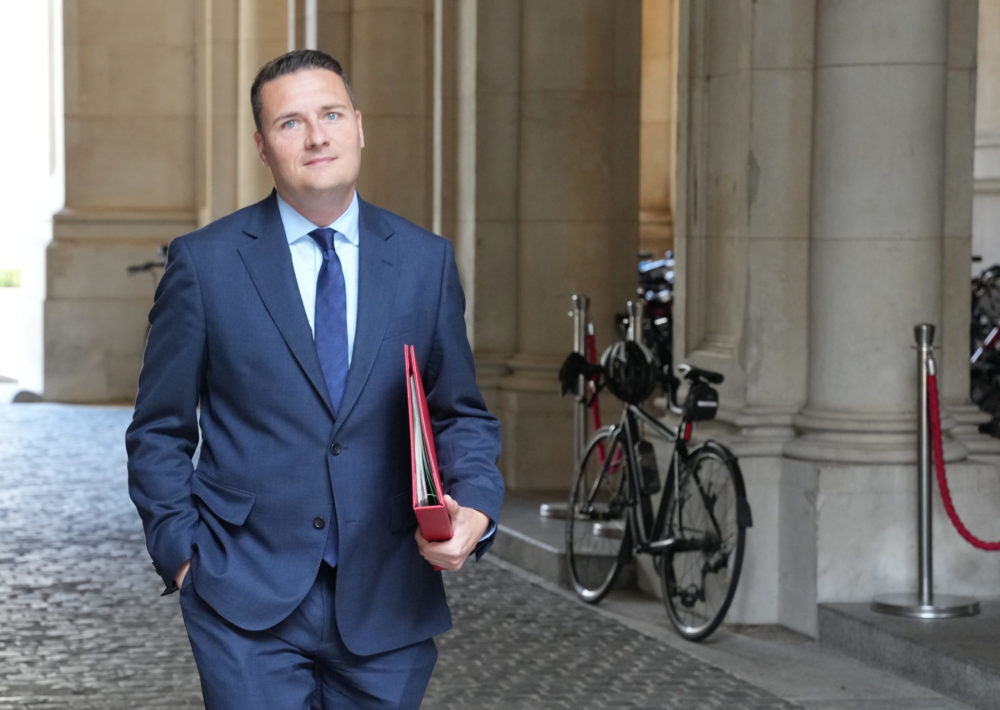
The real Wes Streeting. Photo Jeff Moore/PA Wire

Ben Wildsmith 

I’ve been terrorising my writer pals this week by prompting Chat GPT to produce work in their styles and sending it to them.

It’s an appalling thing to do, rather like emailing photographs of blackened lungs to smokers.

Because, even after reading all that post-structural ‘death of the author’ stuff they accosted us with at university, nobody has really reckoned with the idea of machines replacing us on this level.

We’ve watched cashiers disappear from supermarkets and ordered burgers from those big screens that somehow nudge you towards extra gluttony, as if the absence of human eyes unleashes our abandon.

All of that and the banking apps, satnav voices, and digital assistants have at least posed at centring us in our interactions with them. What’s coming now doesn’t need our grubby, organic input at all.

If anything, we’re a hindrance to its smooth functioning.

[mid-content-banner]

Torrential rain

I’m writing this after a ten-hour day at work and an hour’s drive home through torrential rain. There’s every chance that my memory, technical aptitude, and sense of humour are not in peak condition.

I’m also on another dreary diet, trading in the last vice available to me in the hope of prolonging my presence on our sweet, swinging sphere. Frankly, I’m not in the mood.

I just want a sausage roll, not to be staring into the abyss of Wes Streeting’s smile and assuaging our collective terror with jokes.

I did read a good one the other day, though. What do you call a Welshman with four prostitutes? Pedwar Pimp.

Quality content that, got it off @ChallisMusings Twitter page. I don’t know if he wrote it or just passed it on.

Such concerns are soon to be as quaint as the speaking clock, as cut-and-paste culture is wholly subsumed into a behemothic engine of perpetual creation that is continually refining itself to outpace anything new it encounters.

Here’s where we’re at so far. If I don’t want to write about the sinister jollity of the UK Secretary of State for Health, then let’s have a look at what the machine can do.

Write about Wes Streeting in the style of Ben Wildsmith.

Wes Streeting’s ascent in the Labour Party has been nothing short of remarkable—a rags-to-Parliament story straight out of the political playbook. With his working-class upbringing, Cambridge education, and smooth media presence, he’s managed to position himself as the golden boy of Labour’s future: polished, pragmatic, and permanently in campaign mode.

Streeting is the sort of politician who, when he walks into a room, gives off the distinct impression that he’s already imagining the applause at his first Prime Minister's Questions.

 But here’s the rub: Wes Streeting is trying to be everything to everyone, and in doing so, risks being nothing to anyone at all.

If Keir Starmer is Labour’s reliable Ford Mondeo—steady, dependable, and a bit dull—Streeting fancies himself as the sleek hybrid of politics, equally capable of dazzling the left while purring along the corridors of corporate power. He’s Labour’s ambassador to the business community, and unlike the old guard, Streeting wants you to know that a Labour government isn’t something that will send markets tumbling—it’s a safe pair of hands. Well, his hands, at least.

It took less than two seconds to come up with that. If you’ve read my columns before, you’ll recognise the crass posturing and em-dash-happy reliance on subordinate clauses from pretty much everything I’ve ever done.

I have a go at comedy though, don’t I? Let’s see how it gets on with that.

Make it satirical.

Ah, Wes Streeting. The human embodiment of a focus group in an M&S suit. When he’s not out delivering soundbites to whichever camera is nearest, he’s in a perpetual state of readiness, poised to explain why, no matter what’s happening, it’s a win for Labour, and most importantly, a win for him.

Streeting is that rare breed of politician who manages to be everywhere at once while somehow saying very little of substance—sort of like an Alexa device that only responds with centrist slogans.

 Wes, or as we should probably call him, “The Future of the Party,” according to people who think Keir Starmer is a bit too radical, has developed an impressive knack for being all things to all people. Want someone who’ll stand up to the Tories? Wes is your man. Need someone to quietly reassure the City that Labour isn’t actually going to change anything important? Wes is also your man.

Caution

I’m not going to lie; I’d believe that was me. It’s slightly less offensive but you can probably mark that down to corporate caution on behalf of its owners.

Talking of ownership, who should be getting paid for this? I’ve generated it for free in seconds and sold it to Nation.Cymru.

On the other hand, Chat GPT has plundered my entire professional output to replicate me for anyone who might consider paying for my services.

Most creative people, me included, are deep in denial about how this is going to unfold. Like tribal people having their souls stolen by photography, artists in all fields are feeling this as a threat to their essence.

Culture has already been ironed into flat convenience by the twin steamrollers of commercialism and reproductive technology. Where is your next favourite band coming from if you can order up a new Beatles album on demand?

Let’s give Dylan Thomas the last word.

For even in the coldest machine, there is the spark of creation, the shadow of the poet’s hand. And in the end, we and it are bound together, our fates twisted like the roots of the ancient oaks, deep in the earth, beneath the hum and hiss of the digital sky.

For the price of a cup of coffee a month you can help us create an independent, not-for-profit, national news service for the people of Wales, by the people of Wales.

Get more trusted Welsh news

Choose Nation.Cymru as a preferred source in Google News to see more of our journalism.

Choose Nation.Cymru as a preferred source in Google News

10 comments

Mab Meirion

Clark of Kent would look at home in the back of an old Zil or an 'Aurus Senat' cruising down the Moscow fast lane...

Reply
Mab Meirion

Next to a plaintive bleating seagull chick it's hard to tell them apart...

Reply
Chris Jones

When your current job is taken over by 'robots' and AI, I see a (sort of) future for you as the 'Rick Deckard of the Valleys'. The biggest question of all - is Deckard really human?? Are you? Look into my eyes, butt.

Reply
Jack

Try and get AI to write an anti-woke piece and you will find it will not do so. It has inbuilt censorship. I like free speech and AI will not give it.

Reply
Ben Wildsmith

That's just untrue.

Reply
Mawkernewek

Can you comment on Keir Starmer in the style of Gustav Husak? A Commentary on Keir Starmer in the Style of Gustav Husak Comrades, as we stand at the crossroads of political change in the United Kingdom, we must reflect on the trajectory of leadership under Keir Starmer, a figure who has assumed the mantle of opposition amidst a time of crisis and uncertainty. Starmer, a product of the bourgeois legal establishment, attempts to navigate the contradictions of his class as he leads the Labour Party, a historically working-class movement, through the complexities of contemporary British society. Under his leadership, one might observe a return to pragmatic revisionism—an attempt to reconcile the radicalism of Labour’s past with the realities of global neoliberal order. Starmer's emphasis on law, order, and constitutionalism reflects a deep-seated need to prove his party's competence to the ruling elites. Yet, this very approach risks alienating the popular masses, who once saw Labour as a voice for fundamental societal transformation. The path Keir Starmer has chosen is one of moderation, seeking broad appeal across the class divide, much like the normalization policies implemented in Czechoslovakia after 1968. His cautious approach to policy-making echoes a desire to maintain stability, to appeal to the center, and to neutralize the more radical elements within his own party. In this way, we can draw parallels to the era of normalization, where ideological fervor was dampened in favor of managed stability, quiet compliance, and the rejection of dangerous experimentation. However, history teaches us that an overly cautious leader risks stagnation. The British Labour Party must not merely focus on appeasing capitalist institutions but should also preserve the revolutionary fervor of its roots, which called for the true liberation of the working class. Starmer’s leadership is an exercise in balancing these forces—whether he can succeed in this endeavor will depend on his willingness to go beyond mere rhetoric and embrace the radical reforms necessary for a fairer society. In conclusion, we must observe Starmer’s tenure with critical eyes, recognizing both the necessity of political pragmatism in the current moment and the dangers of losing sight of the broader vision of societal change. Like the political leaders of my time, he walks a tightrope between the demands of his base and the pressures of the establishment. It remains to be seen which side he will ultimately choose.

Reply
Chris Jones

Listen to this comment as a Google notebook LLM generated AI podcast here . Things are getting clever (and scary?).

Reply
Mawkernewek

I like the JS Bach version though: Can you comment on Keir Starmer in the style of Gustav Husak in the form of a JS Bach cantata? Cantata: "Der Führer, der den Weg sucht" ("The Leader Who Seeks the Way") Inspired by Gustav Husak and set to the form of a JS Bach Cantata Chorus (Grave) Oh, Starmer, thou who lead'st the weary throng, In fields of power, where conflict doth prolong, Shall thou ascend and claim the heights of grace, Or fade in shadows, lost in time and place? Aria (Tenor) Wie die Zeiten wenden, so auch das Ziel, Doch bleibt der Schritt oft unsicher, instabil. Starmer wandert, sucht des Volkes Ruhm, Doch schweigt der Wind, verweht das Heiligtum. Shall he rise, or falter in the night? Shall he stand, or vanish from the light? Recitative (Bass) (Solemn, measured) In days of yore, when revolution's flame burned high, The party stood for might of working man, for equity and rights. But now, Starmer walks a line of careful tread— To appease the powerful, to not awaken dread. Like Czechoslovak lands of past, He seeks a normalization that will last. Yet can he see that moderation's chains, May bind his hands, and cool the people's veins? Chorale (Allegro, with vigor) Oh Leader, seek thee balance, firm and strong, But let not caution quell the people's song. For 'tis in fire that iron sharp doth prove, And only with the heart shall nations move. Duet (Soprano & Alto) Kann er auf den Wegen bleiben? Der den Frieden will beschreiben? Doch in Schwäche ist Verzweiflung, Und in Stärke ruht Befreiung. Soprano: Pragmatism guides his careful hand, But to what end—on shifting sand? He leads with law, with measured speech, Yet will true justice find its reach? Alto: To keep the peace, to halt the storm, He quells the fire in reform. But can one lead with tempered heart, And not betray the workers' part? Final Chorus (Largo, profound) Keir Starmer stands where many fell before, Atop the hill, where wind and doubt implore. Shall he, like those of Husak’s age, retain A rule of calm, but built on shifting plain? Or shall he rise, with might and fire anew, And lead the throng to build a world that's true? Coda (Chorale) The time will tell, and fate shall surely show, If Starmer leads to heights, or depths below.

Reply

In reply to Mawkernewek

Chris Jones

Yes, that's pretty amazing. Hmm...needs music score.

Reply
Evan Aled Bayton

Roald Dahl wrote a short story about this and like so much science fiction it has come to pass…

Reply

Leave a comment

Comments are reviewed before they appear.