


Sat, 18th July Cardiff 22°
Nation.Cymru wordmark
Advertisement

Opinion

The Price of Life
By Mark Mansfield
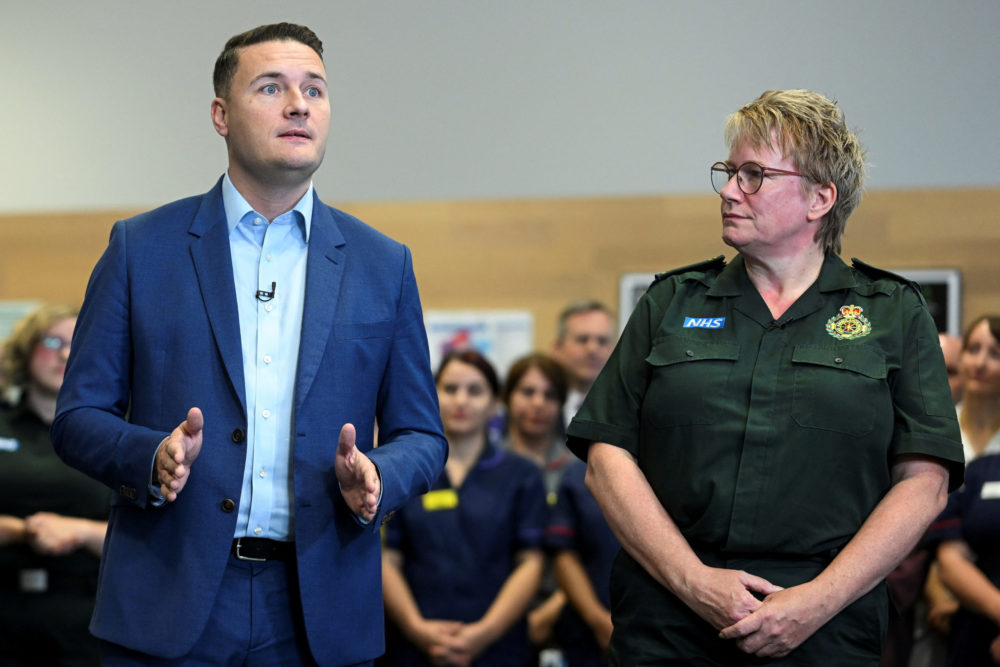
Chief Paramedic of London Ambulance Service Pauline Cranmer with Health Secretary Wes Streeting (L). Photo Jaimi Joy/PA Wire

Ben Wildsmith

I have always believed that assisted dying should be offered to terminal patients. Of all the views I hold, it was the one least likely to change.

Having seen people very close to me endure horrifying, protracted deaths, it’s a belief forged in the furnace of adversity.

I don’t want you to go through what my loved ones experienced, and I’m bloody furious that anybody would compel me to. It frightens me even to think of it.

So, when the issue arrived in the Commons for debate, with a reasonable chance of making it into legislation, I was wholly supportive. Unusually, the debate around it seemed measured and serious.

[mid-content-banner]

Nuanced

The Health Secretary, Wes Streeting’s position was nuanced. He won’t be supporting the legislation, not because of a fundamental objection, but because the current state of palliative care is likely to be an incentivising factor in the decisions people make.

I disagree with that, we all have to play the cards we are dealt in my opinion, but Streeting’s is a respectable pragmatic argument.

Something else the Health Secretary has proposed, however, stopped me in my tracks. In the same week that assisted dying was under consideration, Mr Streeting floated plans to offer weight loss injections to unemployed people.

His case was that the NHS is overburdened with obesity-related illnesses and that they were keeping sufferers out of the workforce. On the face of it, that’s a reasonable position, isn’t it? If conditions can be prevented before they cause complications necessitating expensive care, surely it makes sense to address them.

The problem with Streeting’s position is that these treatments are being proposed only for the unemployed. The proposal explicitly seeks to address a workforce problem with a healthcare solution.

[lower-mid-content-banner]

Frightening

Here is where the instinctive pragmatism of management-class politicians can lead to some frightening places.

The Health Secretary should not be so morally impoverished as to need reminding that the desired outcome of healthcare is improved health. Employment may be a desirable ancillary benefit of treatment, but that is a happy bonus for Liz Kendall, the Employment Secretary, not the business of doctors and nurses.

Kendall, of course, is keen to send work coaches on to psychiatric wards, so cross-pollination between these departments appears to be coordinated in service of the government’s arbeit macht frei ethos.

Often criticised as an opportunistic and overly ambitious politician, Streeting’s arrival at this policy suggests that he is ethically unmoored.

In matters of life and death, the contracts we make with society must be transparent so that ulterior motives cannot be concealed. The prospect of doctors offering treatments to the unemployed that remain unavailable for other patients is antithetical not just to the principles of the NHS, but to the trust placed in the medical profession by patients.

Troubling

So, the question of assisted dying has become rather more troubling. Streeting’s admirable caution on the issue itself is complicated by the wider direction he appears to be taking.

In the spreadsheet used to calculate the viability of treatments for obesity, a column has been created for employment prospects. Such a column is unprecedented. Were assisted dying to become an option in hospitals, is it not concerning that a column detailing the costs saved by patients making that choice would appear in future calculations?

I still support assisted dying, but with considerably more trepidation than used to be the case. I don’t for a moment believe this government, or any likely replacement, would actively pressurise people into euthanasia.

I’m concerned, however, that counselling services designed to explore the validity of patients’ decisions would be vulnerable to cuts the next time a ā€˜black hole’ was discovered in public finances.

If the unemployed can be removed from the deficit column with an injection, so can the terminally ill.

Creating legislation that protects the dying from the juggernaut of cost-saving zeal is work for principled statesmen and women. Do we have them at hand?

For the price of a cup of coffee a month you can help us create an independent, not-for-profit, national news service for the people of Wales, by the people of Wales.

Get more trusted Welsh news

Choose Nation.Cymru as a preferred source in Google News to see more of our journalism.

Choose Nation.Cymru as a preferred source in Google News

4 comments

Jack

Excelllent article.

Reply
Another Richard

I think you're far too sanguine in assuming that no likely British government would actively pressurise people into euthanasia. It might not be an agreed government policy, but that wouldn't necessarily stop it happening, as it does in Canada. https://apnews.com/article/canada-euthanasia-deaths-doctors-nonterminal-nonfatal-cases-cd7ff24c57c15a404347df289788ef6d I am not opposed to assisted dying on principle; indeed until last week I was a paid-up supporter of Dignity in Dying. But I am really alarmed by the slapdash way the government is approaching the matter. It is one of the most delicate ethical issues of our time and needs to be approached with the sort of seriousness that marked the 1984 Warnock Report on human embryo research and infertility treatment. Instead we learn that the PM had promised Dame Esther Rantzen he'd do something, and this takes the form of a Private Member's Bill which has had its 1st reading but has yet to be published. (No, I don't really understand that either.) It will have its 2nd reading on 29 November and MPs will have just 5 hours to debate it. That obviously cannot do the question justice and a better way needs to be found.

Reply
Padi Phillips

I think you may have misread, as as far as I can see not such claim was laid at the door of the NHS, and the claim was made, with some justification, that it is the government who are expressing this arbeit macht frei ethos. Wasn't it the much loved Ian Duncan Smith who some years opined that 'work really does set you free...' Meanwhile, while in opposition as Shadow Employment Minister Rachel Reeves claimed that Labour in government would be even harder on the unemployed that the Tories, this being at a time when the level of sanctions imposed on jobseekers were at a disgustingly high level. The writer also makes it very clear that such 'treatment' would be antithetical to many who work in the NHS and should the proposals become more than thinking out loud I'm fairly certain there would be those in the medical establishment who would very publicly denounce such a policy as wholly unethical. Many people are ill simply because the system has made them ill. It's a matter of proven research that sanctions and the constant stress caused by sanctions and the pressure on jobseekers to find work, often in jobs with awful working conditions and even worse pay that has made them so ill that they then go on to claim ESA and disability payments. We have whole communities where the numbers who are claiming sickness and disability payments as a result not only of occupational illnesses, but also those caused by the sense of hopelessness of ever escaping poverty, either the poverty inevitable with the UK's threadbare welfare system that provides just enough to survive, but not enough to ensure a healthy diet, or poorly paid jobs that still mean claiming Universal Credit and visiting food banks in order to survive. In such circumstances who can blame people for relying on cheap and often less than optimally healthy food, even where it's available locally at a reasonable price. Many communities are food deserts, and getting to the nearest budget supermarket often involves a relatively (within the confines of a low income) expensive bus journey. If Mr Streeting really wants to see more people fit for work he needs to persuade both Liz Kendall and Rachel Reeves to stop the pogrom on the poor started by the Tories and upgrade benefit payments considerably, invest in community mental health services as well as replacing the local community services that have systematically been closed over the past decades, (and yes, it many instances it really does go back to 1979 and Thatcher) invest in new local industry and training and build back the hope people took for granted before the Wicked Witch of Grantham started this neo-liberal nonsense.

Reply
Linda Jones

I fail to see the problem. Surely a living will stating a persons wishes when dying ( backed up by tight regulation) should be acceptable. If someone is already in the process of dying assisting them merely shortens that process. It doesn't shorten their life it shortens their dying. Surely that's better than leaving someone to suffer a long, lingering, painful dying process when all roads lead to death

Reply

Leave a comment

Comments are reviewed before they appear.