Tuesday, 14th July 2026 Cardiff 25° · Clear sky
NationCymru A news service by the people of Wales, for the people of Wales.

Opinion

These shocking stats show why we have to save Welsh now - before it's too late
By NationCymru
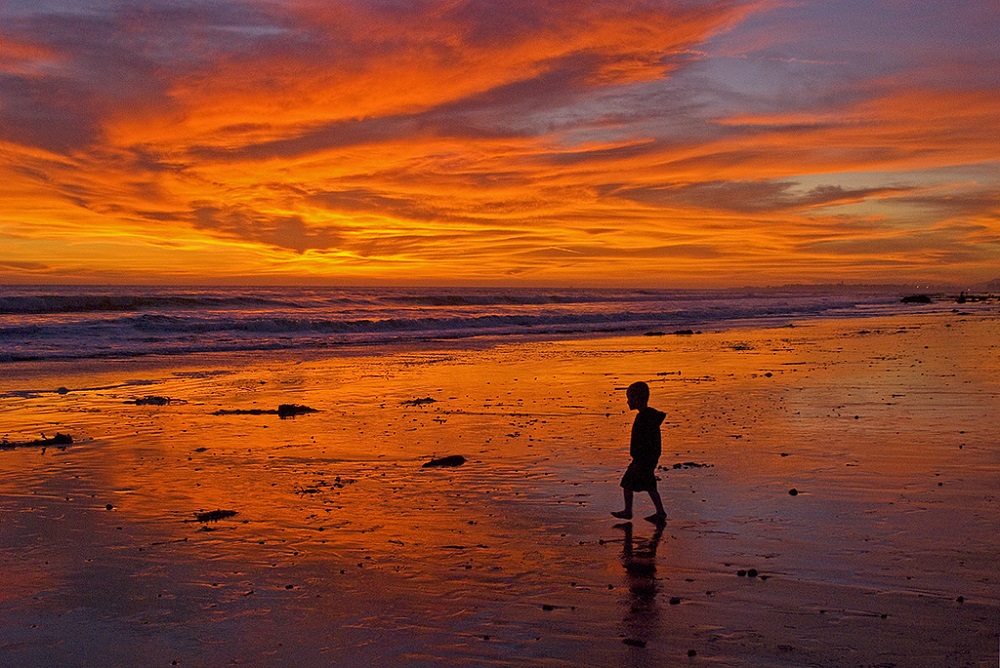
Child playing on a beach. Picture by Damian Gadal (CC BY 2.0)


Abraham Somers Cocks

For much of the 20th century, if someone had said ‘Welsh Wales’/Y Fro Gymraeg, it would have been clear what the speaker was referring to.

In the 1960s and 1970s, there existed a continuous expanse of territory stretching from the top of Anglesey to the Bristol Channel in Carmarthenshire where more than 70-80% of the population spoke Welsh.

In 1961, parishes where more than 80% of the population spoke Welsh covered nearly 40% of Wales’s land area.

Here, Welsh was the language of the community and of the school playground.  Yes, nearly everyone spoke English, but as a second language.

The fifty years since then have been little short of apocalyptic.  The southern half of the then Fro Gymraeg, south of the river Dyfi, can no longer be considered to be Welsh-speaking communities.

Most people in Ceredigion and Carmarthenshire can't speak Welsh anymore, while the percentage of primary school children speaking Welsh at home in 2013 was 27.7% and 22.3%, respectively.

In north-west Wales, things have at least been not as bad; In Gwynedd, 56.4% of primary school children spoke Welsh at home in 2013, and in Anglesey, 37.3%.

I looked at the data to see whether or not Welsh was continuing the hold on out there, and what the future may hold for Welsh in its remaining territory.

To do this, I looked school census data from 2013, 2016 and 2017 for primary schools across Anglesey, Gwynedd, and neighbouring Conwy.

I also compared them to figures given as contextual information in Estyn reports dating back at least 10 years.

Gwynedd and Anglesey

Those of you who have read my blog about Welsh in Gwynedd will know that even there, there are areas where Welsh-at-Home (WAH) children are in the minority:

  • Bangor
  • Most of coastal and southern Meirionnydd
  • Enclaves elsewhere such as Abersoch and Beddgelert.

On Anglesey, most of the coastal areas are no longer Welsh-speaking.  But how are the remaining Welsh-speaking areas doing?

The good news is that many areas do appear to be holding out, for now at least.  The bad news is that other areas are experiencing a rapid decline.

In Criccieth, 64% of children spoke Welsh at home in 2004.  Thirteen years later only 42% do.

Beddgelert had half its children speak Welsh at home in 2005 but now it’s less than 10%.

In Llanberis, the iconic Welsh-speaking base of Snowdon, 69% of children in 2013 spoke Welsh at home, in four years it has fallen to 51%.

In the same four years, in Bala, it has fallen from 60% to 49%.

Up in Arfon, the English-speaking enclave of Bangor has stopped being an enclave; Chwilog and Tregarth at the head of the Ogwen valley have already fallen.

In the latter, the WAH in its primary school has fallen from around 50% to 26.8% in less than 10 years, and the trend appears to have spread further up the valley.

The figure for Ysgol Abercaseg (Babanod), the infants' school in Bethesda, fell from 70.6% to 55.7% between 2013 and 2017.

Although the town of Caernarfon is somewhere that is holding out well, the percentage of primary school children speaking Welsh at Home being higher in 2017 (78.7%) than in 2013, one of its four schools appears to have fallen from 60% in 2005 to 38.2% twelve years later.

De Facto segregation appears to have emerged.

Census problems

Areas that are/were solidly Welsh-speaking are fast reaching a tipping point - sometimes so quickly that you can count the years on the fingers of one hand.

The national census that everyone focuses on is so incredibly useless at revealing such changes, or giving any correct impression on the state of Welsh as the home language in any given community.

Who would have thought that only 32% of primary school children in Dolgellau speak Welsh at Home (2017), when the 2011 Census said that 64% of the town’s population could speak the language?

Who would have guessed that less than 10% of children speak Welsh at Home in Holyhead when the 2011 Census said that 42% of its population could speak Welsh?

The truth is that the general census, which only asks you if you can speak Welsh, can be positively misleading.  We’re misleading ourselves as to the strength of the Welsh language, and with dire consequences.

Why does it matter?
I’ve heard some people say that it doesn’t matter if the Fro Gymraeg disappears.

They think that the fact that more people outside of the traditional Welsh-speaking areas are learning it as a second language is enough to compensate.

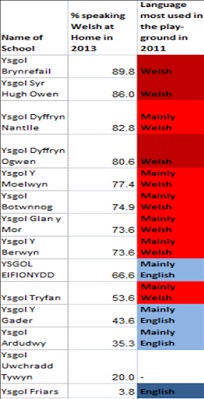
What the table on the right shows, is that there is an indisputably strong correlation between the percentage of children speaking Welsh at Home, and it being used in the playground.

In other words, in order for Welsh to be heard in school playgrounds and in skate parks, you need to have children who speak Welsh at home, and they need to be surrounded by other children who speak Welsh at home.

Otherwise, they will just speak English, regardless of the medium of instruction.  For that reason, there needs to be communities of Welsh-speakers, not just individual Welsh-speakers scattered around the place, as is increasingly the case.

For that reason, for it to truly be a living language, it needs to have territory.

For that reason, the survival of the Fro Gymraeg is the difference between Welsh being a living language and it merely being a subject taught at school.

If a language reaches a stage where there are no school playgrounds left where it can be heard, can it still be considered a living language?


Support our Nation today

For the price of a cup of coffee a month you can help us create an independent, not-for-profit, national news service for the people of Wales, by the people of Wales.

37 comments

W. Habib Steele

You've described the problem and stated what needs to happen to save the Welsh language. What specific proposals do you have make it happen that Welsh is heard in school playgrounds and in skate parks, that children speak Welsh at home, and that children are surrounded by other children who speak Welsh at home?

Reply
Jig

Brawychus, ond yn wir. Dan ni sy'n byw yn y 'fro' yn gweld hyn yn digwydd. Mae mewnfudwyr yn rhannol cyfrifol: 'mesul tŷ nid mesul ton....' . Beth allen ni wneud am hyn a gwleidyddion y gwrthod gweithredu, yn wit yn hybu'r llif mewnfudwyr trwy ganiatau miloedd o dai di- angen! Nid yw addysg yn ateb chwaith, mae' r argyfwng llawer rhy gymhleth. Er enghraifft, Beth sy'n achosi i rieni Cymraeg ddefnyddio, ie dewis defnyddio saesneg gyda'uplant? Hunan-laddiad yw hyn oll Deffrwch, Gymry! Neu fel Seithennyn, cysga'n dawel a gweld ein hiaith, ein unig brawf ddilys o hunaniaeth,yn diflannu gyda'r llanw nesa.

Reply
Dafydd ap Gwilym

All part of the British plan. Thatcher did away with so many secondaries forcing so many into one big comp that we do not have the larger pool of rugby players to call on as we did. Just happened to co-incide with the last upserge in Welsh rugby. Anyway, another distraction for the few while the many grow stronger!

Reply
anon

As long as we blame outsiders for everything, Wales will never move on. Education in Wales in the 1980s was managed at a local level. Thatcher had no power to close schools and did nothing of the sort. The Conservative governments that she and Major headed did, however, put Welsh on the national curriculum, pass a Language Act that gave Welsh official status in the public sector and hugely increase public spending on the language. There is no British plan to get rid of Welsh and there never has been. Frequent ignorance and occasional hostility are not the same as an active programme of destruction. Even the fabled Welsh Not was never local or central government policy but rather the whim of individual teachers. Even the Tudor state paid for the bible to be translated into Welsh thus giving the language immense cultural significance. The British state has failed Wales in a great many ways but the language is not of them.

Reply
sibrydionmawr

Not actually a true reflection. I don't know why you mention Thatcher, as she was nowhere to be seen when the sub-par and ineffectual Welsh Language Act was passed in 1993, and Welsh whilst Welsh was added to the plans for the National Curriculum in 1988, it didn't take effect until 1990, and even so the implementation of the policy was patchy, underesourced and ineffectual - it's still the case today. And whilst Welsh might have official status, it certainly doesn't have parity with English. Depsite the strengthening of language legislation with the 2011 Welsh Language Measure, Welsh speakers still find themselves subject to atrociously poor services if they want to use Welsh. The concessions towards the Welsh language are nothing but risible. They represent crumbs from the table, a crust thrown at Welsh speakers in an attempt to keep them quiet, pacified. The Welsh language legislation only applies to the public sector, so the increasingly promoted private sector remains largely unaffected by the demands of the inadequate legislation. Labour abstained over the Welsh Language Act in 1993, claiming that they'd revisit and 'do the job properly' in the words of Rhodri Morgan. 1997 came, and 2010 went, and we still had no decent legislation that adequately safeguarded the Welsh language, which is still the case today. As for 'hugely' increasing spending on the language, that is fundamentally true, but masks a reality that previously not anything like enough was spent on the Welsh language, and even increasing it to the level spent today represents a mere 0.16 percent of the Welsh government's budget - not nearly enough when it's considered that government spending on the Basque language is almost seven times higher at a full 1%, (2014 figures - it's likely a lower figure now, certainly in the case of Welsh). It's basically a case of smoke and mirrors, as it would be hugely unwise for a government to go on a full frontal attack on the Welsh language, but wise indeed to attempt to kill the language with apparent kindness. There are signs that they are succeeding, as most proponents of the language focus on education, which whilst vital, kind of ignores another vital aspect of language retention, and that is environment: what is the use of a language when there is nowhere to speak it? This has been the case in South East Wales for a long time, several generations in fact. Many of us who live in the South East know people who received their entire education in Welsh, and yet some years after leaving formal education have lost the confidence to speak Welsh. This represents a waste. It is also the case that the language is losing ground in the former heartlands, and this is also having a huge impact on the viability of the Welsh language as a living language. Oh, and the Tudor state's funding of the translation of the Bible into Welsh wasn't some act of enlightened kindness, the idea was that Welsh speakers could compare it with the English version, and so acquire English more rapidly. However, this was 1588, and the majority of Welsh people remained resolutely Welsh speaking. There is also to be considered that the Welsh remained sympathetic to Roman Catholicism for a long time after the establishment of the Church of England, and had stolen a lead on the English church by publishing religious material in Welsh - indeed, the the first known printing press in Wales was used for this purpose, and the authorities would have been wise to this, and would seek to counter it. I assume that you must not be a Welsh speaker, as it appears to me to be naive in the extreme to believe that all you outline has improved the situation of the Welsh language. It's true that we must stop blaming outsiders for what's happening, but the alternative is going to end up being quite nasty as we saw in 2001 when a brave Seimon Glyn and others spoke out and highlighted what was, and still is happening. The most glaring aspect of the result of that period, which saw the creation of Cymuned, was the traitorous stabbing in the back of that organisation by the likes of Plaid Cymru and Cymdeithas yr Iaith Gymraeg who saw their positions being seriously challenged by a movement that was actually relevant to ordinary people of Welsh speaking Wales.

Reply
paul-neath

I have too say that I hear more Welsh spoken in my home town of Neath than I did on the streets and in the pubs of Cardigan on a visit there 3 years ago. Many more English accents there I found. Am currently learning the language through the SSIW Course on the computer. Hopefully those lucky enough to be first language Welsh speakers will use the language and make sure their children use it too.

Reply
Cymro Cymraeg

Erthygl call, onest a chywir! Mae angen i blant a ieuenctid clywed a profi'r iaith Gymraeg fel iaith 'normal' a chyffredin pan maent yng nghwmni eu cyfoedion yn y 'Scouts' clwb tenis, clwb nofio, gwersi offerynnol, ymarferion band, ymarferion hoci ayyb. Ar hyn o bryd, mae'r plant sydd yn derbyn addysg Gymraeg (tua 20% or poblogaeth) yn derbyn ychydig o brofiadau Cymraeg trwy law yr Urdd, Menter Iaith a'r Ffermwyr Ifanc yn y broedd Cymraeg yn unig. Nid yw'r oedolion hynny sy'n medru siarad Cymraeg yn defnyddio'r Gymraeg gyda phlant a pobl ifanc sy'n medru'r Gymraeg. Er bod Llywodraeth Cymru yn gwneud cynnigion addawol a digon didwyll i geisio achub yr iaith ac er bod arweinwyr y sawl strategaeth cymunedol llawn egni ac yn chwysu gwaed i geisio sicrhau dyfodol cadarn i'r Gymraeg, nid wyf yn rhagweld y bydd yr iaith yn goroesi o gwbl ar ddiwedd y ganrif hon

Reply
Capitalist and Welshnash

Do you want Welsh to live or do you want it to die? If you want it to live, we must establish a 'Bro' where Welsh is the only official language. English is too strong for anything else to work. We must get highly and very efficiently organised within the northern half of the traditional Bro Gymraeg and accept we are going to have to stop being nice for a change.

Reply
Dafydd bates

"Stop being nice for a while" biau hi !!

Reply
Capitalist and Welshnash

Yes, dyn ni wedi ceisio popeth arall er mwyn bod yn neis 'we've tried everything else for the sake of bein nice'. Where are the Welsh conservatives at; we have to get organised.

Reply
Cymraes brwd.

Cytunaf yn Llwyr a'r erthygl, ond mae'r sylwad yn y Llif drafod am rhieni sy'n medru'r iaith yn dangos diffyg ymdrech gyda' plant yn sarhau y nifer ohonom sy'n gweithio'n galed i siarad cymraeg mewn cartrefi lle mae un rhiant yn ddi-Gymraeg. Mae fy mhlant i yn rhugl yn y ddwy iaith ac yn gallu symud rhwng y ddau heb unrhyw drafferth. Mae safon ei iaith hefyd yn cael ei ganmol gan yr athrawon yn yr Ysgol. Wi hefyd yn gweithio o fewn addysg Gymraeg. Felly dydyn ni rhieni ddim i gyd yn cydymffurfio ar ystrydeb y mae Cymro Cymraeg yn peintio.

Reply
[email protected]

It is not too difficult to put Scottish Gaelic or indeed Welsh into a home which is English speaking at present but you do need a very different approach plus a new sector has to be created. Indeed it is also the easiest way for adults to learn Gaelic quickly. Adults can learn to speak Gaelic far quicker ( I would say at least 10 times faster) than children under 10 years of age as they have more of the necessary skills to do so. We should not look at the lack of Gaelic or Welsh being in the home other than a new sector to develop but quickly.

Reply
Al

Good points made by finlaymlc. We need a concerted campaign to reintroduce Welsh as a language in the home, which basically means targeting adults who are parents. .Education is not the be all and end all touted by so many. It can help of course. But we need to restore pride in Welsh as a community language, and as a family language.

Reply
Finlay MacLeoid

Yes of course this sector but this age group is extremely late if you wish to have lots of homes that have Welsh speaking children. The age group to target are the 12 to 18 year olds and the 19 to 24 year olds for long term success. Each group need a very different message.

Reply
Finlay Macleoid

This sector has not really been targeted and to get it moving individuals have to start campaigning for this sector. The Government in Wales probably doesn't even know what to do to get the best results as it has put its efforts into the education system as that is what it has been told is the best solution. So they can't be blamed at this juncture if they don't even know some of the answers of what to do for long term stable results.

Reply
Hywel M

I disagree that the census of population's results are misleading. They may be misinterpreted but the census actually reflects the situation reasonably,as long as one looks in some depth at its results, and, as has been done in this article, some further statistics such as those of the Schools' Census (the source of Estyn's figures) are brought into consideration. For example, the recent report on 'Welsh language transmission and use in families' published by the Welsh Government (http://gov.wales/statistics-and-research/welsh-language-transmission-use-in-families/?skip=1&lang=en), included at Table 21 a breakdown of the family language background of 3 year olds, by local authority. It shows in Anglesey, for example, that of the 357 children in households who could speak Welsh, that 217 were in households where both adults could speak Welsh while another 36 were in single-parent households where the adult could speak Welsh. So, one can easily calculate that whereas the headline figure is that 49% of 3-year-olds could speak Welsh, actually the percentage speaking it as a main language at home (only possible where all the adults can speak Welsh) was 34%. Nor, should the School Census result be news unfortunately. Even more detailed results, breaking down the school-level figures by age, from the 2013 Schools' Census were charted here: http://statiaith.com/cymraeg/ysgolion/Ionawr2013/rhuglder_disgyblion_yn_ol_ysgol_2013.html.

Reply
Padog

While wales remains England's colony that can only mean the destruction of the Welsh language. Compare wales to Cornwall and you will see the future of the Welsh language.

Reply
vicky moller

i once thought I heard there was to be an area where people could live without oppressive regulations, could have renewable power and build ecohomes with their neighbours support on only one condition, they lived in Welsh. This seemed too good to be true, and so it was. The burden of changing ones language would be as light as mist if the rewards were the right to live at peace with nature.

Reply
Dafydd ap Ffranc

Only adults can save the language not children. Welsh medium schools are great and we need more of them. But even if every school in Wales was Welsh medium that will never save the language as a community language. Children appear to learn languages fast but they require a lot of exposure to the language to achieve this. Research has shown that hour for hour study and exposure to a language brings results far faster in adults then children. It is imperative that more adults both learn the language and make it the language of their homes to ensure their children get the exposure. There must be a community for the children to be a part of beyond the school to at that requires adults again both using the language in order for them to be exposed to it and for a process of normalisation. In a child's formative years if s/he see's adults speaking English all the time but rarely if at all speaking Welsh then they won't see the language as a normal part of everyday life and won't use it spontaneously themselves even if they have Welsh medium education. 'Cymro Cymraeg' mentioned the role of clubs as well. These are essential parts of the child's community and there is fantastic work going on within them by adult workers and volunteers who shape and mould our children. Be it in Clwbiau Ffermwyr Ifanc or the Urdd or within Scouting or swimming lessons etc. It is clear that their is a lot of passion and dedication here on the part of adults to moulding youth whether they speak Welsh or not. But more of these areas need to become Welsh medium domains. That means more Welsh speaking adults volunteering in great organisations like the Scouts and Guides and more current volunteers learning and USING the language with the children. Welsh speaking communities begin with adults using the language and learning it if they don't already. Only then will children both learn and use it and the language will be passed on and they will become the next generation of of speakers and users who will pass it on to their children. If adults now don't take the language seriously then we can't expect children too and we will have failed them to the point that they won't be in a position to pass it on when they are adults.

Reply
Finlay Macleoid

What you say is correct but without helping those who are not parent as as yet put the language in the home you are not going to have a Welsh speaking home. Secondly, the language used by parents with young children cannot be found in any school why should it be as that is not their territory. It needs another sector altogether. When are the Welsh going to start putting the Welsh language in the home as well as the school. Sadly schools have no chance of doing such work and neither do community organisations unless they are using very specialised courses for that sector. We at the Moray Language Centre have been developing such courses for over 10 years and can see there is need for at least 10 specific courses in this sector. Indeed we have developed 24 different courses altogether for the home for the pregnancy to pre-school (at home) to the 24 year olds. Not an easy task may I say.

Reply
sibrydionmawr

Too much emphasis on education. It's important, vital, but unless Welsh has an economic value then it's just going to wither and die. There needs to be a huge shift if the language is going to survive, and the elephant in the room for me, is the lack of any requirement in the world of work for Welsh in the vast majority of jobs. There is I think, a good case to require the public sector to define all public facing jobs as Welsh essential, and to really plug the fact that all public facing staff are Welsh speaking, in order to encourage people to use Welsh in their transactions with the public sector. Secondly, I think that the public sector should gradually, over a period of perhaps a generation, change the language of administration from English to Welsh, thus further enhancing the economic value of Welsh. There is far too much emphasis on English, but fundamentally, English is 'big enough, and ugly enough' to look after itself

Reply
Bryn-daf

The reason the language is suffering is due to State capitalism based in England dominating everything.....................communities must have land ownership........we must have the power and education plus land owenership to CREATE WEALTH........as Bill Clinton says; its the ECONOMY stupid! (mixed with imperialism!)

Reply
Capitalist and Welshnash

Oh please spare us the ideological economic struggle. Isreal, Quebec, Poland, France, Czech and possibly soon the Basque Country. These countryies made a decision to ensure cultural survival not based upon economic ideology. And it worked.

Reply
Royston Jones

The Last Sigh of the Moor seems appropriate.

Reply
Neil Browning

The elephant in the room: incomers are always noted as a problem, but what about first-language Welsh speakers who *leave* their home areas to work in careers where there are simply no openings where they grew up? This is the other side of the coin of language dilution. Can anything be done about this? Dwi'm yn gwybod... Any schemes to enhance Welsh have to more than cover this exodus in order to make headway.

Reply
Trailorboy

In terms of adults/parents and the language of the home and the community then in my mind there has to be some form of additional incentivisation - something that gives an unquestionable practical answer to anyone who might be asking themselves - why am I doing this. People send their children to Welsh medium schools for all sorts of reasons and there must be many parents who aren't as passionate about the language as you might imagine or who don't actually ever intend to learn the language themselves, but like the idea that their kids might be able to. A Welsh membership club for adults with financial and economic benefits through enhanced promotions and networking is something that comes to mind. Something that could co-ordinate and negotiate discounts on all sorts of things - hotels, B&Bs, holiday attractions, food and drink, travel costs, festival entries, music, hobbies (fishing? etc etc), fashion and beauty products - something where you could somehow earn financial credits for language achievements, whatever they may be and for using the language socially. A club where businesses could get benefits and get a higher profile if they actively use and promote the language themselves. We may be too small collectively to make it fly, but maybe it could be internationalised, with Bretons, Irish, Gaelic, Catalans, Basques, Sardinians and others, to help widen the offering and appeal in terms of destinations, products and services?.

Reply
Trailorboy

As a couple of additional notes on the above - buy-in from Major Sports teams and Unions, would help to get something off the ground - with the ability to offer very enticing rewards, in terms of pre-availability of tickets, VIP treatment or discounts on tickets or merchandise. That could lead to major retailers becoming involved, with their need to address their social responsibilities, promoting local produce etc etc. Also it could be a club with no requirement at all for any Welsh Skills to join up. Members could be given handicaps for example - so 20 for no skills and 1 for fluent and it could have an element of competition linked to it, for those of us who are competetive. The rewards for fluent speakers would be the support they could give to the less fluent - giving a real reason for the fluent and the complete novice to pair-up. Everyone could be rewarded for attracting new members etc etc

Reply
Finlay Macleoid

It is the language of the family and home that creates the language of the community. For close on 140 years English was the only language in the school yet Gaelic was the language of both the home and community where I grew up. How did that happen? Well first of all the language of the home and family is different and it was spoken by all generations. When English television came into the homes then it changed over ten years as its influence was so strong. The English medium school had very little sway in our community therefore it would be wrong to assume in Scotland that Gaelic medium education on its own will have much influence outside the classroom doors, I'm sad to say. Now the biggest question of all here is how to put Gaelic back into the homes and families of those who are 12 to 24 years so the next generation can grow up speaking Gaelic from birth. It can be done without doubt but major changes in attitude have to take place.

Reply
Tame Frontiersman

Some eclectic thoughts; 1. More emphasis on interventions at the point of language use. For example, why might fewer people use Welsh language services or opportunities – at an ATM, enquiries at a council office, a library, in a shop- than might be expected from the number of Welsh speakers in the area? Understand the problem, implement solutions, evaluate their effectiveness, discard unsentimentally anything that isn’t working and share good practice. 2. Smart Technology will be the principle means of intervention. Consider the interaction involving at least 1 person with minimal Welsh language skills. The technology mediates between the speakers with predictive prompts displayed on screens or mobile devices. The technology provides feedback afterwards which allows the learner to practice and improve and gain confidence. The technology might be used to reward (financially) the use of Welsh 3. There are international standards for things like environmental (ISO 14001) and energy (ISO 50001) management systems. They allow organizations to gain accreditation and display their commitment to the world. These and other international standards promote virtuous cycles of plan-do-check- improve. What about an international standard for the promotion of minority languages? 4. Are non-Welsh speaker being handed a moral high ground when they move to an area where Welsh has been traditionally spoken? Explain that one is too busy to give the language serious study - but explain that one is sending one’s “spog” to a Welsh medium school- and one is now a language hero for some and done enough to avoid any unpleasant niggling of one’s own conscience. If I was asked to guess what would happen, it would be that the “sprog” becomes the catalyst for the use of English in the playground and establishes English as the language of post school networks. Has anyone studied this? In many countries the children would attend an “international school” where the principle medium of instruction is English.

Reply
The Bellwether

I have learned and forgotten at least four languages (including Amharic!) as a child and a young adult. None of these languages were officially taught (at me as in a school) they seem to have been 'acquired' or absorbed purely from a necessity to communicate in the countries I happen to have found myself living at the time. On revisiting these countries I seem to be able to fairly quickly regain most of that which I had forgotten even after decades of absence. The trick seems to be able to 'think' in the language rather than laboriously having to mentally 'translate' all the time. If I'm in France I find I can actually think in French and it has meaning. I don't teach languages, and I can only speak from personal experience - does this make sense? As a businessman most of my communications are 'transactional', greetings, curses or pleasanteries with next to zero 'academic' content or rigour. As someone with an advanced scientific education the 'language' for this is Saesneg and maths - can't be helped. Unlike many English incomers I don't and have never 'resented' having to learn the local language but that's not say that some are alot more difficult than others. People might think Cymraeg is on the difficult end of the spectrum but just try to learn mandarin Chinese as a European. Now that is hard!

Reply
Iestyn Lloyd

On Sunday I was talking to someone I had only just met, we were talking in Welsh. He then turned to talk to his very young daughter and talked in English! ?

Reply
Mabon

Where abouts in Wales was this?

Reply
Mike Flynn

Surely the question must be ,after massive amounts of money being spent on trying to to propagate Welsh,why is it still declining. Dare I suggest it is just like Manx,Cornish or indeed the local Norfolk dialect where I live.An outdated method of communication in a global world where English is the international language. That is why this discussion is in English!

Reply
Cofi Dre

Mike - the reason the discussion is in English (mostly - as several contributions are in fact *in* Welsh despite your inability to see that...) is that the blog is in English, the article is in English and the site is predominantly in english. There's plenty of Welsh blogs, and I daresay you don't know about them. You're making the classic British nationalist anglo-supremacist mistake of thinking that what you don't see or know about doesn't exist. It's in English partly so people like you (and me) can contribute. You can't win with the anti-Welsh: if you speak Welsh you 'exclude' them, if you speak English you're proving your language doesn't exist.

Reply
Dave M.

I think it's worth pointing out that the statistics from the 2011 census may not be anything like accurate, since the question asked had changed since the previous census. I think the questions about the four skills (writing,reading, speaking, understanding) may well have put a lot of people off, feeling their Welsh wasn't up to scratch in reading and writing, even though they were native speakers of the language. So the whole basis for all this soul-searching may be a red herring. Doesn't mean we don't have to keep on the alert for ways forward, of course.

Reply
Hywel M

I'm afraid you're incorrect. The Welsh language questions in the 2011 Census of Population were exactly the same as in 2001. Some history of the census question asked in 2001 and earlier can be found in http://www.comisiynyddygymraeg.cymru/English/Publications%20List/A%20statistical%20overview%20of%20the%20Welsh%20language.pdf

Reply
Aubrey wilson

I’m afraid that depending upon government intervention is a sign of desperation. There is only one thing - a practical thing - that will halt the decline and that is for educated welsh-speaking families who have left Carmarthenshire, Ceredigion etc to return from Swansea and Cardiff. Without their on-the-ground leadership nothing will happen. Of course, I understand why they would not wish to do this - they have well paid jobs and live in exciting cities with lots of shopping and museums etc, but you cannot expect a drain of the brightest in such numbers not to have its effect. It is largely a one-way draining of talent. And again, I don’t blame individuals for leaving, but it is the density and quality of welsh-speaking that is important not overall numbers.

Reply

Leave a comment

Comments are reviewed before they appear.