


Opinion
Putin's claim that Ukraine and Russia are one nation has no historical basis - he's just a thug with an army
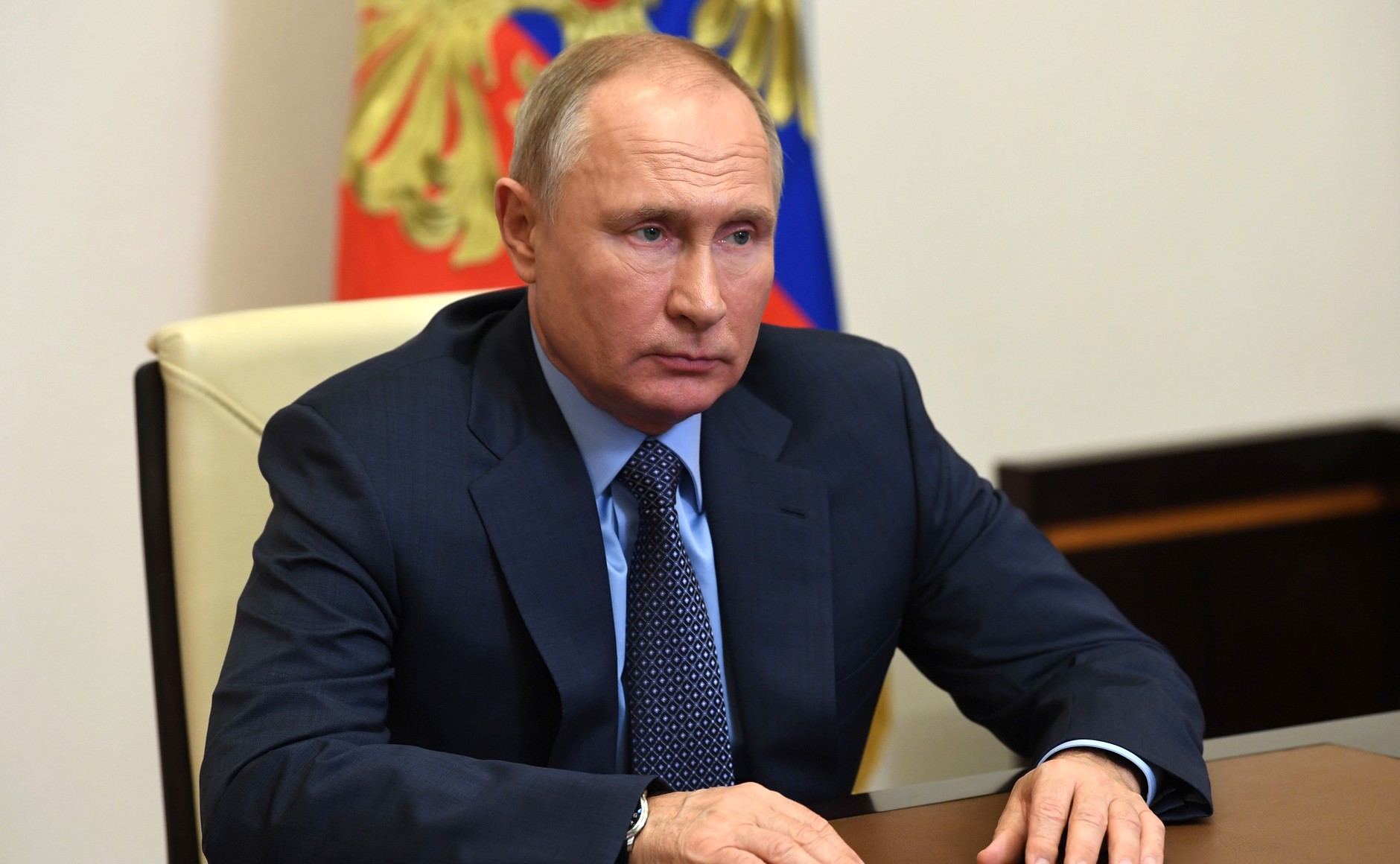
(CC BY 4.0).
Owain Jones, lecturer in history at Bangor University
As war continues in Ukraine, thinking of history can sometimes seem an irrelevant indulgence, a distraction from the world as it is.
Nevertheless, Putin’s attacks on the existence of Ukraine are justified by him as the righting of a historical wrong, a culmination of the natural course of Russian and Ukrainian history. Ukraine’s distinctiveness as a people and independence as a state cannot be denied on historical grounds – in terms of language, culture, history, and identity Ukraine is its own nation. Politically it is its own state. Vladimir Putin has attempted to change this through war and bloodshed.
We have perhaps spent too long considering the inner thoughts of Vladimir Putin, casting him as an expert strategist and second-guessing his grand schemes. But his use of history as a justification for war and murder must also be considered and refuted.
Putin’s own attitude towards Ukraine is explained at length in his long historical essay, ‘On the Historical Unity of Russians and Ukrainians’, published in July 2021. In it he presents his own view of Russian and Ukrainian history, emphasising the basic indivisibility of the two countries and arguing for Ukraine’s status as an integral but subservient part of a wider Russian people led by Moscow.
It is clear from the article that Putin’s historical understanding is a partial and simplistic narrowing of the variety of continuities and discontinuities, the changes, and the political, cultural, and social developments that form the history of the peoples of Russia and Ukraine over the span of nearly a thousand years.
His presumption that Russia is in some way the guardian or supreme authority over Ukraine is fundamentally a situation of modern politics. Its consequences can be seen in the murderous invasion of Ukraine that still goes on. But the supposed justifications of this imperialistic view are historical, and as such can be discussed in historical terms. The argument rests fundamentally on the distant shared past of both nations.
[mid-content-banner]
Coherence
In simple terms, both Russia and Ukraine can trace their origins to the medieval state usually known in English as Kievan Rus’ or Kyivan Rus’, which developed along the great rivers connecting the Baltic Sea with the Black Sea. Its ruling dynasty were of Swedish, Viking descent, but by the time of its emergence as a network of cities and rulers under the Grand Prince of Kyiv, it was fundamentally Slavic in culture and language.
The Byzantine Empire to its south gave Kyivan Rus’ its Orthodox religion, and as well as being a route of trade between the Black Sea and the Baltic, Kyiv stood between Europe to the west and the wide expanse of the Asian steppe to its east.
It was from the east that the Mongols or Tatars came in the thirteenth century, defeating the already-fragmented principalities of the Rus’ and making many of these polities tributary to the Mongol Empire. After this, the south-western parts of Kyivan Rus’ followed a different political path to the north-eastern, with modern-day Ukraine and Kyiv becoming first part of the Grand Duchy of Lithuania and then of the Polish-Lithuanian Commonwealth.
At one point the largest country in Europe, this was a multi-ethnic state, and a multi-confessional one characterised by its toleration of different religious groups – Orthodox, Catholic, Protestant, and Jewish. Its complex constitution featured an elected monarchy and parliament, and its history has recently been discussed in an excellent episode of In Our Time.
Often maligned in later European historiography, the Commonwealth sat awkwardly with nineteenth-century nationalistic ideas of ethnic and cultural coherence and strong central government.
Threats
The imperialistic view of Russian history expounded by Putin sees the emergence of Moscow as the most powerful post-Mongol state, and its conquest of surrounding Russian polities, as the recovery of the lost unity of Kyivan Rus’. The creation of the Russian Tsardom and, subsequently, the Russian Empire continues this re-unification.
In this story, the other polities which emerged from Kyivan Rus’ are incidental, and Poland-Lithuania is something of a bête noire, a nonsensical and inconsistent conglomeration of different peoples which consistently undermined the ambitions of the Russian Tsars to reunify their inheritance.
The experience of Ukraine under Poland-Lithuania was by no means entirely positive. From the mid-sixteenth century, Polish settlement in Ukraine and the spread of serfdom led to Ukrainian Cossack revolts in the seventeenth century. These hugely significant events in the development of the Ukrainian people severely weakened the Commonwealth and enabled Russia to conquer large parts of modern Ukraine. But the independence of these Cossacks was further reduced within the Russian Empire, which had by the end of the 18th century taken much of the rest of modern Ukraine and achieved the extinction of the Polish-Lithuanian state.
In Putin’s narrative, Ukraine and the Ukrainians are only ever passive actors in the more important work of Russia’s empire. Russia’s role is as the re-unifier of the Eastern Slavs and the cradle of Slavic civilisation. This reading of history casts Muscovite Russia as an uncomplicated hero, with western states, most notably Poland-Lithuania, the deceitful and undermining villains.
No wonder a man so taken by these historical fantasies can interpret the choice of neighbouring, sovereign nations to join defensive alliances like NATO as dastardly threats to Russia’s civilising mission.
Distinct
This view also ignores and abuses the wonderful complexities of the histories of Russia and of Ukraine. Muscovite Russia developed into a powerful and fundamentally autocratic empire, but it would be a grave mistake to see this as the inevitable outcome or the ‘pure’ political inheritance of the history of Kyivan Rus’ and its neighbouring peoples.
In Ukraine, the political and social independence of the Cossacks demonstrates a distinct political tradition with its own inheritance from medieval Kyiv, though one eventually undermined and suppressed by the Russian Empire. Within Russia itself, the city of Novgorod in the later middle ages had a republican system of government comparable to the Renaissance cities of northern Italy, until its conquest by Moscow in 1478.
These separate inheritances, these different paths, and parallel developments are what create states and define peoples. The aggressively simplistic view of Russia’s history in Putin’s own essay ignores or downplays these paths, and he denies and distorts Ukraine’s own history in the name of imperialism.
Refutation
I have concentrated here on the pre-modern period, but the egregious oversimplifications of Putin’s worldview are apparent in the modern. Consider his description of the events of 1939 in eastern Europe:
"In 1939, the USSR regained the lands earlier seized by Poland. A major portion of these became part of the Soviet Ukraine."
Not only do the people of Ukraine have no role here, the events of Molotov-Ribbentrop and the division of eastern Europe between Soviets and Nazis during the Second World War are cast as simple, unproblematic events: the ‘regaining’ of territory earlier ‘seized’.
It may be wasteful to attend in such detail to the words of a tyrant, giving a transparently partial, political, and morally corrupt abuse of history more attention than it deserves. Perhaps it is to repeat some of the mistakes of international politics, casting Putin as the master-strategist, the puppeteer.
Putin’s repeated assertion that Ukrainians and Russians are basically the same people can be dissected and disproven in detail, but fundamentally it is not an historical argument but a political one. Its refutation is in the sacrifice and resistance of the people of Ukraine themselves as this war drags on.
Putin is not a complex historical thinker, but a thug with an army. It is easy to mistake a thug with an army, convinced of his own destiny, for a master-strategist or a military genius. That is a fundamental truth of Leo Tolstoy’s portrayal of Napoleon Bonaparte in War and Peace, a work deeply concerned with the falsity of the idea that history is created by ‘men of destiny’.
Putin’s careful plans for the conquest of Ukraine may be beginning to unravel, thanks to the resistance of Ukrainians who reject his idea that they cannot be their own country. We should consider Tolstoy’s depiction of Napoleon in Moscow, when this dictator’s invincible reputation was itself beginning to unravel:
"During the whole of that period Napoleon, who seems to us to have been the leader of all these movements – as the figurehead of a ship may seem to a savage to guide the vessel – acted like a child who, holding a couple of strings inside a carriage, thinks he is driving it."
Owain Jones is a lecturer at the School of History, Law and Social Sciences at Bangor University.
Support our Nation today
For the price of a cup of coffee a month you can help us create an independent, not-for-profit, national news service for the people of Wales, by the people of Wales.
Get more trusted Welsh news
Choose Nation.Cymru as a preferred source in Google News to see more of our journalism.
