


Opinion
Our leading politicians are not serious people
Martin Shipton
I rarely agree with Nigel Farage, but his acceptance of Welsh devolution as an unchallengeable reality shows he has a better grasp of our politics than the Tories who want their party to morph into an Abolish the Senedd outfit.
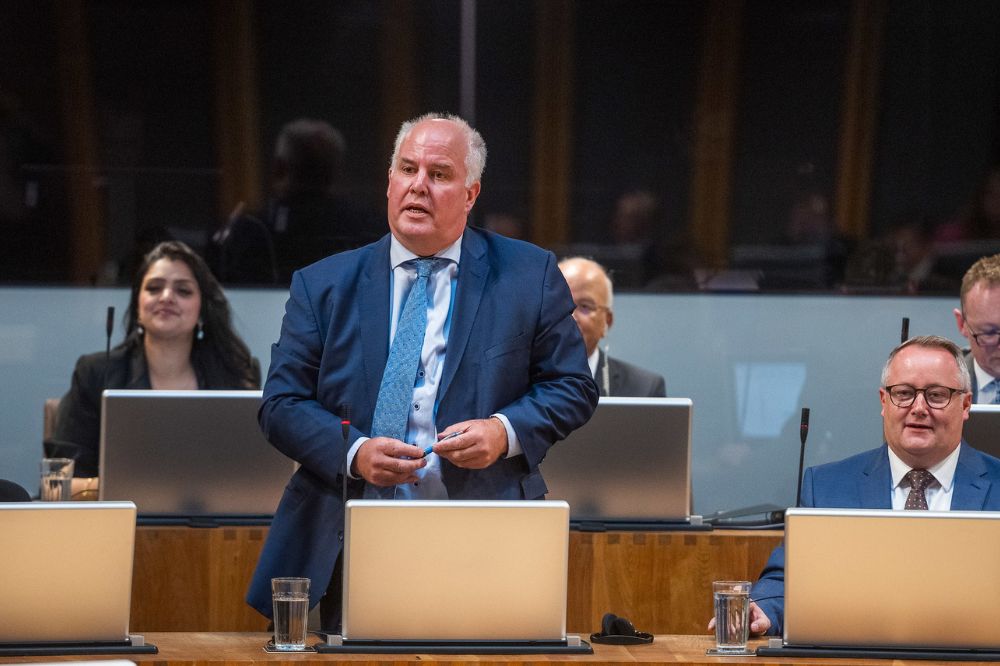
Such nonsensical talk has, of course, been encouraged and enabled by Andrew RT Davies, the Welsh Conservatives’ embarrassing Senedd group leader whose ability to sink to new depths of buffoonery is unrivalled.
Over the summer, Mr Davies thought it a jolly jape to ask those attending the Vale of Glamorgan Show to put balls into different buckets according to whether they wanted to shut the Senedd down or not.
Perhaps he was advised to do so by Conor Holohan, his group’s media manager who used to be on the payroll of former Abolish the Assembly MS Mark Reckless.
People like Joel Williams, the Cardiff councillor who we at Nation.Cymru outed as the frontman of a campaign within the party to back Senedd abolition, think they’re being clever because most Welsh Tories are against devolution.
But that’s a very shortsighted view because young people - who are far less likely to vote Tory - are overwhelmingly in favour of Wales having its own parliament. So closing the Senedd down isn’t going to happen.
If the Welsh Conservatives become an abolitionist party, their opportunity to widen support at the 2026 Senedd election at a time when Labour is likely to be unpopular will be seriously diminished. What is the point of electing politicians to a parliament they want to shut down?
Before the last election in 2021, the hierarchy of the Abolish the Assembly party was dishing out regional list seats to each other as if they were a shoo-in. In the event, despite much hype and publicity, Abolish’s vote actually declined from 4.4% in 2016 to 3.73%.
[mid-content-banner]
Old buffers
Andrew RT Davies and his followers have clearly reached the conclusion that they can’t win a Senedd election, so the only thing to do is to campaign for its abolition, picking up support from as many old buffers and young fogeys as they can muster along the way.
This is an incredibly negative attitude towards politics, and particularly reprehensible from what is the longest surviving party in Wales, despite what many would perceive as the negative baggage it has accumulated over the years.
Of course there will be protest votes to be had in 2026 arising out of disillusionment with Labour over its handling of the Vaughan Gething scandals and 20mph speed limits, as well as the already mentioned disenchantment with Keir Starmer’s government in Westminster.
But with an abolitionist stance not many will be going to the Tories. Instead they’re likely to head towards either Plaid Cymru or Reform.
Rhun ap Iorwerth has impressed as Plaid’s leader, but to succeed in 2026 the party needs to focus on the core issues that concern the bulk of the electorate. And Reform shouldn’t fall into the trap of believing it can scoop up seats on a policy-free agenda based on the appeal of Farage alone.
All these points derive from a recognition that politics in Wales and at Westminster is in a depressingly bad state. At Westminster, after years of Tory austerity and sleaze, we’ve entered a new era of Labour austerity and sleaze.
Ethical behaviour
In Wales, following egregious conduct from a now ousted First Minister who believed that breaking no rules was an acceptable substitute for ethical behaviour, his successor is telling us that decisions made by her own party’s Prime Minister shouldn’t be raised at the Senedd.
There is no sense that political ideas are being thought through. Thought itself is seen as a bad thing. Instead of developing a coherent plan about how to govern while in opposition, UK Labour strategists focussed on blocking candidates who thought somewhat differently to them.
By failing to have critical friends on board who would have pointed out the folly of scrapping the Winter Fuel Allowance, for example, they have made serious mistakes that will cost them dearly.
The revelations about the purchase of clothes for Keir Starmer, his wife, Angela Rayner and Rachel Reeves, with some concealed under a vague description in the register of members’ interests, indicate a certain lack of moral fibre as well as breathtaking vanity. Every time they impose cuts in public spending that impact on a disadvantaged group, they will be reminded of the extravagance of the clothing donations.
Reactive
Politics has ceased to be about ideas and has become purely reactive to unfolding events. Of course it has always been true that unexpected events have forced governments to change course, or at least to divert their attention for a time - the former Tory Prime Minister Harold Macmillan famously responded “Events, dear boy” when asked by a journalist to say what could blow a government off course - but now the concern must be that the party or government doesn’t have a course to follow and deviate from.
If the Welsh Conservatives become a Scrap the Senedd party, everything they say will be viewed through that prism. Equally, the failure of Keir Starmer to develop a compelling narrative for government has left him looking like a poor leader, which is what we must suspect him to be. In the international arena, his virtually unwavering support for Israel’s murderous activities helps enable further atrocities to be committed, with potentially dangerous consequences for us all.
Our leaders are not serious people. It’s not that they are necessarily malign in intent - it’s more that they have neither the conscience, nor the grounding in political thought, that would give them the confidence they need to make a distinct impact for the better that would be recognised.
Aneurin Bevan
I’ve been reading Nye Davies’ newly published book The Political Thought of Aneurin Bevan. It takes as its starting point the notion that while Bevan is obviously revered as the founder of the NHS, he has often been perceived as a practical politician who had his roots grounded in the industrial community of Tredegar, from where he came, but that he wasn’t someone who had developed much in the way of an intellectual underpinning for his political outlook.
In fact, as Nye Davies amply demonstrates, this is a misreading of Bevan that has done him a serious misservice.
Over a period of many years Bevan wrote, in addition to his book In Place of Fear, literally hundreds of articles for Tribune magazine, of which he was for a period during World War Two the editor. The articles show the development of his political thought in four thematic chapters: Class, Capitalism, Power; Parliament, the State, Public Ownership; War, International Relations, World Development; and Ideas, Hegemony, Democratic Socialism.
Mark Drakeford sums up the collective significance of Bevan’s articles in a quote that appears on the back of the book: “When canvassers knock on your door, the key question to ask is not ‘What will you do?’ but ‘What do you believe?’. That’s what this book is all about. The creator of the NHS is well-known, and this book explores the beliefs and values on which Bevan’s work was founded. The one cannot be understood without the other.”
It is difficult to imagine such a book being written about the political thought of Andrew RT Davies or indeed of Sir Keir Starmer. Which partly explains where we’re at politically.
Support our Nation today
For the price of a cup of coffee a month you can help us create an independent, not-for-profit, national news service for the people of Wales, by the people of Wales.
Get more trusted Welsh news
Choose Nation.Cymru as a preferred source in Google News to see more of our journalism.
