


Opinion
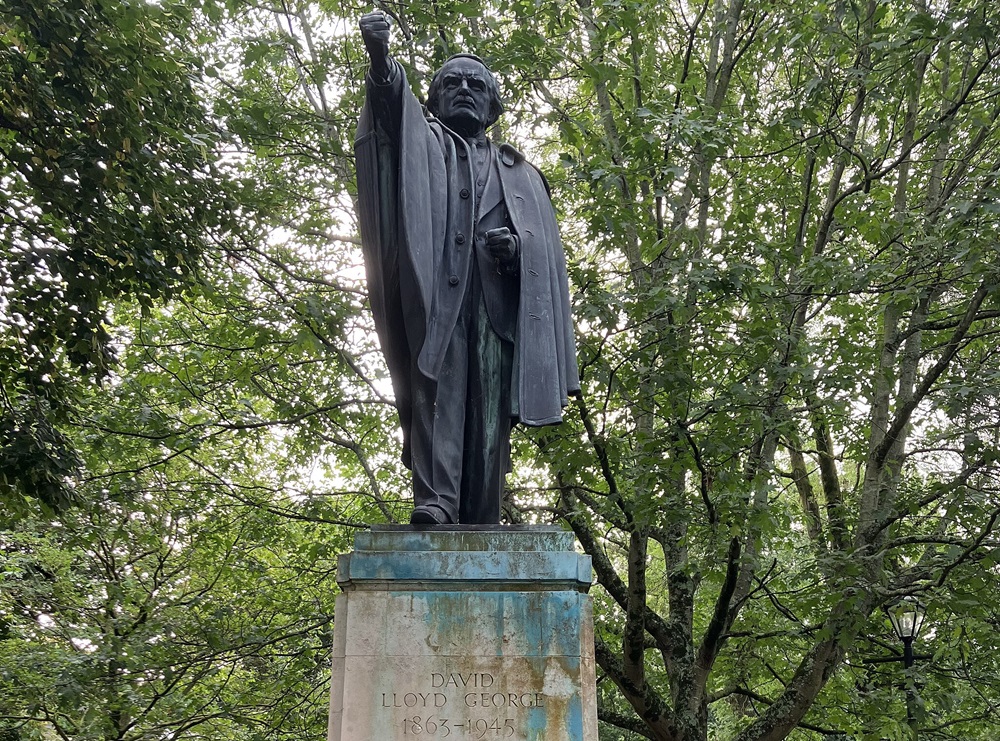
Lloyd George was not a one-dimensional villain and his statue should remain in Cardiff City Hall
Martin Shipton
The demand made by pro-Palestine demonstrators that a statue of David Lloyd George should be removed from Cardiff City Hall because of what is known as “the Balfour Declaration” is misplaced and should not be acceded to.
When I interviewed Sheikh Ahmed Yassin, the founder of Hamas, at his home in Gaza in 1997, he raised with me the issue of the Declaration, a message of support from the British Government for the idea of creating a “national home” for Jews in Palestine.
It’s true that most Arabs, who formed the great majority of Palestine’s population in 1917, when the Declaration was written, regard it as an unforgivable betrayal. In view of the subsequent theft of Palestinian land by those who are euphemistically described as “Jewish settlers”, that’s understandable.
Dated November 2 1917 - 107 years to the day as I write this - it was contained in a letter written by British Foreign Secretary Arthur Balfour to Lord Rothschild, a leading figure in the Jewish community at the time.
[mid-content-banner]
Palestine
The Declaration was quite short, stating: “His Majesty's Government view with favour the establishment in Palestine of a national home for the Jewish people, and will use their best endeavours to facilitate the achievement of this object, it being clearly understood that nothing shall be done which may prejudice the civil and religious rights of existing non-Jewish communities in Palestine, or the rights and political status enjoyed by Jews in any other country.”
Lloyd George’s name did not figure in the Declaration, but he was Prime Minister at the time, and supported the Declaration together with the rest of the Cabinet.
Yet to what extent should he be held responsible for the appalling slaughter of Palestinians being perpetrated by the Israeli Defence Forces today?
Firstly, it’s important to point out that when the Declaration was made, the territory of what is now Israel and the occupied Palestinian Territories had for many centuries been in the Ottoman Empire, a multiracial entity whose capital was at Istanbul. Britain was not the colonial power and was not in a position to create a “national home” for Jews at that time or later.
Contradictory wording
It’s also worth drawing attention to the contradictory wording of the Declaration itself, which as well as committing the UK Government to “use their best endeavours” to create a national home for Jews also stated that “nothing shall be done which may prejudice the civil and religious rights of existing non-Jewish communities in Palestine”.
And Lloyd George, of course, ceased to be Prime Minister in 1922, after which he was never again in government. He died in 1945, three years before the creation of the state of Israel.
Realistically, too, the success of the long campaign by Zionists to establish Israel had more to do with the persecution and murder of Jews by the Nazis and their allies in the 1930s and 1940s than with the Balfour Declaration. Balfour, Lloyd George and the rest of the Liberal-led government in 1917 were not to know that the Holocaust would take place decades later, making the establishment of a Jewish state much more likely than had been the case before, when the idea was not universally popular among Jews themselves.
Beyond these considerations, it’s surely important to look at Lloyd George’s career as a whole before deciding whether he should no longer be regarded as one of Wales’ greatest statesmen, but as a one-dimensional villain.
Cymru Fydd
From a Welsh perspective, he was in his early years in politics a leading figure in the Cymru Fydd (Wales to come) movement that advocated home rule. But he became disillusioned with the cause after a traumatic meeting in Newport where he was howled down and prevented from speaking by hecklers shouting angry comments like: “Enough of this Welsh nonsense!”
He then concentrated on issues relating to Britain.
He was undoubtedly a pioneer of the welfare state, introducing as Chancellor of the Exchequer the old age pension in the “People’s Budget” of 1909, as well as raising tax on the wealthy and reducing it for people less well off. For many, that alone would entitle him to his place on a plinth.
William Manchester, one of Churchill's biographers, called the People's Budget a "revolutionary concept", arguing that it was the first Budget in British history with the expressed intent of redistributing wealth equally amongst the British population.
During the First World War, Lloyd Geprge’s roles as Minister of Munitions and subsequently as Prime Minister were seen as crucial in providing the weapons, ammunition and leadership needed for victory.
Lloyd George personally has probably been the subject of more criticism over his handling of Irish Home Rule than anything else.
The partition of the country into two parts was the result of Unionist intransigence, but as a pragmatist Lloyd George believed there was no realistic alternative.
Northern Ireland
The creation of the six-county statelet of Northern Ireland resulted inevitably in the assassination of Michael Collins, who would have been a great national leader, civil war in the Irish Free State, and many decades of bitterness. Ireland remains a divided island to this day. It would, though, be unfair to blame Lloyd George for that.
In the aftermath of the First World War, and with guerrilla warfare underway in Ireland, it was vital to reach a settlement as quickly as possible. The Unionists had received huge supplies of armaments with the connivance of senior Conservative politicians including Andrew Bonar Law, who succeeded Lloyd George as Prime Minister in 1922. If partition had not occurred, there would undoubtedly have been armed resistance from the Unionists, potentially leading to a massive loss of life. To blame partition on Lloyd George would be unjust.
There’s no doubt that Lloyd George was a complex figure who had an enormous influence on domestic and international politics. To dismiss him as a one-dimensional colonialist at a time when Britain still had the biggest Empire the world had ever seen is a simplistic judgement that ignores the significant progressive elements of his contribution.
He couldn’t avoid the fact that he was the Prime Minister of an imperial nation. Had he attempted to dismantle the Empire unilaterally at that time, he would have immediately been ejected from office.
I asked Russell Deacon, a visiting professor at the University of South Wales who chairs the Lloyd George Society, what he thought of the campaign to remove the former Prime Minister’s statue from Cardiff City Hall. He said: “Lloyd George was an imperfect politician, as all are. He did a lot in his career and people can make their own judgements.
“The Lloyd George Society is not a Lloyd George fan club, and clearly there were things he said and did that many people would not agree with or approve of. But he ceased to have a role in government more than a century ago and times then were very different.”
To suggest there is a cause and effect between Lloyd George’s approval of the Balfour Declaration in 2017 and the IDF’s genocidal bombing of Gaza in 2024 is a stretch too far.
May his statue remain in Cardiff City Hall.
Support our Nation today
For the price of a cup of coffee a month you can help us create an independent, not-for-profit, national news service for the people of Wales, by the people of Wales.
Get more trusted Welsh news
Choose Nation.Cymru as a preferred source in Google News to see more of our journalism.
