Wednesday, 15th July 2026 Swansea 21° · Clear sky
NationCymru A news service by the people of Wales, for the people of Wales.

Opinion

I've felt included and welcomed in Wales – regardless of my language and race
By NationCymru
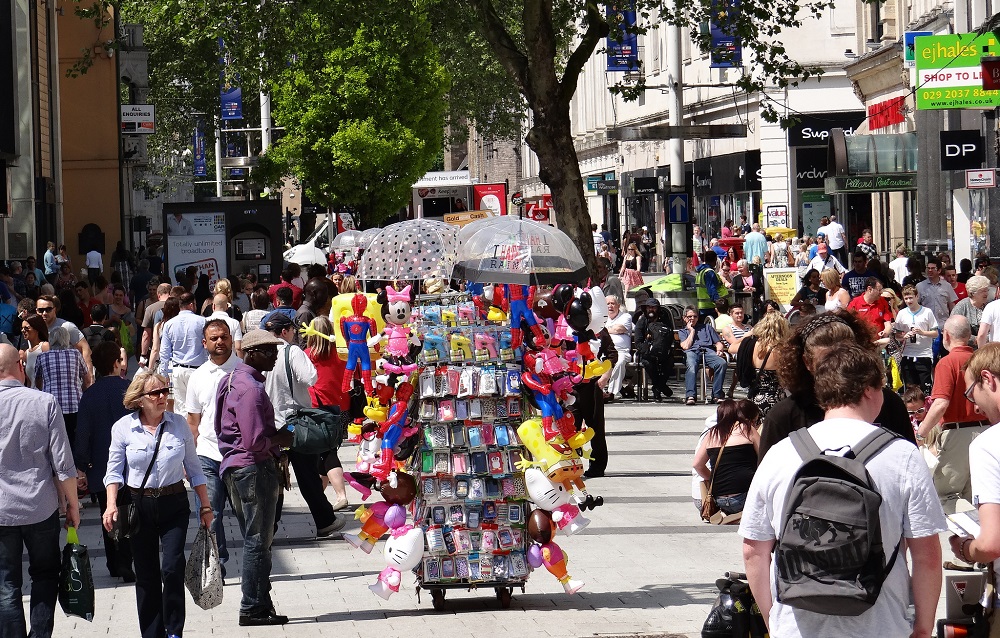
A busy Queen Street in Cardiff. Picture by Jon Candy (CC BY-SA 2.0)

Radha Nair-Roberts

I recently read Oruj Defoite’s complaint on WalesOnline about feeling excluded in Wales because of race and language with disbelief and consternation.

I was puzzled and dismayed because her experiences were in no way related to mine, following my arrival to live in Wales, at the age of 30 in 2006.

Like Oruj, I too am an immigrant with brown skin. I was born in Singapore, to an Indian father and a Malaysian mother. I was raised in Pakistan and then France.

Not a word of Welsh crossed my lips before 2004.

Yet it seemed completely obvious to me to make an effort to learn as much as I could of the Welsh language when living in Wales, in the same way I learned French when living in France.

It seemed clear to me that learning Welsh was the way to truly connect to the culture and history of my adopted country.

After all, Welsh place names from hundreds of years ago were all around me – curiosity and a passion for the land and culture naturally drove me to find out more, and in doing so, I gained so much more than a language.

Rather than exclusion, my first clumsy attempts to converse with native Welsh speakers (including my own husband, a native Welsh-speaker from Wrecsam) were met with nothing but kindness and encouragement.

This gave me the confidence to carry on learning, and to welcome the opportunity to send my children to Welsh medium school.

They are both thriving academically in a truly bilingual environment, slipping seamlessly from one language to the other.

This, I believe should be the future for this country I love and I have chosen.

Dismay

I’m Singaporean by birth, Welsh by choice. I have never once felt that the requirement to speak Welsh influenced whether or not I was able to gain employment.

As a scientist, linguistic ability has been largely irrelevant to the positions I’ve applied for and obtained in Wales.

I do of course realise that some jobs (translation, government, administration etc) might well require Welsh language skills, or at the very least a willingness to learn.

But there are many jobs I am excluded from because of a lack of basic skills in that field – would I expect to get a long-distance haulier’s job without an HGV license?

The same is true for the small subset of jobs in Wales requiring Welsh language skills.

As we live in Wales, is it not entirely natural to expect Welsh residents in certain public-facing roles to speak a modicum of the language of Wales (even if it’s only a few words)?

A small effort to converse with Welsh speakers in their own language in the public sphere would show respect for their decision to live their lives through the medium of their own native tongue.

To conclude, I feel dismay but also considerable pity when reading Oruj’s opinion piece.

I am sorry she has felt unable to access the language, culture and communities of her adopted land.

If I ever had a chance to meet her, I would hope to show her that another way is possible.

I have found that through respect, cultural appreciation, open-mindedness and a bit of linguistic graft, it’s possible to find a meaningful place in Welsh society even as an immigrant with brown skin.

For the price of a cup of coffee a month you can help us create an independent, not-for-profit, national news service for the people of Wales, by the people of Wales.

50 comments

James W. Soares Jones

Diolch, for your well written depiction of your Welsh welcome.

Reply
Graham John Hathaway

The tides Rush over ribbed shores Of our land, Touching ankles lying deep, For those it soothes The softly open mind, To learn, to give, To cherish, to love, For these are qualities Of who you are, And pray will Always will be.

Reply
Dafis

Best article in a long time. Thank you for making the effort, please send out a call for more of your kind to come and live among us and be part of us.

Reply
Colin J Williams

Thank you for this. This reflects my experience as a second generation Welsh man who returned home two and a half years ago having lived my first 50 in Birmingham.

Reply
T

As Osi Rhys Osmond would say you can make Welsh people out of Martians. I read the apology on WOL by the editor responsible for said article,making all the right sounds, and protesting that as a Welsh speaking individual he and many in WOL are pro-Welsh. It's a pity therefore that they are working for an organisation that is so entrenched in the colonised mindset and which contributes on a organisational level to a culture of subservience, internal colonisation, and many other things unhelpful to the aspirations of the Welsh people. The original article unlike this one was poor and contained much muddled logic, supposition and generalisation you have to question the wisdom of its publication, worst and unforgivably was the headline presumably an editorial decision linked Exclusion-Racism-Cymraeg. You don't have to be a rocket scientist to join the dots.

Reply
Graham John Hathaway

The article is one thing, but as Huw Edwards commented, it's up there with the worst. But the editorial header line is as mendacious, and up there with the worst. I've deleted my WOL app. It's the poorest anyway that I see. Always a survey of low quality, adverts popping up in text, and a site this is eternally crashing. Isn't there any proper management of this site, and does it reflect the values and culture of Wales. I'd like to know who funds this news service, by reference to poorly written and subjective personal and one sided rants,and xenophobia. Let there be glad tidings in this season of goodwill to all!

Reply
Elvey MacDonald

Thank for your excellent article Radha. Roedd yn gysur mawr cael ei ddarllen a deall eich bod, fel cynifer o dramorwyr eraill, wedi cael croeso yng Nghymru ac na wnaeth neb wahaniaethu yn eich erbyn oherwydd eich tras neu eich lliw. Pob dymuniad da i chi yn eich gwlad fabwysiedig a gwlad eich plant.

Reply
Radha Nair-Roberts

Diolch yn fawr for these kind responses, and the beautiful poem (speaks straight to my heart). Tolerance and open-mindedness are a blessing, especially if you are a migrant, and I have been so fortunate to have encountered that here in Cymru.

Reply
sianiflewog

Diolch Radha Nair-Roberts am ddysgu ein hiaith ni - iaith dda hefyd 'nde! just had a quick look at the piece in wales online: Pretty obvious you can't won't learn any language with one session a week: language is not an 'academic subject'. It is not easily acquired by reading books and writing essays. Language is more akin to activities such as running or carpentry: the more you do, the b etter you get. The more frequently you do it the faster you learn or improve your competency. It is my personal belief that language is 'taught' in the uk with the aim of proving that language acquisition is impossible, and therefor there is no point in trying. This runs along with the anglo mentality of social/racial/linguistic superiority (aka colonial attitudes) that let 'jonny foreigner' learn my language since we are above the jabbering of 'sub-human idiots'. Whilst learning language is not impossible it requires regular application: if you brush your teeth regularly twice a day fairly thoroughly, you can learn a language. it also helps to have a good teacher who has already learned another language AS AN ADULT - they can remember the pitfalls and tricks that are helpful. Listen to others speaking your language of choice as much as possible. You must take part in the conversation as often as possible. you will find people are very helpful here. Read children's books to start with. Pob Hwyl efo'r dysgu!

Reply
Robert Williams

Diolch yn fawr, Radha. ‘Rydych wedi codi fy nghalon.

Reply
Radha Nair-Roberts

a gwylio Cyw ;)

Reply
kim erswell

Great piece, Radha. As for , Oruj Defoite's, article - Well, that comes from the, Diane Abbot, outlook of finding racism in every molecule of life. Like her I suspect, Oruj never leaves her home without her "race card" in her purse.

Reply
Wrexhamian

Diolch yn fawr i Mrs. Nair-Roberts. In presenting a description of a positive approach (albeit with the encouragement and support of a Welsh-speaking husband), and putting that approach into practice, she has done the language an untold amount of good. We can only hope that others with a non-Welsh background will adopt the same attitude and engage with our culture in the same positive and successful way. I suspect that at present she is in a minority among those born outside Wales, however, although something tells me that that might change with the next generation, through the influence of increasing implementation of Welsh-medium education in the English-speaking areas. Only people like Katz and Ruck will find anything to quibble about with what she has achieved. The real issue is with the article by the woman Defoite, whom she quotes. Miss Defoite's own record of personal failure and bad attitude has been used to promote the anti-Welsh agenda beloved of the English media, usually couched in the form of a spurious and increasingly-irrelevant 'debate' about the value of the Welsh language. We must be on our guard to ensure that the anti-Welsh lobby does not exploit issues of race to place the Welsh language in the dock.

Reply
Neil McEvoy

Welsh by choice. Exactly. Lovely piece.

Reply
iantoddu

Very good piece. Mind you, it is always difficult to access the "language, culture and communities of [an] adopted land" unless you actually live in that land. Oruj Defoite lives in England, and has done for some time- something that was omitted from the original article.

Reply
Isabel Adonis

Dear Radha, Thank you for your article. I'm glad you have felt included in Wales, but that does not disqualify Oruj from her feelings of exclusion.

Reply
Dafis

Try damning the language with even fainter praise. That article in Walesonline was a ghastly piece of shabby prejudice. A person struggles to master a language then blames that language's speakers and surrounding cultural environment for her lack of success. Worse still the Mail uses the material to push its own devious anti Welsh language agenda.

Reply
Isabel Adonis

Hi there Dafis, My understanding from the piece is that the writer has understood that racism and the language go hand in hand. For me identity (through language) is already problematic since to create an identity involves those that are in and those that are out. She feels out. Besides I thought that Welsh people have already made the language a race issue?

Reply

In reply to Isabel Adonis

Dafis

Anglicising everybody is no way to treat anyone's identity. It's not an "in" or "out" matter but a basic part of one's makeup. There are examples of people who seem to be able to integrate into their host communities either easily or with a bit of effort, while another set seem to think that their new community will just get on and adapt to suit them. This is especially so if they come with a strong sense of superiority like a lot of the more recent wave of Anglicised arrivals ( English and people from further afield who just want to be English ). It is that element of superiority that creates the mindset in them that any other language doesn't matter.

Reply

In reply to Dafis

Isabel Adonis

Davis, what does .. Anglicising everybody is no way to treat everyone's identity mean?"

Reply

In reply to Isabel Adonis

Dafis

It means exactly what is written. Evidently people of colour or other nationalities are happy to come to Wales and push the Anglicising agenda. Given the historical exposure to colonialism I'm surprised and disappointed. Rabab below asks " were you not aware that ‘other kinds’ of people have been living in Wales for generations?" Yes indeed well aware. The difference is that until some time in the late 20th century people came from all over especially into the more rural parts and integrated smoothly picking up a working knowledge of the language and adapting into the way of life. Since sometime late 60's maybe later the newer incomers have arrived expecting the host community to adapt to their requirements often making little or no effort to become part of the indigenous community. So any racism in that picture is on the part of the supremacist Angliciser, whether he/she is English or some other nationality aspiring to be English.

Reply
Petroc

As a Wrecsam boy myself it is heartening to read your story and the success you have made of it. As a fellow scientist and welsh speaker I appreciated your clear analysis of the welsh language in work. Nice to have a wide variety of topics on Nation.Cymru. Diolch o galon.

Reply
Rabab Ghazoul

Appreciate your article Radha, but also found it deeply patronising, not to mention concerning in how it served to further exclude and castigate what were someone's existing feelings of exclusion. Those feelings of exclusion that Oruj experienced are her entirely legitimate experience. It's always dangerous when we refuse to acknowledge people's experience of racism, which is real, and not for anyone else to judge. That you haven't had that experience Radha, is wonderful, but others have, important to let them be the judge of their own their experience, otherwise we enter very dangerous territory. That no one on this thread seems to get that is interesting - apart from Isabel Adonis of course, who happens to be a woman of colour. I applaud Isabel's plea and her vital reminder that feelings of racism and exclusion are valid, and its not really for any other individual, even other POC, to claim otherwise. Perhaps Radha if you stopped pitying Oruj, you might hear that she has a legitimate experience. That just happens to be different to yours. Finally, it makes things a hell of a lot easier to have a partner who is a fluent Welsh speaker. Learning another language requires a number of things: time, commitment, means to pay for classes, and access to the means to continue practicing that language, which also has a monetary dimension if only in one's time. There are dimensions of social and cultural capital attached to being able to learn a language, not everyone has all the privileges in place to be able to do so. If you've got a partner you're able to practice with, I suspect that might make things significantly easier, it probably really helps. Please remember to be open minded about the diverse nature of different people's experience, their means, their capacity. Finally (finally) there are shocking and disturbing levels of racism in the responses to your article here alone Radha - "please send out a call for more of your kind to come and live among us and be part of us" - I don't know where to start. Dafis, were you not aware that 'other kinds' of people have been living in Wales for generations? And Kim - "Well, that comes from the, Diane Abbot, outlook of finding racism in every molecule of life. Like her I suspect, Oruj never leaves her home without her “race card” in her purse" - this is vile. If you have failed to understand the vitriolic racism, hatred and abuse that Dianne Abbot has suffered and believe that's someone playing the race card, you need to educate yourself. Such comments for me, disgusting as they are, invalidate and undermine your platform on other vital and important issues, including the Welsh language.

Reply
Isabel Adonis

And there I was trying to keep my colour out of it !! A very articulate heartfelt and measured response Rabab..wish I could have written it myself!

Reply
kim erswell

I'm of black origin, Rahab (touch of Jewish). I find your own comments - presumptious disgusting, offensive, vitriolic, hateful; judgemental, invalid, etc..Just for the record many people - such as myself - say the same about, Diane Abbot - that she plays the race card. By the way not all of us darkies are on the left: even if the left think they own our vote. Many of us have left the plantation...Just saying.

Reply
kim erswell

I meant I have a touch of, Jewish too - not you, Rahab.

Reply
sibrydionmawr

I can't comment on Oruj's experience of racism, which no-one should be subject to, but her comments regarding the Welsh language are quite simply bizarre and unbelievable. Over the years I've met many, many people who have claimed that to get a decent job in Wales one has to speak Welsh, but that just isn't true; it wasn't true back in the mid 80s when I first heard those arguments, and it isn't true in the Wales of 2017. There are of course some jobs that are regarded as 'Welsh essential' which basically requires the postholder to be a Welsh speaker. Languages are a skill, so I just don't see how language comes into the issue of racism, apart from where a language spoken by someone is used as evidence of racial inferiority, which, in the context of the Welsh language usually means also embracing dodgy late nineteenth century notions of race. Quite simply if you don't speak Welsh, and the job requires it, then you don't have the skills to do the job. Would it be 'racist' scenario if the person had white skin? I've heard such claims, but they are ridiculous in the extreme, and and Orujs' comments regarding the Welsh language are equally ridiculous. However, the vast majority of jobs on offer in Wales make no requirements that the post holder be Welsh speaking, which makes the kind of claims that Oruj is making somewhat contrived in the context of the Welsh language. Also, if interviewer are indicating any kind of approval/disapproval to a candidate at interview over an issue being discussed in the interview, then they are very poor interviewers indeed. On the other hand, there are many jobs where the ability to speak Welsh is regarded as being 'desirable', usually completely unrelated to whether or not the job requires Welsh language skills. In the bad old days, this kind of comment served as a useful clue to whether the Welsh language was being used as some kind of tie breaker, where two otherwise similarly qualified people were being considered, the one who spoke Welsh got the job, even though they would probably never be required to speak it in post. I hope those days are long over, but suspect that they are not. Indeed, languages are a lot of work to learn,(I know, having done just that) and do involve a great amount of investment in time, if not money, but fortunately many employers, particularly in the public sector, do sponsor workers' Welsh lessons, and actively encourage staff to take up opportunities to learn the language, so there are always means of acquiring Welsh language skills, if someone really wants it. All the WOL article is in essence is yet another atrocious attempt to besmirch the Welsh language and Welsh speakers by attempting to conflate the Welsh language with racism in an attempt at stirring up controversy, the only difference this time is that the subject involved has a dark skin, so therefore somehow more authentic that if that person had a paler skin. It wouldn't be too difficult to construct an argument that that article was itself quite racist in intent

Reply
Isabel Adonis

My understanding of the original piece is that the writer is Welsh but finds herself feeling excluded because of her colour and her inability to speak Welsh. She is not in a position to separate the intimacy of her skin colour with the intimacy of language.Her feelings are neither good nor bad..they are just her feelings. Interesting how few people have validated her feelings...is this not the exclusion she is talking about? It is my experience that Welsh people have already conflated the language with racism as just about any critiscism becomes an issue of race. Isn't it time that Welsh folks stopped being so innocent?

Reply

In reply to Isabel Adonis

CambroUiDunlainge

Majority of people in and around Ebbw Vale, in fact the entire south only speak English. So some talking about feeling excluded because they do not speak Welsh in an English speaking area completely bemuses me.

Reply
Rabab Ghazoul

Langauges are a lot of work to learn, and money. I'm a Welsh learner, I paid recently for an intensive 5 day course, but I'm self employed, so don't have an employer who is going to sponsor any future Welsh lessons. But I'm fortunate to at least to be working. The learning of a language assumes a certain amount of economic capital, and this is the glaring oversight people seem to make when they insist everyone should learn the language. Personally I'd be quite happy for every single person living in Wales who was not Welsh speaking to have to undertake half a day of Welsh language learning per week until we all became fluent. Obviously this is in some utopian future where money is no object. The reality is that a lot of people can't afford to learn, or at least learn in a sustained way until they reach fluency. It is indeed an investment. If your employer can offer support great, if you freelance and can save, great, but what if you're unemployed, what if you're in receipt of benefits? We have to factor in the reality of life for many people, to state blithely that 'there are always means of acquiring Welsh language skills if someone really wants to' I think is a gross simplification, I hear it a lot, and fails to factor in privilege and the the lack of the financial level playing field for everyone to do so. Where I do agree with you, and I think the Western Mail article was pretty crass, is that of course, if jobs require Welsh language, they require the language, end of. It would be interesting to ask Oruj how SHE felt about the article she wrote, which I suspect was informed by a significant amount of editing from the WM and ends up simplifying the issue. Regardless, trying to undermine Oruj's legitimate experiences of racism gets us nowhere, and if anything attempts to smooth out what are deeply relevant intersections across language, geography, race, class, gender and privilege. We erase these complexities at our peril.

Reply
Rabab Ghazoul

Hi Kim. I'd like to point out that my name is actually Rabab not Rahab. You've made a point of rolling out your extensive use of adjectives to invalidate my points...but have failed to actually address a single one of them. Both you and Radha have very conveniently used your identities to invalidate both Diane's and Oruj's experiences of facing racism, and you've done so, in Wales, in order to gain favour and social and economic capital amongst your White peers...the fact that an article like this is being commissioned in the first place is testament to that. With that being said, I wonder who is 'really' playing the race card? Your lack of empathy as well as your ''presumptious disgusting, offensive, vitriolic, hateful, judgemental, invalid, etc.'' display of misogynoir towards Dianne Abbot, does not stop being so simply because you share the same skin colour as her. I refer to my earlier point '...that feelings of racism and exclusion are valid, and its not really for any other individual, even other people of colour to claim otherwise.’ Perhaps if you stopped and thought about this, you might hear that she has legitimate experiences, that just happen to be different to yours. As to not all POC being on the left, you have a point here. It’s rare, but sometimes there are indeed people of colour who happen to be Muslim hating, Trump-supporting, right wing xenophobes, not many it has to be said, but they do exist.

Reply
kim erswell

I'm at a loss to what your points are or see the logic of your post, Rabab...including this part. "It’s rare, but sometimes there are indeed people of colour who happen to be Muslim hating, Trump-supporting, right wing xenophobes, not many it has to be said, but they do exist..." Er, what!...Seems to make assumptions that I can't fathom out...Could you expand so that someone, not on the the left or uses its rhetoric could understand?..From my experience most racists have been both left and right - though both equally rare. Whether or not I support Israel I'll keep to myself. Joke!

Reply
Rabab Ghazoul

Isabel - sorry :-) It remains the case that yours was the only comment that made sense on this thread.

Reply
Isabel Adonis

Rabab, Well yours made a whole lot of sense too and very well expressed. I debated whether to come out and support you in the light of such hateful comment but decided against it. Best Wishes.

Reply
Wrexhamian

For an explanation of why the private resentments of Rabab Ghazoul and Isabel Adonis are wrong, slightly offensive, as well as inappropriate, see Sibrydionmawr's response above. Any immigrant of whatever colour would almost certainly be welcome if they invested in the culture of Wales and learned the language, and it requires no financial investment or privileged position in order to do so, as Sibrydionmawr also pointed out. The comments of both contributors, and those made by Oruja Defoite, are blatantly anti-Welsh, and the last-named cannot escape condemnation by highlighting her status as a member of an ethnic minority. Accusations of racism are hardly appropriate in reference to the people of a small country that has been on the receiving end of colonialism and racial bigotry for a long time now.

Reply

In reply to Wrexhamian

Isabel Adonis

Hmm..where have I highlighted that I came from an ethnic minority?

Reply

In reply to Wrexhamian

Isabel Adonis

Yes..I see now you didn't mean me! Rabab's post is very measured I thought and well written. I thought she was in the main defending a woman of colour's right to speak about her feelings and I wholeheartedly agree with that. I am an ethnic minority and Welsh and have experienced racism over many years living in Wales. My family in fact were forced to move house because of it.

Reply

In reply to Isabel Adonis

Wrexhamian

Very saddened to hear that, but it's not pertinent to the discussion in hand, which is a comparison and critique of two women's contrasting approaches to coming to a country and learning to live with the culture and language. One embraced it, the other didn't and was isolated as a consequence, prompting her to make derogatory remarks about her host nation. I give you leave to have the last word if you wish, but I shall refrain from replying as I have to practice my Welsh. Pob lwc i ti.

Reply

In reply to Wrexhamian

Rabab Ghazoul

To be clear, I don't harbour private resentments, I'm expressing myself on a public forum, which invites debate around issues that intersect across the culture, society, history and politics of Wales, seems perfectly appropriate to to share my thoughts. A couple of questions: when we say an immigrant is welcome if they invest in the culture of Wales, what does that mean? Language? Certain traditions? Observation of certain customs? What is meant by the culture of Wales? I have no idea what people mean when they talk about the 'culture of Wales' in as much as I wouldn't understand what people meant in generalised terms by the culture of Syria, India, England or Croatia. Do you mean by investment that people need to engage in learning the language? Or that and other things too? Second question: in what way is an accusation of racism inappropriate in reference to Wales? Do you think Wales' experience of colonial subjugation immunises you, as a White majority, nation to racism? Do you think no racism exists in Wales? That position is so extraordinary that all it does is serve to underline your sense of Welsh superiority and supremacy - that somehow Welsh people are innately, inherently unable to be racist. I find it desperately dangerous territory. What many White Welsh people seem unable to countenance is the complexity of their experience, as both a subjugated people, but also as a White majority country that has benefited from the European colonial project, and continues to do so. I never hear White Welsh people acknowledging the privileges of their Whiteness for example. No one is actually denying the subjugation of Welsh people, language, culture, resources, but today, in 2017 at least, that experience is currently different to the colonial subjugation experienced by communities of colour globally. A White Welsh person has yet to experience death in police custody because of their race, White Welsh young men have yet to be stopped and searched by the police disproportionally to their English counterparts, I could go on. The lost opportunity in not recognising the complexity of Wales' position is that you will fail to recognise the potential of your solidarity with others. Instead, in a position of permanent defence, you'll end up doing - precisely what Nair Roberts does in her article - deny that it's possible to experience racism in Wales. It's a deeply lost opportunity to develop solidarity with other oppressed groups based on a shared but also DIFFERENT experience of subjugation. On that basis it will be h and for you truly be an ally, or forge alliances with other oppressed groups, as long as you deny that their experience of racism and exclusion from within your own borders is legitimate.

Reply

In reply to Rabab Ghazoul

Isabel Adonis

Interesting that my support for a black Welsh woman should be seen as offensive, wrong, inappropriate and anti Welsh. I would be interested to discover what if anything you are referring to...Wrexhamian? Are you saying that if you learn Welsh you will be immune from racism? That has not been my experience. My Welsh children were not welcome in the community, nor were they welcome in local schools and despite my Welsh mother , as a family we suffered years of racism and harassment from all levels of Welsh society. A discussion of racism is relevant to this discussion. It is not my experience that there is a welcome in the hillside, but I would say that not everybody was antagonistic to me and my family. At the centre of this conflict is a Welsh nationalism, a fragmentation of Welsh identity - the separation of the Welsh and English language. It is not the case as Davis has pointed out that there is the Welsh and the rest of us, Welsh people included(those who don't speak Welsh) are English wannabees.?! People who have been oppressed all have the image of the oppressor within them. It is a difficult psychological challenge to realise this but it is very liberating. I think it is time for Welsh people to wake up to their mixedness...it is only diversity that will carry Welsh people forward. Time to give up our innocence...

Reply

In reply to Isabel Adonis

Rabab Ghazoul

I can't help but agree with you Isabel, I can't understand why your position in supporting another black Welsh woman is inappropriate or offensive. These are deeply relevant questions, thank you for raising, and for sharing your experiences which are also deeply relevant if not horribly traumatic for you and family. It's so vital to challenge the lazy catch all of 'I didn't experience racism so why should anyone else' articulated by the article in question, I appreciate the perspective you bring, especially this articulation of oppressed and oppressor, true in so many many ways.

Reply

In reply to Rabab Ghazoul

kim erswell

Rabab, I see both you and Isabel are artists - do you know each other?

Reply
Trailorboy

Sounds like a new twist on "I walked into a pub and they...". Let's see where this new line goes...

Reply
kim erswell

“I walked into a pub and they…all asked, if they'd be an opinion piece on, Gareth Bennet in - Nation Cymru..."

Reply
Elin Tudur

Diolch Radha. Erthyg i godi calon. Bu fy mab yn byw yn Singapore an flwyddyn tra yn y Brifysgol. Yr hyn a wnaeth argraff ddofn arno oedd mor oddefgar oedd y gwahanol ddiwylliannau at ei gilydd ('aml ddiwylliant' ar ei orau). Fe es yno ar wyliau hefyd tra roedd yno, ac fe brofais yr un goddefgarwch a'r cyfeillgarwch.

Reply
Benjiman L. Angwin

Erthygl dda. Good article

Reply
Jonthan Edwards Sir Benfro

Thoughts on drawing lines: "The World is like great big onion... What we need is a great big melting pot Big enough enough enough to take The world and all its got And keep it stirring for a hundred years or more And turn out coffee coloured people by the score…" Blue Mink 1. Who else remembers this feel-good anthem from way back? A lot of people hold this view, often subconsciously. 2. The problem with the Blue Mink view is that there is another perfectly valid view, completely opposed. Diversity is one of the riches of being human. Sub-divisions of humanity enrich us. 3. The whole thing is a minefield. Because of the opposing standpoints, there will have to be room for negotiation. If this does not happen then, yes, there will be conflict including war. 4. So, does a country, a society, have the right to draw lines? To say that you are in and you are out? There is no agreement on this - see especially the divided US. 5. Personally, I have noticed a gender divide. Women dislike drawing lines. Men usually feel there is in practice a need to do so. 6. Being a man, I therefore incline to drawing lines - civilised ones based on history, law and statesmanship. 7. The US has an attractive theory about drawing its line. You swear allegiance to a Constitution with your rights spelt out, the best that humanity could devise, they say. You know what you are signing up to or should. You swear allegiance you are in, you don't swear you are out. In theory. But the US has a problem in that a lot of its citizens seriously seem oppose drawing lines - they agree with Blue Mink. This is now (almost) an uncrossable Dem v GOP line. 8. The line I draw is the US one. Applied to Wales it means: Wales should devise its own Constitution spelling out the structure of the Welsh State and the rights of the citizens. The Welsh ratify it. Either the Constitution or the laws then passed by the Welsh Parliament will then define who gets to vote. OUCH! You are then drawing a line, citizen +vote = in. Otherwise out! the Welsh people then have one obligation - to obey all the laws of Wales including the citizenship/voting one. If they don't like it they can campaign to change it. Simples, as the Meerkats used to say. 9. What law should Wales devise? Easy - you pick either the Welsh Rugby Union rule or the Football Association of Wales rule. Whatever - you draw the line. Probably based on residence. So there is a line. 10. Tough examples of lines - look at the Baltic States. They had the problem that they'd been invaded by Russians who had opted to stay after the end of the USSR. 40% in some cases. Well the Baltics were quite strict about this. You qualified for residence based on residence. And allegiance. Scary, eh? What if the Welsh did this to the English.....? In practice, if there are such things as countries you cannot dodge this process. Blue Mink sounds good but not quite the real world. Footnote. I have been involved in Welsh nationalist politics since at least 1981. I have hear lots about dealing with the English somehow. That is because Wales is distinctive. And the language has been recognised by experts as one of the things which has historically kept Wales distinct. And a lot of English resent the Welsh identity. Not because they agree with Blue Mink, for heaven's sake, but because they are colonialist even if its only forcing Radio 4, the Archers and Gardeners Question Time on the good folk of Newport Pembs. But aside from the English Question, i have never ever heard. "So and so is not white. Can't be Welsh." Or, so and so is Welsh (by residence or whatever) but does not speak Welsh so is not Welsh." Never heard this. Don't think Royston and Co are Welsh Ukippers in this sense. But they, and I, do think that Wales should not go into Blue Mink's melting pot because we have some thing to offer humanity, even if its only singing "Myfanwy" as it should be sung. And we welcome all who welcome us.

Reply
Trailorboy

I have wondered how much tuition and education is freely available for people who come to Wales and have no knowledge of the language. I notice that Syrian refugees and asylum seekers are provided with extensive English language lessons and access to interpretors, in order to enable them to participate actively in society, but are we giving equal precedent to Welsh language services? It could be argued that English is enough and is the most important - I don't adhere to that logic, precisely because some people are going to end up feeling excluded in some ways from being able to participate in local communities. Also if people aspire for the small number of jobs in which Welsh is essential or the much larger number of public facing roles where it is clearly very highly desirable, then we clearly need to address that issue through education and tuition. The answer to questions of being prejudicial is to ensure that we have the correct level of provision available for everyone to become fluent in both languages and by demonstrating that we in Wales do not favour English over Welsh, we are demonstrating a nation built on cultural diversity. It is essential that we ensure that we do not give extra tuition in English at the expense of Welsh. We need to assist all people as much as possible along that journey, in order to ease and accelerate the process whereby people can become successful and feel truly content within our society. At the end of the day we want everyone who comes here to be able to experience our languages and our cultural diversity, just as we are undoubtedly enriched by interaction and experience of other cultures. Being able to converse and work in both of Wales' main languages is the best way to ensure that there are no barriers.

Reply
JasRob

Okay, Radha. But here's the thing, what can we learn from Singapore, apart from the lovely "Inspector Singh", to enable Wales to go forward? A monthly column by you, if you could spare the time, using the Singaporean experience, on what direction we could take, would be great! I think we are ready to be humble and disciplined.

Reply
cadarnresearch

The Westminster government idolises Singapore but the reality is that the prosperity of Singapore is built on the back of cheap migrant labour. Try 30% immigration (and rising). No natural resources tThe one of those at Port Talbot). One thing Wales could learn from Singapore is to set up a sovereign fund genuinely for the Welsh people. All Wales' coal wealth squandered over the centuries. If only a small portion of that had been invested for the Welsh nation, we'd be in a much different place now. Singapore would die for the land and water Wales has.

Reply

Leave a comment

Comments are reviewed before they appear.