


Opinion
Investigating the mysterious Mr Thomas - Wales' potential next First Minister
Martin Shipton
Less than 11 weeks remain before Senedd election day, yet considerable doubts remain about one of the two men most likely to become First Minister in the election’s aftermath.
We know - or can easily find out if we don’t - about the political history of Rhun ap Iorwerth and how he came to lead Plaid Cymru. A former BBC journalist who became the Senedd Member for Ynys Mon in 2013, he was elected unopposed to succeed Adam Price as leader 10 years later following a damaging report about bullying and sexual harassment involving the party’s staff.
Ap Iorwerth was widely seen as the Plaid politician best placed to unify the party following a troubling period, and the subsequent rise in support for the party, as well as his own poll ratings, appear to have validated such hope.
Reform UK’s Dan Thomas is not in a comparable position. He has spent virtually all of his adult life outside Wales, despite having been brought up in Blackwood. It’s true that on two occasions he stood as a Conservative Westminster candidate in Islwyn, but no one, including himself, believed that he had a cat in hell’s chance of winning.
His political activity was focussed on the London Borough of Barnet, where he was a councillor for 19 years and where from 2019 until 2022 he was the council’s Tory leader, having previously been deputy leader.
It is well documented how Barnet’s Conservative council with Thomas as a key figure engaged in the mass-outsourcing of front-line services to the private sector.
Barnet council initially awarded Capita a 10-year contract to run the authority’s main internal support services, including HR, finance, IT and estates, as well as outward-facing customer services and the revenues and benefits service in 2013.
The council also went into partnership with Capita, forming Regional Enterprise (RE), to run services including highways, planning, regeneration and development, trading standards, cremation and environmental health.
Critics accused the authority of hollowing out services and leaking money to failing private contracts.
Calls were made for Thomas to resign as deputy leader after an independent council-commissioned review by consultants Grant Thornton concluded that a £2m fraud involving fake property transactions could likely have been prevented if the council’s and Capita’s financial controls had been effective.
The council’s opposition Labour leader said at the time: "The council are clearly not able to manage this kind of commercial relationship, and Capita have demonstrated they are not able to run key services to a basic standard."
In 2022 the Conservatives, with Thomas as leader, were swept from power in what had been Margaret Thatcher’s local council in the biggest swing against it since local government reorganisation in the mid-1960s. The new Labour administration has been taking service delivery back in-house.
Wales has, of course, had Tory-led local authorities, although in recent decades none have sought to push through the kind of extreme, ideologically-driven shift to privatised public services seen in Barnet under Thomas and his predecessors.
Thomas, while still a member of Barnet council although having moved away in 2024, defected to Reform UK in the summer of 2025.
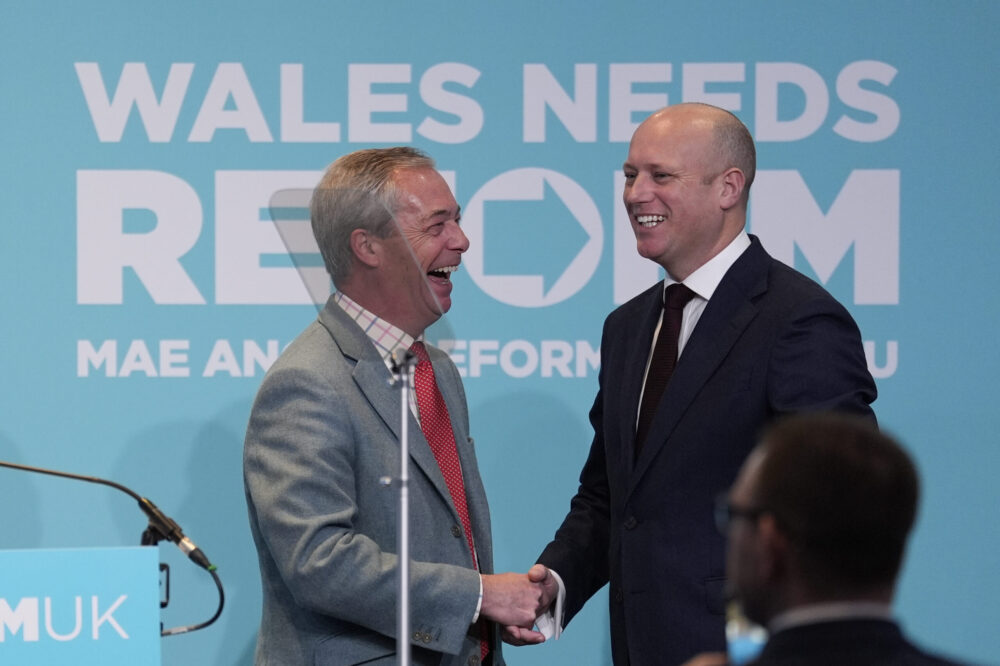
There remain many unanswered questions about his appointment by Nigel Farage as Reform’s leader in Wales.
Nathan Gill
The narrative that Reform would have us believe is that Thomas had decided to move back to Wales to bring up his young family here, and that because of his commitment to Wales and his experience in leading a large council, albeit in London, he was a perfect fit for the leadership role that had previously been filled by the now jailed Nathan Gill.
Yet when looked at more closely, it is apparent that this doesn’t stack up.
A number of sources have told Nation.Cymru that when Thomas moved away from London, he told people there that he was moving to “the West Country”, Bath or “the Cotswolds”, and would be taking up a job in the financial sector.
Reform tried to close this “West Country” theme down, simply insisting that Thomas was living in south Wales. Pressed, the party admitted that he owned a house in Bath, but claimed he didn’t live in it. It was part of a “property portfolio”.
Questions
For us, this opened up a new area of inquiry. We asked a series of questions:
“His former Barnet council colleagues and others say they were told he had sold his house in Edgware and bought a home in the Bath area, where he was relocating for work and to be closer to family members in south Wales.
This is different to moving to Wales in order to bring his family up here.
“When did he buy a house in the Bath area?
“Did he move into it after leaving Edgware?
“If so, when did he move in?
“Why did he buy a home in the Bath area if his intention was to relocate to Wales?
“Was his original intention to relocate to the Bath area?
“What is the address of the house in the Bath area?
“You claim that he is letting the house out. When did tenants move in? Did he buy the house as a “buy to let” property with a “buy to let” mortgage, with a conventional mortgage or for cash?
“What rate of Stamp Duty Land Tax did he pay on the property in the Bath area - the basic rate or an additional 5% because he owns another residential property?
“What is his wife’s name?
“You claim that he is living in Wales. What is his address and when did he move there? Does he own the property or is he renting it? If he has bought it, what rate of Stamp Duty Land Tax did he pay on the property in Wales - the basic rate or an additional 5% because he owns another residential property?
“If he is only renting in Wales, what is the explanation for that at a time when he has recently bought a house in the Bath area?
“Is he living with his parents or his wife’s parents or is this a discrete dwelling?
“Former colleagues of his have told us that he moved to the Bath area to work for a large financial institution. Is that the case and if so what is the identity of his employer?
“Did his accommodation plans change as a result of the plan to announce him as leader of Reform UK Wales?
“To repeat questions I put previously that have not been answered, what are the the circumstances under which he became leader of the party in Wales - was the first approach made by him or the party, and when did this occur; when was it decided by Mr Farage that Mr Thomas would be appointed the leader and on what basis was the decision taken?
“In addition, did the decision entail a change in Mr Thomas’s living arrangements in order to comply with the legal requirement that he lived in Wales in order to be a candidate for the Senedd?
“Does he appear on the electoral register in the Bath area or in south Wales, and if so when was he registered?
“Is his wife registered at the same address?
“Given the opaqueness relating to Mr Farage’s accommodation in Clacton, you will understand why these questions are detailed and designed to produce as much clarity as possible.”
None of our questions were answered.
Letter
Instead, another news outlet ran a story stating it had been shown a letter sent to Thomas from Caerphilly council in summer 2025 telling him that he was registered to vote at an address in the county borough.
For me, this is wholly inadequate. Dan Thomas is standing to be the First Minister of Wales. He clearly has a checkered career as a local politician in London, and deserves to be held to account for it.
There has also been a lack of candour from him and Reform about the circumstances and timing of the decision to appoint him as the party leader in Wales, and about the circumstances of his registration as a resident of Wales. For that to be valid, it has to be his principal dwelling - something the local authority would as a rule take on trust.
When did Thomas come onto Farage’s radar as a potential leader in Wales? Could it be that other Reform members were told they were being considered for the role when Farage had already decided the role would be Thomas’s?
By its very nature, Reform is not a democratic party in the conventional sense. Its leader in Wales is decided not by its Welsh members, but by its self-appointed dictator Nigel Farage, who represents a seaside constituency in Essex.
Some people may be fine with that. I believe it’s a democratic outrage and I suspect many in Wales will agree with me.
Support our Nation today
For the price of a cup of coffee a month you can help us create an independent, not-for-profit, national news service for the people of Wales, by the people of Wales.
Get more trusted Welsh news
Choose Nation.Cymru as a preferred source in Google News to see more of our journalism.
