Opinion
Declaring a new Prince of Wales with no discussion with the people of Wales wasn't right
Ifan Morgan Jones
There’s an interesting scene in the hit Netflix show The Crown where Prince Charles is being invested at Caernarfon Castle, and suddenly expresses sympathy for the political views of those who opposed the occasion.
"If this union is to endure, then we must learn to respect each other's differences,” he says.
“Nobody likes to be ignored, to not be seen or heard or listened to."
Of course, this was an invention of the show made for the purpose of Charles’ own character development. In reality, he did not say it.
And we now know that - after his announcement yesterday that the Prince of Wales title was being passed on to his son William without any suggestion of asking what the people of Wales thought - that he did not think it either.
William becoming Prince of Wales will no doubt be very popular with a large part of the Welsh population. There’s no point denying that.
But it will also be very unpopular with part of the Welsh population too, who will feel very, very strongly about it.
It was a politically divisive announcement. And the now King Charles, having held the title for 53 years, would have known that better than anyone else.
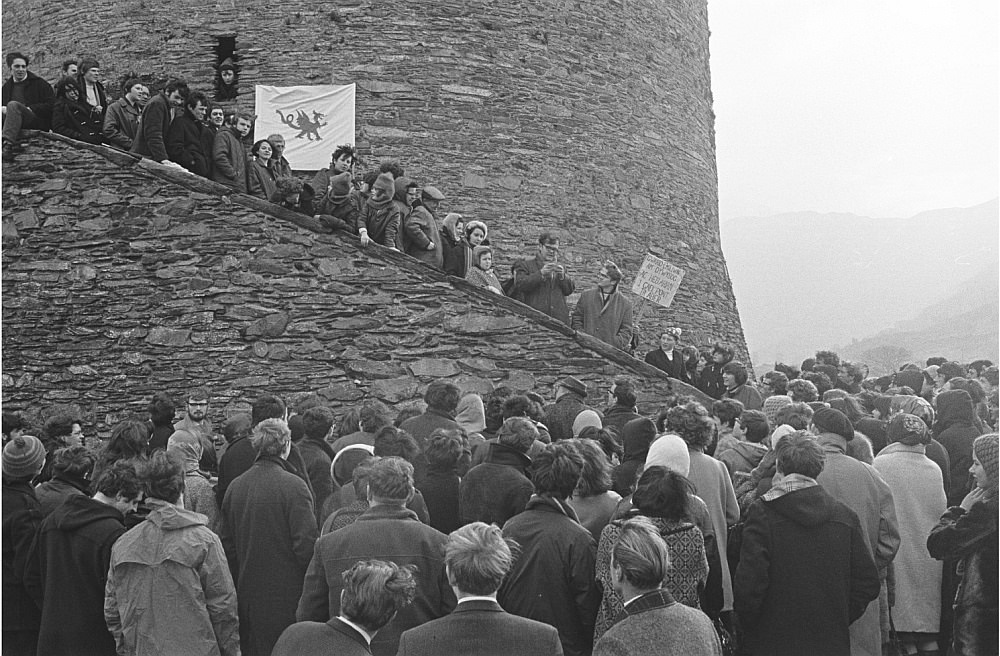
It’s worth remembering that alongside the drowning of Tryweryn, the investiture of the Prince of Wales in 1969 was one of the episodes that most inspired the political Welsh nationalism of the second half of the 20th century.
For all their emphasis on tradition, the institution of the Royal Family doesn't seem to always learn from its history - or perhaps, in this case, have chosen to ignore it.
[mid-content-banner]
Consent
So why does the holding and handing on of the title of Prince of Wales annoy many people in Wales?
Well, it’s nothing against the holder of the post. Prince William is, to all accounts from friends who have spoken to him, a very nice guy on a personal level.
Just as republicans had nothing personal against the Queen or the new King Charles, it’s the institution itself that they think is outdated in a democratic society.
There are ultimately two issues here. The first is the historical one. The title of Prince of Wales was designed to be an insult to the people of Wales.
It was originally created by Edward I, for his heir who would become Edward II, after his conquest of Wales.
The aim was to make a strong and deliberate political statement, by taking a title that had originally meant leader of the people of Wales – ‘Tywysog Cymru’ – and debasing it.
By giving it to someone who would always be less powerful than the King of England, his own heir, he was deliberately undermining the status of the Welsh leaders that he had conquered.
But there are very modern reasons to be annoyed, too. Ultimately, it’s a matter of consent. A new ruler is being symbolically declared for us without any kind of consultation. Our opinion was not asked for.
The designation of ‘Tywysog Cymru’, whose more literal translation would be ‘Leader of Wales’, is a choice that has been imposed on us from without.
If anything it's more a provoking decision than it was in the 50s and 60s because it runs contrary to all that Wales has fought and voted for over the last half-century at least – for a system of government that gives us a voice.
We now have a Senedd, we now have a Welsh Government. But the title of ‘Prince of Wales’ remains something that can just be decided for us by an institution that no one voted for, least of all in Wales.
Parked
What happened yesterday will rankle more because there was no good reason for the title of Prince of Wales to be bestowed in such haste.
The title does not automatically pass on to the heir of the throne. It was only bestowed on Charles himself in 1958, six years after Elizabeth II’s reign started.
There have also previously been long periods of history, such as between the ascension of Edward Tudor to the throne in 1547 and the passing of the title to Henry Frederick Stuart 63 years later, when the title did not exist at all.
Meanwhile, the title as something of great symbolic importance to Wales was largely an invention by Prime Minister Lloyd George in the early 20th century.
He invented the tradition of investiture as a means for the Welsh people to think of themselves as equal partners in the British Empire.
Investing Prince Edward in a castle dressed up with Welsh dragons, leeks and daffodils was the way to demonstrate that.
But this way of seeing Wales, now a more confidently autonomous nation, has gone. We have our own Senedd and Parliament. In a young, modern, vibrant country, such medieval forelock-tugging feels like a throwback.
Prince Charles could easily have parked the title for the time being and, if he insisted on exploring it further, done so with his son as part of a dialogue with the people of Wales.
Scrutiny
People will say that this isn’t the correct time to comment. That it’s insensitive to criticise the Royal Family in any way during a period of national mourning.
Even Plaid Cymru Adam Price said that there would "be time, in due course, for a public debate surrounding the title of the Prince of Wales".
I don't agree. It’s the Royal Family, not the people of Wales, who chose the timing of this announcement. And all these arrangements had been very carefully made by clear-sighted people far in advance of the Queen's death.
Ultimately, if the new Head of State thinks he’s going to be free from scrutiny he’s going to be surprised. It comes with the job.
The age of automatic deference is over – it doesn’t pass over automatically with the crown. It has to be earned.
Support our Nation today
For the price of a cup of coffee a month you can help us create an independent, not-for-profit, national news service for the people of Wales, by the people of Wales.
Get more trusted Welsh news
Choose Nation.Cymru as a preferred source in Google News to see more of our journalism.