


Opinion
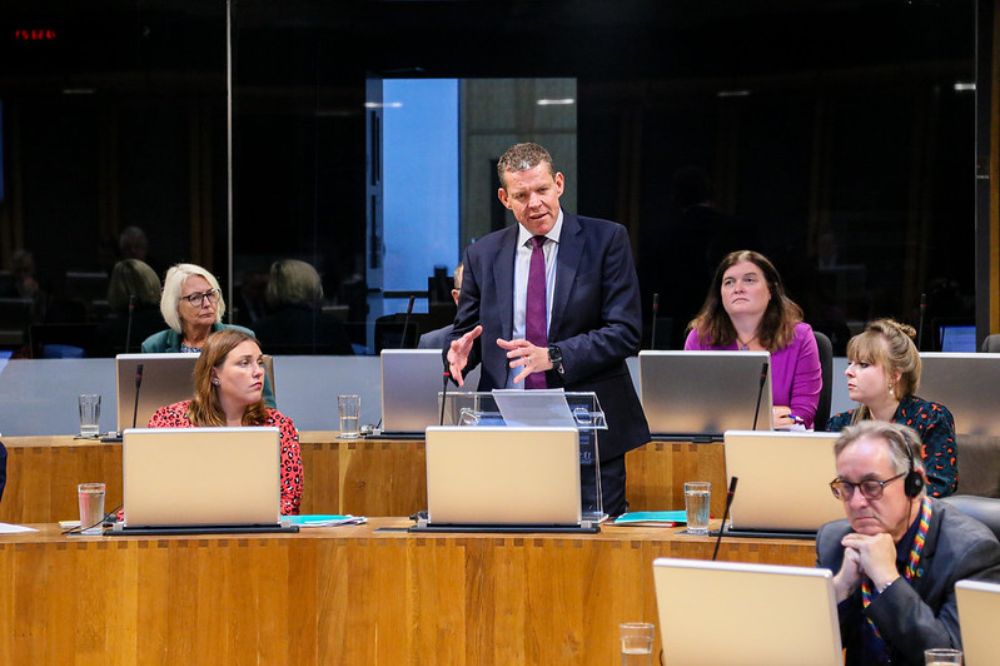
Could Rhun ap Iorwerth really become First Minister in 2026?
Martin Shipton
Can Plaid Cymru shake off its history and take charge of the Welsh Government in 2026?
In August 2025 it will celebrate the centenary of its foundation. Nine months later, at the next Senedd election, it will get another chance to see whether it can measure up to its name in English: The Party of Wales.
In principle it should be well placed to scoop up votes and seats from Labour, which has already experienced a big drop in support since the general election in July. In 18 months time Labour could be even less popular. The new “closed list” electoral system will also create a new dynamic in Welsh politics, making it even more difficult for a single party to win a majority of seats - something that never actually occurred under the system that’s been in use since the first devolved election in 1999.
But Plaid’s future success or otherwise depends on a number of factors, one of which is whether it can break free from the mistakes it has made in the past.
[mid-content-banner]
Mistakes
These mistakes are recounted with great skill and verve by Richard Wyn Jones in his new book Putting Wales First: The Political Thought of Plaid Cymru - Volume 1. “New book” isn’t entirely apposite, because it was first published in Welsh in 2007. But that doesn’t detract from the freshness of the analysis, and the one criticism that can fairly be made of the author is that he took far too long to get it translated. Let’s hope we don’t have to wait another 17 years for Volume 2.
The book explains convincingly how the first two significant leaders of Plaid Cymru - who between them were in charge for more than half of its existence so far - were almost the opposite polar image of the kind of person you’d imagine leading a successful political party.
Saunders Lewis, who became party president the year after a small group of patriots met in Pwllheli to set it up, was an academic, a playwright and a Roman Catholic convert - the last factor in particular being unlikely to make him a vote-winner in what was still largely a Nonconformist country.
[lower-mid-content-banner]
Romantic view
Lewis had a romantic view of Wales’ past that coloured his vision of what kind of future Plaid Cymru should stand for. His top priority was to turn Wales into a country where the only official language was Welsh. This stemmed from his wish to preserve the distinctiveness of Wales’ culture, which for him was very largely centred on the language. Such a view flew in the face of demographic change that had resulted in people from outside Wales coming in to work in the mines and other industries.
Lewis’ view of the Welsh economy wasn’t in tune with contemporary reality either. He wanted Wales to return to a pre-industrial part where the economy was based on agriculture.
His third key policy was based on the constitutional position of Wales. He ruled out “independence”, but supported the nebulous concept of a “free Wales”, without ever defining in precise terms what that would amount to.
With such an eccentric outlook, it’s no wonder that Plaid Cymru’s electoral performance was so poor during the period when Lewis was in charge.
In 1945 Gwynfor Evans became Plaid Cymru’s president, having delayed taking the leadership because he didn’t want his status as a conscientious objector to compromise the party’s position during the Second World War.
Evans is now largely remembered for being Plaid’s first MP - initially elected at the famous Carmarthen by-election in 1966 - and for threatening to starve himself to death unless Margaret Thatcher kept her election promise to create an exclusively Welsh language TV channel.
But in policy terms, argues Richard Wyn Jones, the core of Evans’ view of where the party should be remained heavily influenced by Lewis. He writes: “By examining Gwynfor Evans’ attitude towards the place of the Welsh language, the economy and Plaid Cymru’s constitutional objectives, it becomes abundantly clear that Saunders Lewis’ ideas had a far-reaching influence on those of his successor. Evans not only adopted Lewis’ ideas on the importance of the national community and the particular characteristics of the Welsh nation, but also his ideas and much of his rhetoric on those policy areas that the party regarded as most important.”
Britannic Confederation
In constitutional terms, the most bizarre proposal put forward by Evans was that a Britannic Confederation should be created as a replacement for the UK that accepted “the Crown as a symbolic link” and would include “both Ireland and the Six County State [Northern Ireland]” as members”. As Wyn Jones put it: “It was delusional stuff”.
The final chapter of Wyn Jones’ book is devoted to the 1980s and 1990s, when Plaid was led successively by Dafydd Wigley and Dafydd Elis-Thomas, and then by Dafydd Wigley again. In 1970 Wigley and Phil Williams [later an Assembly Member] had produced a report called Economic Plan for Wales, which saw the party get to grips for the first time with the economic challenges faced by Wales. It proposed the establishment of what later became the Welsh Development Agency, whose remit was to diversify the Welsh economy and attract inward investment. As yet, however, there was no locus for Plaid to take forward such ideas, and the rejection by the people of Wales of a watered-down version of devolution in a referendum in 1979 robbed the party of any incentive to become more pragmatic.
While the small number of Plaid MPs certainly punched above their weight when representing their constituents and holding to account successive governments, the tendency remained for the party to look inward. Hence there were interminable internal debates in the era of the two Dafydds about ideology, and not so much about practical policies that would appeal to voters.
Navel gaze
The arrival of the National Assembly, and later the Senedd, has provided Plaid Cymru with a vehicle through which such practical policies could be delivered. While there is still an inclination among some party members to navel gaze, it’s true that Plaid has been pretty successful in getting some of its policies implemented - both during the period when it was a junior partner of government with Labour between 2007 and 2011, and subsequently, including the period of the Cooperation Agreement with Labour that began in 2021 and was curtailed by Plaid in 2024.
Weeks before he died prematurely in 2003, Phil Williams told me in an interview as he stepped down from the then National Assembly that it was perhaps Plaid’s fate to formulate policy that would later be delivered by Labour.
The arrival of a new Senedd electoral system gives Plaid Cymru the chance to go one better. There are many hurdles to jump, of course, including the need to focus on policies that the bulk of the population relates to.
But if Plaid can leave behind the eccentricities of its past and make itself more appealing to the disaffected than the cliché-ridden, cul-de-sac negativity of Reform UK, Rhun ap Iorwerth could become First Minister in May 2026.
Putting Wales First by Richard Wyn Jones is published by University of Wales Press at £19.99.
Support our Nation today
For the price of a cup of coffee a month you can help us create an independent, not-for-profit, national news service for the people of Wales, by the people of Wales.
Get more trusted Welsh news
Choose Nation.Cymru as a preferred source in Google News to see more of our journalism.
