Opinion
The night we sang calon lân in Catalunya
Aaron Wynne
Today marks two years since the people of Catalunya voted in a referendum to secede from the Spanish state and form an independent republic.
Right now, 12 Catalan politicians are still in prison awaiting trial in Madrid, the Parlament de Catalunya has limited powers, and armed Spanish state police still patrol the streets of Barcelona.
What happened? What’s going on now? What is next for the world’s youngest nation state?
Following 12 hours of heated debate in Parlament de Catalunya, on September 6, 2017, the Law on The Referendum on Self-determination of Catalonia was agreed.
The ruling coalition of the Junts pel Sí and CUP–CC alliances (made up of several political parties) voted for the law, whilst the left-wing CSQP alliance abstained, and the remaining opposition parties left the chamber without casting their vote.
The next day, the Spanish Constitutional Court suspended the law following a successful appeal from the Spanish government, calling it “a breach of Spain’s constitution”.
Despite this, the Generalitat de Catalunya (Catalan government) prepared for the referendum, which was to take place on the 1st of October, asking electors “Do you want Catalonia to become an independent state in the form of a republic?”=
In anticipation of a police crack-down on polling stations on referendum day, the Generalitat de Catalunya agreed a ‘universal census’, meaning that registered voters could vote at any polling station.
Two weeks after the passing of the referendum law, on the 20th of September, the Guardia Civil (Spanish state Police) launched Operation Anubis. The operation’s aim was to subvert the framework of the Catalan independence referendum.
The result of this oppressive action was 14 arrests on the launch of the operation, including senior government staff and CEOs of printing businesses, who were accused of preparing the ballot papers.
The Chief of Mossos d'Esquadra (Catalan Police) resigned without giving a reason, however many speculate it was due to his unwillingness to enforce court orders by the Spanish state, which sought to prevent the referendum.
In the following days, the number of Guardia Civil and Spanish Military Police officers located in various Catalan cities reached 16,000. They continued - well into polling day - to disrupt and dismantle the democratic process, arresting more officials and seizing polling equipment.
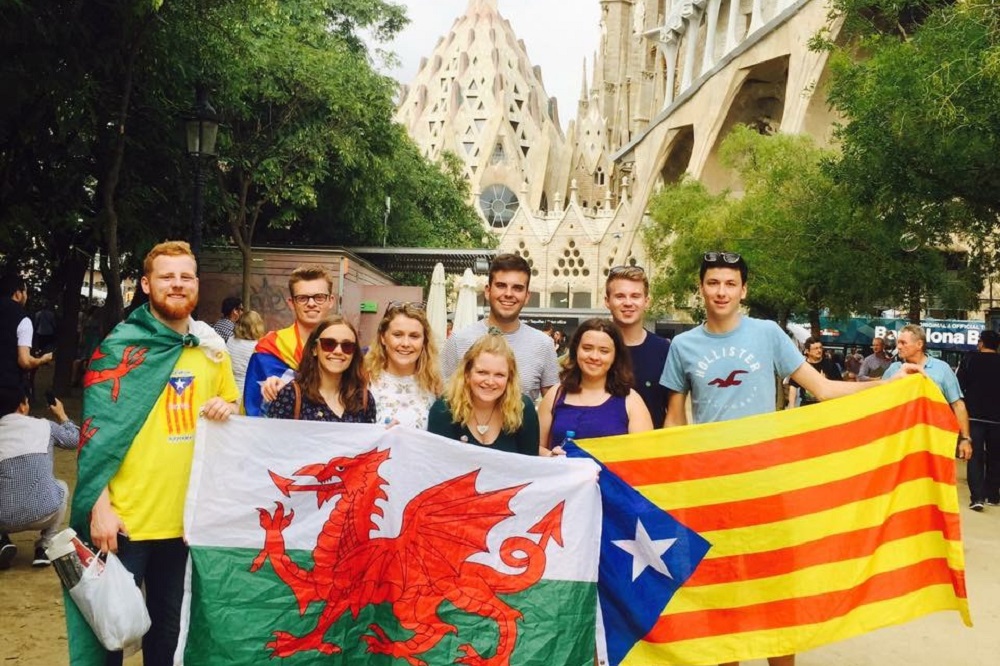
Late Friday night the 29th of September, the Plaid Ifanc delegation arrived at Barcelona Airport. Our goal was to join other young people from across Europe to help protect polling stations on referendum day, and stop the Guardia Civil from confiscating ballot boxes, and allow Catalans to exercise their democratic right to vote - yes or no.
[mid-content-banner]
Referendum day
At 7:00am on the 1st of October 2017, polling stations across Catalunya opened. This historic moment will forever remain a vivid memory of mine. The opening of the polling stations were followed by chants of “votarem” (we will vote) by hundreds of people queuing outside, eager to cast their vote.
At the start, polling day was like any other. People came and went to cast their vote, without fuss or hinderance. We knew it was the calm before the storm. Just after 9:30am, the first images and videos emerged online of clashes between the Guardia Civil and voters.
— Aaron Wynne (@aarwynne) October 1, 2017
We had prepared, to an extent, the day before for the possibility that the Guardia Civil could get violent, but we hadn’t anticipated the extent of their violence on voters that day.
The violence we witnessed was unnerving. The police weren't “clashing with protestors” like the BBC reported back home. They were attacking regular people, who simply went out to cast their vote.
This video is possibly one of the most striking:
— Aaron Wynne (@aarwynne) October 1, 2017
The rest of the day was marked by continued violence. We moved from polling station to polling station acting on intelligence, whilst watching battlefield-like videos flood our social media feed, as the Guardia Civil turned polling stations into blood baths.
At 5:00pm, with only five hours remaining until polling closed, we were told to go to Institut Vall d'Hebrón, a Middle School in the north of Barcelona, and although the police didn’t turn up, this is where we spent the rest of the day.
Plaid Ifanc defending democracy and common decency in IES Vall d'Hebron, Barcelona. pic.twitter.com/3nLNIKIkJi
— Aaron Wynne (@aarwynne) October 1, 2017
At 10:00pm, the polling stations closed, which was followed by a huge cheer, and as the sun set on Catalunya that night, the buzz and excitement was unreal. Hundreds of voters remained outside the polling station to await the result.
As the ballots were counted, Catalans remained cheerful and hopeful. Some began to sing, some began to make speeches, and many danced. As the Welsh delegation, we couldn't let the chance pass us by - so we gave our best rendition of Calon Lân.
Sitting outside polling station in Barcelona to defend polling booths from Police. Crew from Wales singing Calon Lân to show support ❤️
— Aaron Wynne (@aarwynne) October 1, 2017
The “Yes” vote won with a considerably large margin, gaining 92% of the vote. The turnout was 43% of registered voters, but this democratic miracle had darker facts lurking beneath the surface. According to the Generalitat de Catalunya, polling stations representing 770,000 voters were closed down by police. Many people were also likely discouraged from voting from the violent pictures and videos reported by the media.
On 27 October 2017, the Parlament de Catalunya unilaterally declared independence from Spain.
Aftermath
Within hours of the declaration, the Spanish Senate assumed direct control over most of Catalunya’s autonomous powers. Spain’s Prime Minister Mariano Rajoy - with approval from the Senate - fired the Catalan President Carles Puigdemont and his Cabinet, a power grab akin to coup in all but name.
To this day, 12 Catalan politicians remain in prison, and are due to stand trial in Madrid for sedition and rebellion. A UN report has strongly condemned the actions of the Spanish government, as "arbitrary" and labelling the imprisoned 12 as "political prisoners."
Catalan’s exiled President, Carles Puigdemont and his imprisoned former cabinet have vowed to continue the campaign for independence, forever loyal to their cause, even behind bars. Many stood in the most recent European Parliament elections campaigning over Skype.
So what has become of this resounding “Yes” vote for Catalan independence? The issue is in a state of purgatory. We cannot afford to let Catalunya return to being a satellite anchored to the Spanish state, the result was clear.
The media has moved on, looking for the next sensation, but the true Catalan government remains incarcerated on no legitimate grounds. I believe that we can play a role in this cause. We cannot allow history to forget the result of this referendum, the actions of the tyrannical Spanish government or the people who bravely turned out to exercise their right.
Wales and the world has a duty to future generations to talk about and remember this power struggle. History is written by the victorious. Let us use our voices to stand up for those who have been forcibly silenced, as that will speak volumes.
One day Wales will call upon Catalunya to welcome us to the world stage as a truly independent nation.

Support our Nation today
For the price of a cup of coffee a month you can help us create an independent, not-for-profit, national news service for the people of Wales, by the people of Wales.
Get more trusted Welsh news
Choose Nation.Cymru as a preferred source in Google News to see more of our journalism.