


Opinion
Bottoms up! How we can reform Wales to put power back into our communities
Neil Anderson
In one of Laura McAllister’s latest challenges to all of us to contribute towards rebuilding our country she asserts that “real change can’t start through structures or bureaucracies”. While this may be correct, it is also the case that those structures can act to ensure that change does not occur.
In Cymru as elsewhere, top-down politics have done us few favours. But authority, though derived from the top, has scant legitimacy when elections have low turnouts, the voting system nullifies many votes, the elected members are unrepresentative and some candidates with nebulous local connections can be parachuted in. Our democratic process is a blunt weapon, too easily undermined by power and privilege.
The outcomes speak for themselves. Economic policies promoted by financial interests and adopted by fiercely-lobbied conservative governments of either the left or right have drifted well away from the real interests of people – even basic needs. For example, child hunger ought to be anathema in any civilised country, yet one-third of children in Cymru will be hungry tonight. This is not acceptable!
And yes, agreeing with Laura, and with Geraint Talfan Davies, it is in our hands to bring about change. Citizens assemblies must surely be one of the tools we can utilise.
I contend that additionally, we need wider participation. We must embrace everyone in the change process, and we need a decision-making process to which all can subscribe. The assemblies can define issues, set agendas, secure expert opinion, organise debates, make recommendations, but for change to become established, our future society must become fully participatory. The people must decide!
[mid-content-banner]
Four regions
First then, I propose universal access to online voting. That in itself would require some organisation, but Senedd Cymru might find it difficult not to support. While broadband coverage is not complete as yet, and local speeds can be poor, that must be a priority.
We need to insist on access to online voting by all registered adults 16+.
Second, we need to understand, as Laura says, that our existing structures and bureaucracies are often barriers to change. Most local government units are too small and under-financed to be effective, while Senedd members are frequently over-worked. I propose a bottoms-up approach to their replacement.
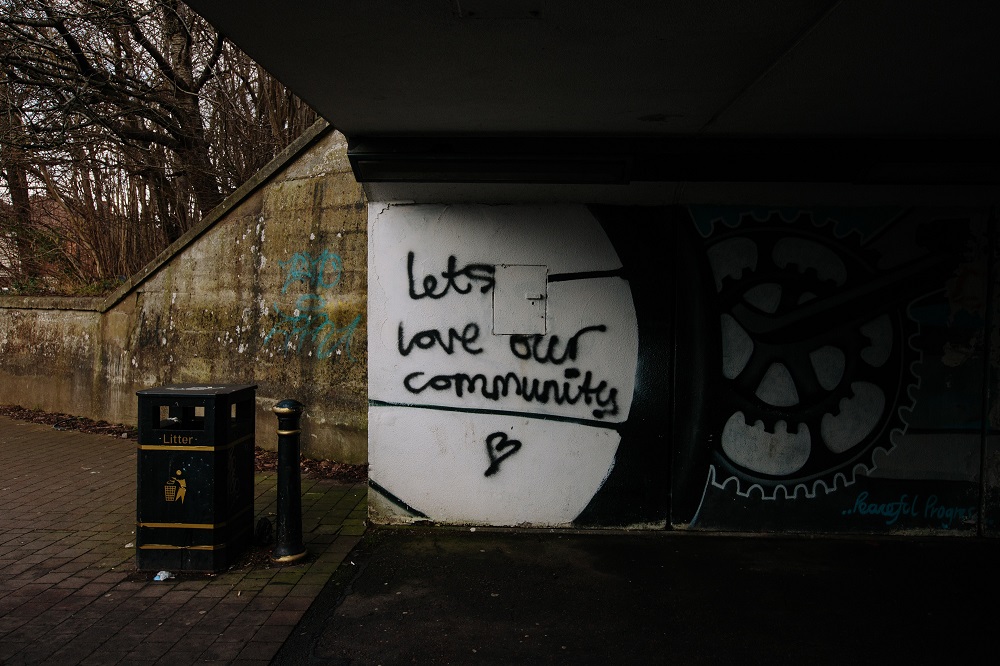
The basis for our country’s governance ought to be communities. There is already a measure of agreement across the political spectrum for this – the Welsh Conservatives have recently spoken of community empowerment, while Neil McEvoy’s WNP argues for community sovereignty (along with personal and national sovereignty).
Ignoring postcodes and telephone number prefixes, our suburbs and towns are usually poorly defined on the ground. Post Offices were once signed by the area they served, now one could be anywhere with few clues to orient us. The boundaries of suburbs are often left for estate agents to determine, rather than the people who live there.
Demographic studies would quickly help us to define our future communities, and it could be left to local residents to agree the details at the edges and subsequent identification.
A community might be 20 – 50 000 people. Let’s say 40 000 and rounding up numbers to keep the arithmetic easy. For a long-term population of 4m, that’s 100 communities.
Cymru is relatively compact, but badly served by transportation networks ill-suited for internal circulation. The latter aside (an issue for a later date), I propose the establishment of four regions of roughly equal population sizes and numbers of community councils. There is a case for a capital region, but we would need to ensure that its weight in decision-making was proportionate. The example of Washington DC is not a happy one.
A region would be somewhat equivalent to a state (US) or a unitary county authority (UK) with wide powers to provide for the well-being of its residents. It would have control of all non-national matters and as much of those as possible would be delegated to communities (the principle of subsidiarity). The region would be staffed by competent professionals in administration, health and social welfare, engineering and other disciplines. To ensure consistent (and high) standards of education across all schools, I propose that this be considered a national matter though with regional and local input.
Each community would be staffed by a manager and secretariat serving a small council (optimally seven members). The community would elect the councillors, the chair of the council, two regional councillors and, collectively, members of the Senedd. Only residents of at least two years’ standing would be entitled to stand for election. Overall gender balance and representation of minority groups would be prerequisites. Their councils should sponsor regular Town Hall-style meetings.
Altogether, that would mean about 1000 elected people in Cymru, 20% less than currently. They should be well-paid on a half- or full-time basis, and fully accountable to their electors. The length of a member’s term should be 6 years, with one-third facing election every two years.
While party politics could assist in policy development at the community and regional levels, there should be strict controls on campaigning and funding to ensure that the records of members while in office are properly scrutinised by electors without interference by their national parties. Lobbying should be registered, limited and fully transparent. Voting at these levels should be by STV.
Post-independence, the establishment of an upper chamber would be strongly advisable, with each region electing, say, 5 - 8 members. Voting should be by PR. The head of state should be directly elected by all registered voters using STV.
Having their legitimacy squarely based on communities would ensure that all elected members would be focused on local needs.
Balanced
By prioritising the transformation of our governmental structures from the bottom up in the change we seek, we can ensure that our elected members and government act thereafter in the interests of the people by the people for the people (Gettysburg Address 1863). I, and clearly many others, do not have that confidence at the present time.
It is well attested that economic power follows political power. The establishment of four regional capitals of roughly equal powers would ensure that the future of our country would be more evenly balanced and much less Cardiff-centric.
For an initial period, our elected members would be guided by local, regional and national referenda on a monthly basis. Those that result in 50 – 55% majority should be considered advisory, 55 – 65% would require legislation consistent with its spirit if not the letter, while 65% plus should not be over-ruled.
Political parties would be well-advised to tailor their principles to meet the aspirations of the people as the referenda signpost, or fall at the next elections. Citizens’ assemblies should be convened as required, on either a regional or national basis.
By adopting these priorities, we could ensure that our transition into a new age could occur smoothly and with the concurrence of the populace, aided and abetted by representative and accountable structures.

Support our Nation today
For the price of a cup of coffee a month you can help us create an independent, not-for-profit, national news service for the people of Wales, by the people of Wales.
Get more trusted Welsh news
Choose Nation.Cymru as a preferred source in Google News to see more of our journalism.
