


Opinion
A particular threat to health: Why it is vital to stop the dumping of mud from Hinkley Point C in the Severn Estuary
Richard Bramhall
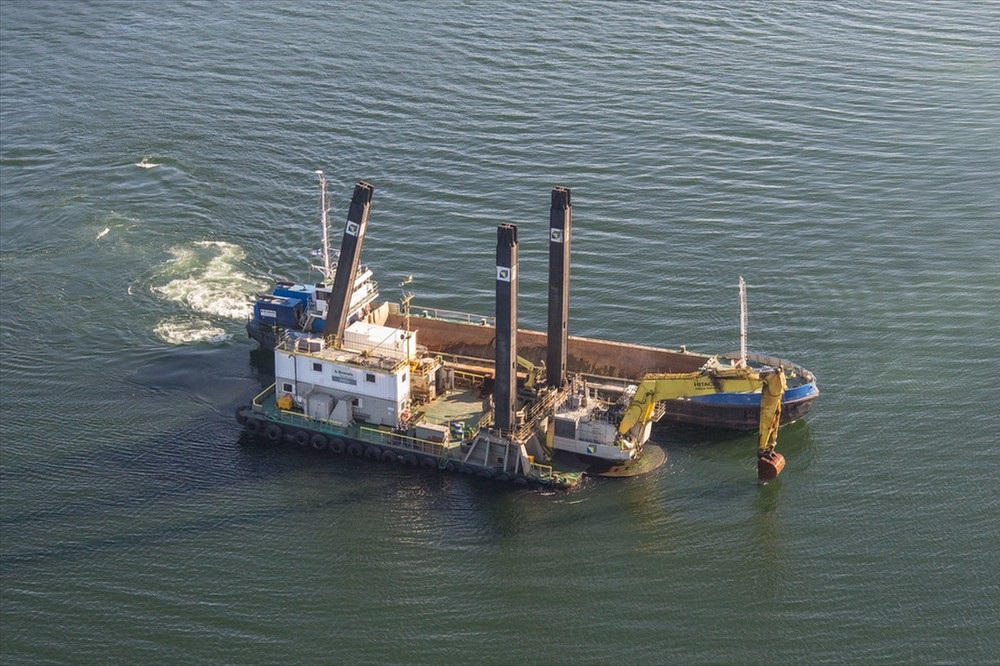
In 2018 the French state-owned company Électricité de France (EDF) dug more than 100,000 tonnes of radioactively contaminated mud from the bed of the Severn near Hinkley Point. Ignoring widespread protests they dumped it back into the water less than two miles from Cardiff. This was to allow construction of huge inlets and outlets for water to cool the reactors in the new nuclear power station - Hinkley Point C - which EDF is building in Somerset.
EDF held an old licence for the 2018 dump but it expired before they could shift their target volume of nearly a million tonnes. They applied to renew the dumping at Cardiff but, because of strong opposition in Wales and more protective Welsh environment law, they switched to a site at Portishead near Bristol. This August the Marine Management Organisation granted a licence for the Portishead operation and dumping immediately began again. Campaigners on both sides of the estuary have now applied for a Judicial Review.
The legal challenge identifies many scientific and regulatory issues. This article concerns only one:- the health impact of radioactive particles in the mud. Every nuclear power station in the world vents dust particles. They are licensed to do this. Filters trap fragments bigger than about 5 microns (thousandths of a millimetre) but thousands of billions of smaller particles are released, as data published by the UN show. Particles this size are inhalable and are biologically very mobile.
The greatest proportion are made of uranium.
Many of the particles will have fallen into the sea, adding to fallout from atom- and hydrogen-bomb tests between 1953-62, from Chernobyl, and from other (now closed) nuclear power stations on the Severn. Nuclear industry research in the 1980s showed that breaking waves and white water resuspend the particles, and that they blow inland as far as the investigators were able to sample, which was 10 km. It must be assumed that they travel further than that.
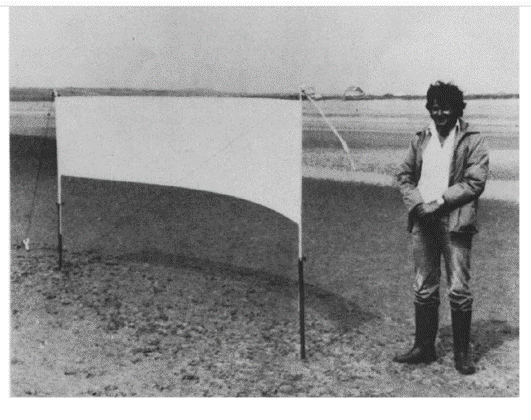
It is not difficult to detect the particles with a plastic called CR-39 which is also routinely deployed to check whether the natural radioactive gas Radon is getting into buildings. The plastic detects alpha rays emitted by atoms in the particles. Alpha radiation is very destructive over the microscopic distance it can travel, so it is a health threat only when the particles are inside the body.
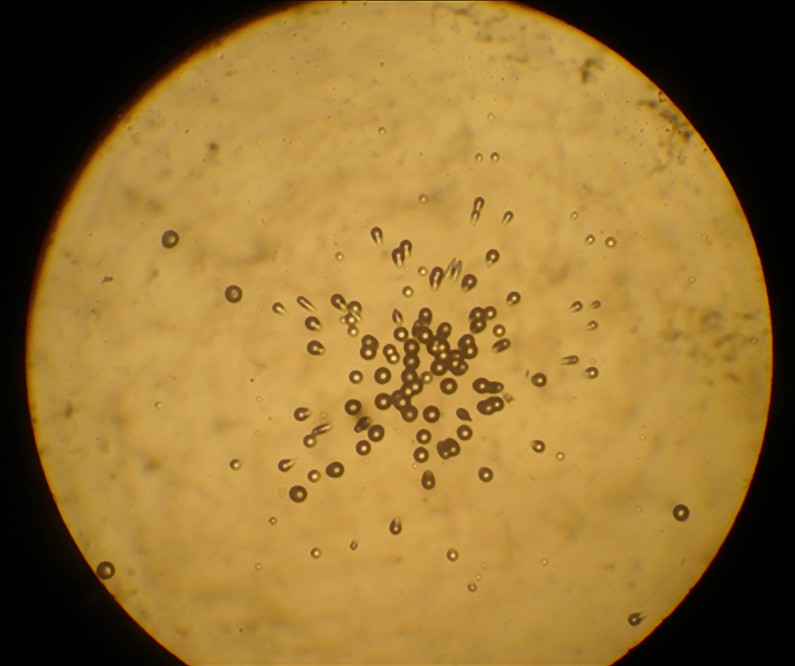
The CR-39 in this image was smeared with a very small random sample of dust from the engine air filter of a car that had been driven exclusively in the vicinity of Hinkley Point. Each of the round marks is a pit created by the impact of a single alpha track. The oval pits show the impact of tracks travelling diagonally. The clustering of pits shows the tracks came from a dust fragment; the size of the cluster shows this fragment was smaller than 5 microns.
The CR-39 technique can't detect tracks travelling parallel to the plastic or away from it, just as a camera doesn't show what's behind it. But a particle embedded in body tissue affects cells lying in any direction up to a distance of 8 cell diameters. Within that small volume of cells, the dose from a single alpha track is about 200 times greater than the whole human body receives from natural background radiation in a year. The image shows only a small part of a piece of CR-39. The whole thing is the size of a microscope slide and it contained seven similar clusters. (The particles were inevitably lost in developing the image.)
Before the Senedd elections this year (2021) Petitions Committee asked Natural Resources Wales to respond to campaigners' demands for the mud to be tested with CR-39. NRW refused without offering a scientifically valid explanation.
[mid-content-banner]
Contamination
The new umbrella group Tarian Hafren Severn Shield, which unites campaigns from both sides of the estuary, says Wales can take no comfort from the fact that EDF is dumping at Portishead instead of Cardiff where the 2018 dump was done. Tarian Hafren says the estuary's known anti-clockwise circulation will spread contamination east as far as the new M4 bridge and then west along the south Wales coast.
In July the Japanese government extended health benefits to people who fell ill after the Hiroshima bomb although they were too far from the blast to receive any external radiation.
This news is highly relevant to Wales. For the first time a national government has gone against official claims that radiation from fallout cannot cause any detectable health effects. The Hiroshima bomb was made of uranium. The Black Rain which fell widely across the region was black with uranium particles. People inhaled and ingested them. This, though more extreme, is the same kind of exposure as the people of south Wales are now facing long-term. It is vital to stop the dumping.
Richard Bramhall is Company secretary of the Low Level Radiation Campaign. He was a member of the 2001-2004 San Steffan government scientific advisory Committee CERRIE (Committee Examining Radiation Risks of Internal Emitters) and has been involved in many dialogues with the nuclear industry and its regulators.

Support our Nation today
For the price of a cup of coffee a month you can help us create an independent, not-for-profit, national news service for the people of Wales, by the people of Wales.
Get more trusted Welsh news
Choose Nation.Cymru as a preferred source in Google News to see more of our journalism.
