


Fri, 28th August Cardiff 17°
Nation.Cymru wordmark
Advertisement

News

Welsh language education bill clears first hurdle
By Mark Mansfield
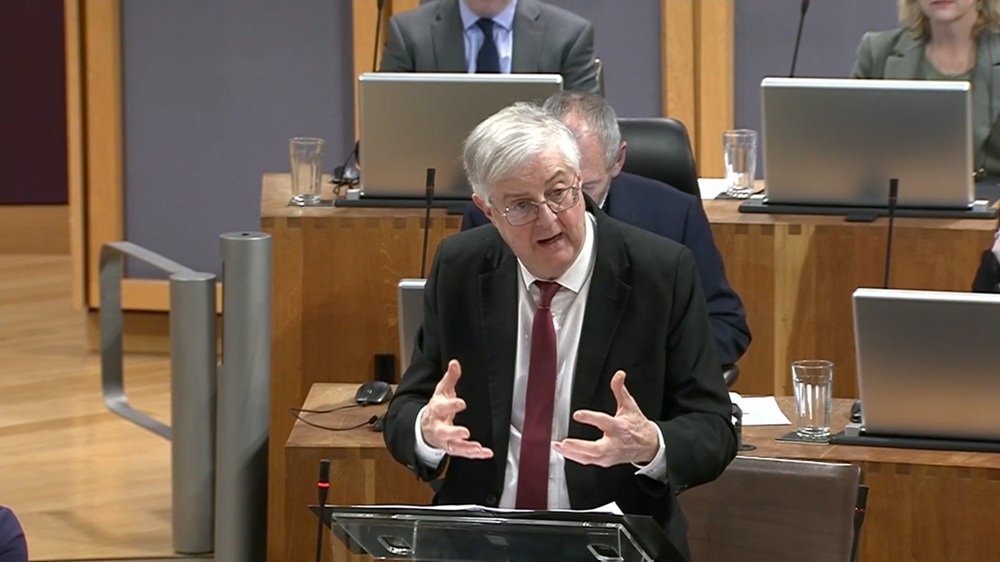
Finance and Welsh language secretary Mark Drakeford

Chris Haines, ICNN Senedd reporter

A shake-up of Welsh language education cleared the first hurdle in the Senedd despite concerns about staff shortages, teachers’ workloads and the cost to schools.

Senedd members unanimously agreed the general principles of the Welsh language bill, which was part of the now-collapsed cooperation deal between ministers and Plaid Cymru.

Mark Drakeford told the Senedd the reforms aim to improve how Welsh is taught, ensuring all pupils become confident Welsh speakers by the end of compulsory school age.

The finance and Welsh language secretary said: “The majority of children in Wales receive their education through the medium of English.

“It has been mandatory for them to learn Welsh for decades now. But we know that we haven't succeeded in providing the same quality of experiences to them.”

[mid-content-banner]

‘£100m’

The bill, which would cost an estimated £103.2m in the years to 2034/35, would set a 10% minimum level for the amount of Welsh provision in primarily English-language schools.

It would also:

put targets including a million Welsh speakers by 2050 on a legal footing;
embed a standard way to describe language ability based on the CEFR;
establish new categories of school;
create a chain of accountability with duties on schools, councils and ministers; and
set up a National Welsh Language Learning Institute.

Leading a debate on January 14, Prof Drakeford said: “If the bill is to succeed then we must ensure there is capacity within the education system to implement it.”

He pointed to the education secretary’s announcement of a strategic workforce plan, which will include the teaching of Welsh and teaching through the medium of Welsh.

Prof Drakeford committed to bringing forward amendments to address workforce concerns as the bill moves through the Senedd’s four-stage scrutiny process.

[taboola-banner]

‘Biggest barrier’

Buffy Williams, chair of the education committee, said: “It is rare for a government target … to capture a wider imagination but a million Welsh speakers by 2050 has.

“Yet, the last census result shows a decrease in the number of people saying they’re Welsh speakers. It is clear action is needed to put this decline into reverse.

“The bill, we believe, is an important mechanism to support delivery of this target.”

Ms Williams warned the biggest barrier is having a workforce with the right skills, saying: “This is not going to be easy. We know there are currently shortages across Wales.”

She called for clarity on proposed new categories of school: primarily Welsh; dual language; and primarily English, partly Welsh: and the targets for each.

‘Already stretched’

Sam Kurtz, the Tories’ shadow Welsh language secretary, welcomed the ambition to increase the number of Welsh speakers.

But he said: “Key challenges remain, particularly in terms of workforce capacity,” warning of the financial implications for “already stretched” schools and councils.

Mr Kurtz argued the workforce plan should have been developed alongside the bill, pointing out that there was no mention of Welsh in the education secretary’s statement.

Plaid Cymru’s Cefin Campbell said the Welsh Government has lowered the bill’s ambitions since his party ended the cooperation deal, with ministers “rowing back” some elements.

Mr Campbell, a former lecturer who is Plaid Cymru’s shadow education secretary, said targets to expand Welsh-medium education have been missed for more than 20 years.

‘Hugely fragile’

Alun Davies, who initially introduced the target of a million Welsh speakers by 2050, backed the bill but cautioned against overly complicated school categories.

He said: “To be entirely honest with you, and I didn't want to say this at the time, but when I was minister with responsibility for the Welsh language, and now, I'm still not sure I understand all of the school categories that we have.”

Warning minority languages are “hugely fragile” around the world, Lee Waters, another Labour backbencher, described the bill as a uniquely ambitious and important step.

He said pupils in primarily English-medium schools are currently “shortchanged”, with a low chance of them leaving school being able to hold a meaningful conversation in Welsh.

Mr Waters suggested this breeds resentment and bitterness among pupils subjected to such a poor experience, “so, it's essential we focus on the quality of English-medium provision”.

For the price of a cup of coffee a month you can help us create an independent, not-for-profit, national news service for the people of Wales, by the people of Wales.

Get more trusted Welsh news

Choose Nation.Cymru as a preferred source in Google News to see more of our journalism.

Choose Nation.Cymru as a preferred source in Google News

10 comments

Ash

Almost 20 years in charge over which we've seen education standards drop and numbers of Welsh speakers drop. Welsh Labour are useless. I have zero faith that they can turn it around, it's time for a change.

Reply
Garycymru

Fantastic news, but why on earth do the Tories have a Welsh language minister? Their policy is to wipe it out.

Reply
Pen-Y-Bont boy

It or totally wrong to force the language on students, welsh lessons should be optional then those who really want to learn it can and those who are not interested won’t be wasting their and teachers time.

Reply
Valley G

It’s a shame that English has been thrown on us and don’t hear enough of people complaining about that because the Welsh history has been erased over the centuries by Westminster. It’s time to correct all this wrong doing.

Reply
robin campbell

Seems to be very little substance here. Buffy Williams's statements mean that they don't expect the plans to succeed. Schools will carry on as usual because of lack of resources and will. Surely the best way to increase the number of Welsh speakers is to gradually make most of our schools Welsh medium. How have the Basques turned it around? Children absorb languages with no problem at a young age.

Reply
Valley G

This is why we need to make Welsh medium compulsory from 3 upwards.

Reply
Ben Davies

All talk, no action. We've been here before. Obvious intejecrtions and statements by parties. Plaid say it's not enough. Tories welcome it "but". An insidious but clear "we don't support the Welsh language but we can't be seen to be so overtly". The truth of it is that there is very little will in the English medium sector to improve Welsh language outcomes. To many of senior leaders, it is an irrelevance. They are a major obstacle. Their entrenched attitudes will not be overcome within my lifetime. It is a fight. A fight for cultural, not just linguistic survival. But the unenlightened powerful don't see it. A monoglot, sterile monoculture is what they know and wish to preserve. The so-called English Fragility. Upset the status quo at your peril.

Reply
William Robson

If people want to lean Welsh let them carry on but don’t take the current education budget. Seek extra funding

Reply
Valley G

Why would it cost extra funding?

Reply
WelshCC

Focusing on getting people to claim they are Welsh speakers on the census as an end goal is pointless (look at Ireland lol. I learned Irish and lived there and I can tell you that their census results are hilariously 'aspirational', very few of the 'yes' tickers can speak Irish at all besides a basic few words). Sociolinguistic research on language maintenance and revival shows that schools cannot revive languages, but they can support dedicated and genuine revival efforts in the surrounding community if a critical mass of Welsh speaking parents are trying to raise children through Welsh (though the current model hamstrings such parents in some areas, as their children would be going to school with monolingual native English speakers, and if their Welsh was good at home it will suffer because of their peers). Schools are also necessary to support a community which already speaks the language. My main point is, it is pointless to talk about 'a million Welsh speakers' as long as the sociolinguistic viability of the language as a first language, is in decline. Statistics show that Welsh speaking areas are still losing ground to the English language and becoming anglicised. Out of all the Celtic languages, Welsh starts from the strongest position, and it is slowly squandering that position. Current policy seems to be aiming to create a society which supports native English speakers only, with Welsh as an optional second language. Two centuries from now (maybe even four centuries, being more optimistic, given that a few areas in the north are strong enough now that there might be tiny holdout regions for a while yet) when there are no native Welsh speakers and no Welsh speaking communities, the standard of the teaching of that second language will be so dire that Welsh will not be Welsh anymore. The focus should not be on 'a million speakers'. Because what does 'speaker' mean. And what does it matter when that speakers language is as fragile to intergenerational transmission as the languages of all other refugees and immigrants? The focus should be on protecting Welsh speaking areas from anglicising forces and expanding Welsh speaking Wales. Make Welsh speaking areas of Wales into regions with a high degree of democratic autonomy. Create a Belgium/Switzerland situation in Wales. Belgium, Sweden, Switzerland and Canada are the only Western nations that have succeeded in remaining stably bilingual. Learn from them. Stop trying to copy the Irish approach (but bigger) because all you'll get from that in the end is native English speakers with poor Welsh at best pretending to be Welsh speakers because of how strongly they 'identify' as Welsh and with Wales as a nation.

Reply

Leave a comment

Comments are reviewed before they appear.