


Sun, 9th August Cardiff 18°
Nation.Cymru wordmark
Advertisement

News

Voters set to get power to sack misbehaving Senedd members
By Emily Price
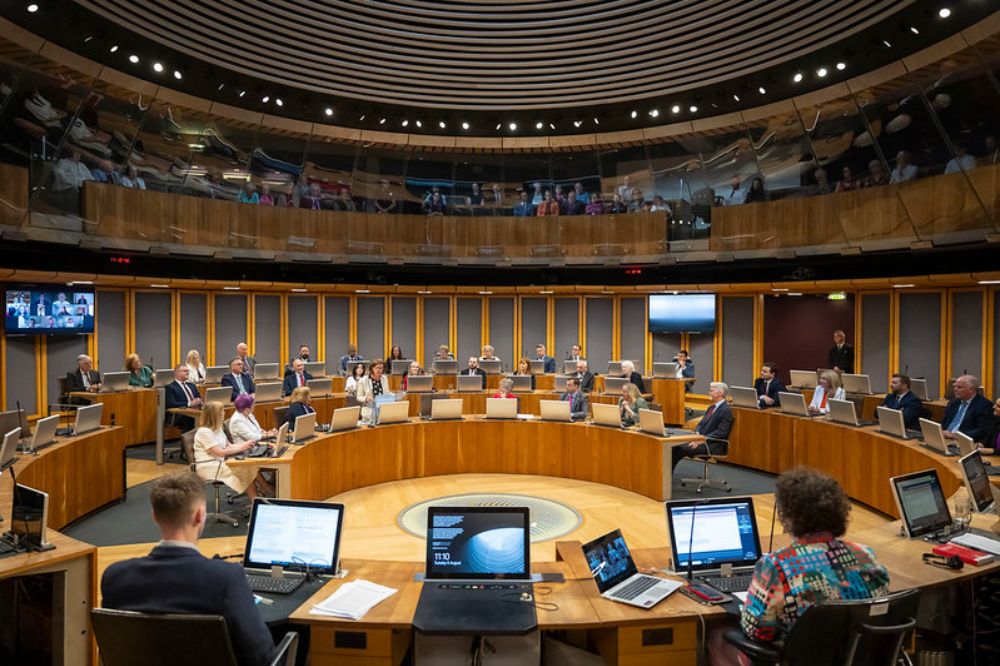
Senedd Members in the Chamber - Image: Senedd Cymru

Chris Haines - ICNN Senedd reporter

Voters would be given the power to remove Senedd members from office between elections under a new draft accountability bill published by the Welsh Government.

Julie James, who is counsel general, the Welsh Government’s chief legal adviser, announced publication of a draft member accountability bill in a written statement.

Voters would be given a say on whether to “remove or retain” a sitting politician through a “recall poll” and if a Senedd member was booted out, the seat would be filled by the next person on the party list, unless there are no more candidates or that the member recalled is an independent.

Under the draft bill, which was published today (October 6) following similar reforms in Westminster and Scotland, a recall poll would be triggered in one of two ways:

Conviction: If a politician was convicted of an offence and sentenced to imprisonment, including a suspended sentence.

Misconduct: If the Senedd voted by a majority to hold a poll after a standards committee recommendation as a result of serious misconduct.

Before the Senedd can trigger a recall for misconduct, the standards committee would need to publish "recall guidance” setting out more detail.

To be successful, a simple majority of those who vote in the recall poll must vote to remove the Senedd member and the draft bill does not include a minimum turnout requirement.

[mid-content-banner]

‘Own-initiative’

The power to recall politicians does not have an automatic start date and the draft bill states the system would come into force on a future date specified by Welsh ministers separately.

The draft bill also seeks to strengthen the Senedd’s standards of conduct committee, which is made up of politicians, and the role of standards commissioner.

The standards committee would become a permanent, legal requirement for every Senedd and independent “lay members” could sit on the committee for the first time.

Douglas Bain, the standards commissioner who investigates politicians in Cardiff Bay would be given “own-initiative” powers to launch investigations rather than rely on complaints.

The draft bill also includes a duty on Welsh ministers to prohibit false statements during election campaigns in an effort to tackle deliberate deception by politicians.

In a statement announcing the bill, Ms James stressed that the draft bill is subject to change before its formal introduction in the Senedd in the autumn.

For the price of a cup of coffee a month you can help us create an independent, not-for-profit, national news service for the people of Wales, by the people of Wales.

Get more trusted Welsh news

Choose Nation.Cymru as a preferred source in Google News to see more of our journalism.

Choose Nation.Cymru as a preferred source in Google News

4 comments

Amir

How about useless councillors?

Reply
Valley Girl

Shane it didn’t extend to MP’s.

Reply
Charlie Pearcy

A far better idea would have been to give voters the power to remove specific Senedd members at election time, by using a better voting system than the closed list system. The Closed List voting system for future Senedd elections is rightly criticised because it requires voters to pick a party list without having any say over which candidates get elected. There are other, better systems of Proportional Representation (PR), like Open List PR, and the Single Transferable Vote (STV). These systems give voters a real choice, not only between parties, but also between candidates of the same party. Unlike FPTP, they allow voters to get rid of an unwanted representative without having to vote for a different party. With these systems it is a party's voters, not the party itself, who decide which candidates get elected. With STV voters not only choose their preferred candidate, but also may, if they wish, number any or all of the candidates in order of preference. Evidence from Scotland and Ireland suggests voters use STV in quite sophisticated ways. If you believe that voters, rather than the parties, should decide which candidates are elected, you may wish to consider signing and sharing the following petition that is on the UK government website: “Replace First-Past-The-Post with Single Transferrable Vote & Alternative Vote We urge the Government to abolish First-Past-The-Post (FPTP) for all elections. We would like the Government to replace it with Single Transferrable Vote for General and Council elections, and Alternative Vote for mayoral and by-elections.” The petition can be found by web searching “petition 727860”, or via the following link: https://petition.parliament.uk/petitions/727860 If you would like to learn more about different voting systems, including STV, you can do so by web searching “ERS types of voting system” or via the following link: https://electoral-reform.org.uk/voting-systems/types-of-voting-system/ Also, please consider supporting one or more of the following groups that are campaigning for Proportional Representation: The Electoral Reform Society (https://www.electoral-reform.org.uk/) Make Votes Matter (https://makevotesmatter.org.uk/) Get PR Done (https://getprdone.org.uk/) Thank you.

Reply
Only Considerable Upsides

The closed list system has already been in use to elect the Senedd's regional MSs, but in that voters cannot elect an individual candidate it isn't fundamentally different to the first-past-the-post method. It was nevertheless adopted, so I'm led to believe, due to its familiarity and because it better reflects the proportion of votes cast. Changing it to a STV method in the future would be a welcome step, and one which reflects the wishes of a large number of MSs who voted this Senedd reform through.

Reply

Leave a comment

Comments are reviewed before they appear.