


Wed, 19th August Cardiff 17°
Nation.Cymru wordmark
Advertisement

News

KC questions Reform UK’s ‘influence’ on Rupert Lowe investigation
By Mark Mansfield
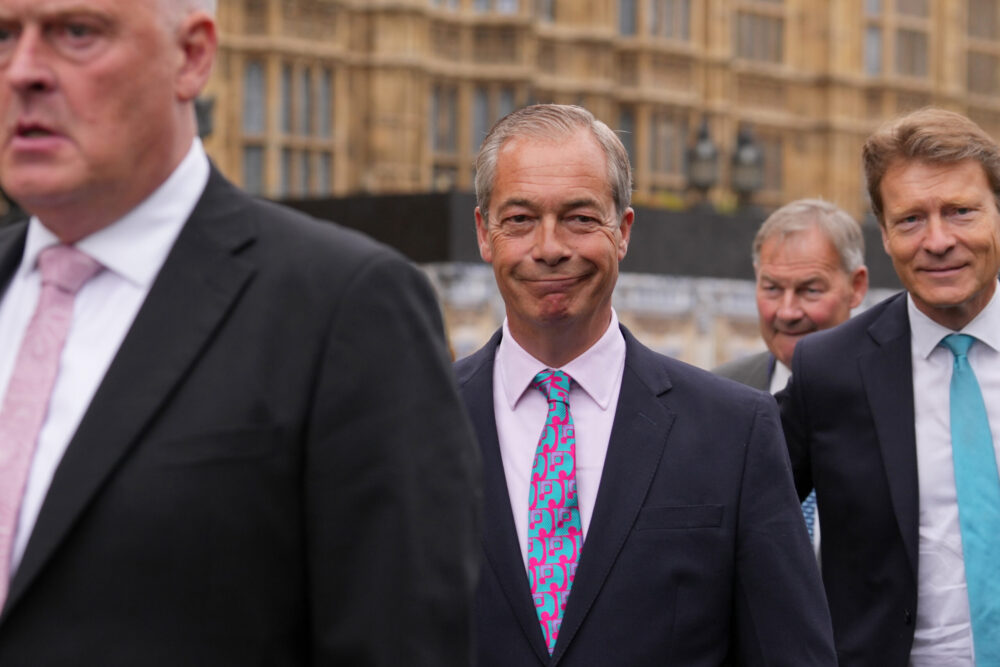
(left to right) Reform UK MP, Lee Anderson, Reform UK leader, Nigel Farage, Reform UK chairman, Richard Tice, and Reform UK MP, Rupert Lowe, arrive at the House of Commons in Westminster. Photo Maja Smiejkowska/PA Wire

A KC has questioned whether an investigation into MP Rupert Lowe was conducted “independently of the influence” of Reform UK, in a review commissioned on behalf of the suspended politician.

Mr Lowe said the “independent review” showed the investigation conducted on behalf of the party was “fundamentally flawed, unfair, and influenced by political motivations”.

Reform UK said last month that an “independent KC” had found “credible evidence of unlawful harassment of two women by both Mr Lowe and male members of his team”.

The Great Yarmouth MP lost the Reform whip after the party said it had received evidence of “serious bullying” and “derogatory” remarks made about women in the MP’s offices.

[mid-content-banner]

Verbal threats

Mr Lowe, who has repeatedly denied the allegations against him, was also reported to the police over allegations of verbal threats towards Reform chairman Zia Yusuf.

A review, commissioned by law firm Irwin Mitchell LLP on behalf of Mr Lowe and published on Friday, claimed the KC who investigated the politician had “produced” witness statements on behalf of the complainants following lengthy telephone interviews.

It added that “no terms of reference were ever set by the party” and that the report was provided to Reform before the expiry of the deadline set for Mr Lowe to respond to allegations made against him.

The author of the review, named as Gemma White KC, wrote: “In addition to being unfair to Mr Lowe the sequence of events which led up to provision of the report to the party gives rise to real questions as to the extent to which the KC conducted the investigation independently of the influence of the party.”

Ms White claimed it was not apparent that the KC who conducted the investigation commissioned by Reform, named in the party’s report as Jacqueline Perry, had “recent experience” conducting independent investigations into allegations of bullying and harassment.

[lower-mid-content-banner]

'Vile'

Following the publication of the review, Mr Lowe said: “In 67 years, I have never seen such vile and unprofessional behaviour. Including, but not limited to, publicly shaming my staff without even giving them the opportunity to respond to the false and damaging allegations.

“Reform has proven itself not only unfit to govern but unfit to sit in the House of Commons. To handle such a basic process in a hideously unprofessional and malicious manner is simply unacceptable.

“I asked reasonable questions of (party leader Nigel) Farage, after months of pushing behind the scenes. My punishment for bruising his ego? A concerted smear campaign to ruin my name and reputation.

“Nigel Farage must never be prime minister.”

Mr Lowe was one of five MPs elected for Reform in last year’s election.

Reform UK has been approached for comment.

For the price of a cup of coffee a month you can help us create an independent, not-for-profit, national news service for the people of Wales, by the people of Wales.

Get more trusted Welsh news

Choose Nation.Cymru as a preferred source in Google News to see more of our journalism.

Choose Nation.Cymru as a preferred source in Google News

5 comments

Daniel Pitt

By now, the story of Stephen Hartley, a suspended candidate for Reform UK in the upcoming Oxfordshire local elections, should have prompted more than just a media flurry. It should have prompted a fundamental reassessment of the party’s vetting process, particularly when it comes to safeguarding children. Unfortunately, what we’re witnessing instead is a disturbingly complacent response from a party that claims to be the guardian of British values and the protector of children. Hartley’s social media posts praising Jimmy Savile as a “working class hero” and casting doubt on the credibility of Savile’s victims should have been a glaring red flag. Jimmy Savile, of course, was one of Britain’s most notorious serial sex offenders, whose decades-long reign of abuse was only revealed after his death in 2011. In his comments, Hartley not only failed to acknowledge the enormity of Savile’s crimes but also implied that the victims’ testimonies – hundreds of them, many of which were corroborated by police investigations – might be exaggerated or false. For anyone concerned with the protection of vulnerable people, this is simply indefensible. And yet, despite the seriousness of the situation, Reform UK – led by Nigel Farage – was seemingly blind to Hartley’s unsuitability as a candidate until the BBC uncovered these posts. Farage, who has made a career out of championing moral righteousness, especially in his crusade against the so-called “threat” of Muslim grooming gangs, should have known better. If Reform UK is serious about child protection, why was Hartley even allowed to stand for election in the first place? The party’s handling of the situation is nothing short of baffling. When the posts surfaced, Reform UK suspended Hartley and withdrew support for his candidacy within hours. However, the fact remains that his name will still appear on the ballot paper, a glaring oversight that underscores the party’s failure to implement the kind of thorough vetting process one would expect in any political organization. This is especially troubling given that, in its public rhetoric, Reform UK presents itself as the party that is vigilant about safeguarding children – a stance often directed at others. When it comes to their own, however, the party appears woefully negligent. There is no evidence that Hartley has a history of sexual misconduct. But praising Savile – a man whose actions left a trail of destroyed lives – is a grotesque failure of judgment, one that calls into question the integrity of a candidate and the competence of the party that allowed him to stand. Hartley’s comments don’t just reveal a lack of empathy for abuse survivors; they demonstrate a disregard for the severity of child exploitation and its long-lasting consequences. Reform UK’s defense – that Hartley may have “forgotten” to disclose his social media account – borders on the absurd. This is not a minor technical oversight. This is a candidate espousing views that directly contradict the values of basic decency and human dignity. The deeper irony, of course, is that Reform UK has spent much of its political life positioning itself as the defender of children from the supposed threat of “Muslim grooming gangs,” a narrative that has fueled divisiveness and fear. Yet, when confronted with an actual candidate who trivialises the most high-profile case of child abuse in British history, the party’s response is a shrug and a rushed suspension. It’s almost as if their concerns about protecting children are selectively applied, convenient for electoral purposes but shockingly absent when it comes to confronting real harm within their own ranks. Farage’s populist rhetoric has long been built on casting himself as the champion of the “silent majority,” a self-appointed defender of traditional values against the so-called cultural elites. But his party’s failure to vet candidates properly, to take safeguarding seriously, and to confront uncomfortable truths about its own affiliations undermines this moral posturing. How can Reform UK claim to stand for the protection of the most vulnerable when they allow figures like Hartley to even be considered in the first place? The question now is whether voters will see through the party’s rhetoric and recognize the dangerous gap between its words and actions. Will the public realise that while Reform UK warns against imaginary threats, it fails to take action against real ones? This is a party whose moral authority is fast eroding, and with Senedd elections just over a year away , it’s crucial that Welsh voters take a hard look at the party’s record and its complete inability to provide something that should be non-negotiable in any political movement - namely, stringent internal safeguarding policies. It’s hard to take seriously a party that preaches family values while its vetting process lets through candidates with deeply troubling views on abuse and exploitation. Farage may want to rethink his party’s definition of “vetting,” because if this is the best they can do, they’re in more trouble than they realise.

Reply
Fi yn unig

Thank you for this A person I knew nothing about until now but it’s hardly a surprise to me. If this party was to win a Westminster majority, the whole of this island will be dragged into the cess pit of moral bankruptcy it inhabits.

Reply
Fanny Hill

That was an eye opener.

Reply
Fi yn unig

‘Vile’. A perfectly chosen word. The man who used it is a willing member of a vile hate movement which kicked HIM out, HE did not leave of his own accord, and he is an intrinsic part of this band of thugs which he says are not fit to be in the House of Commons. He’s right in what he says but he’s wrong to tell us that HE is somehow different from them. ‘Reputation’? Someone will have to explain that one. I despair.

Reply
Fanny Hill

What does this say about a potential Reform government? The shutting down and abuse of the US judiciary by the Trump administration, which Farage looks to for inspiration should be a warning to us all.

Reply

Leave a comment

Comments are reviewed before they appear.