


News
Ireland: A new Government for Christmas?
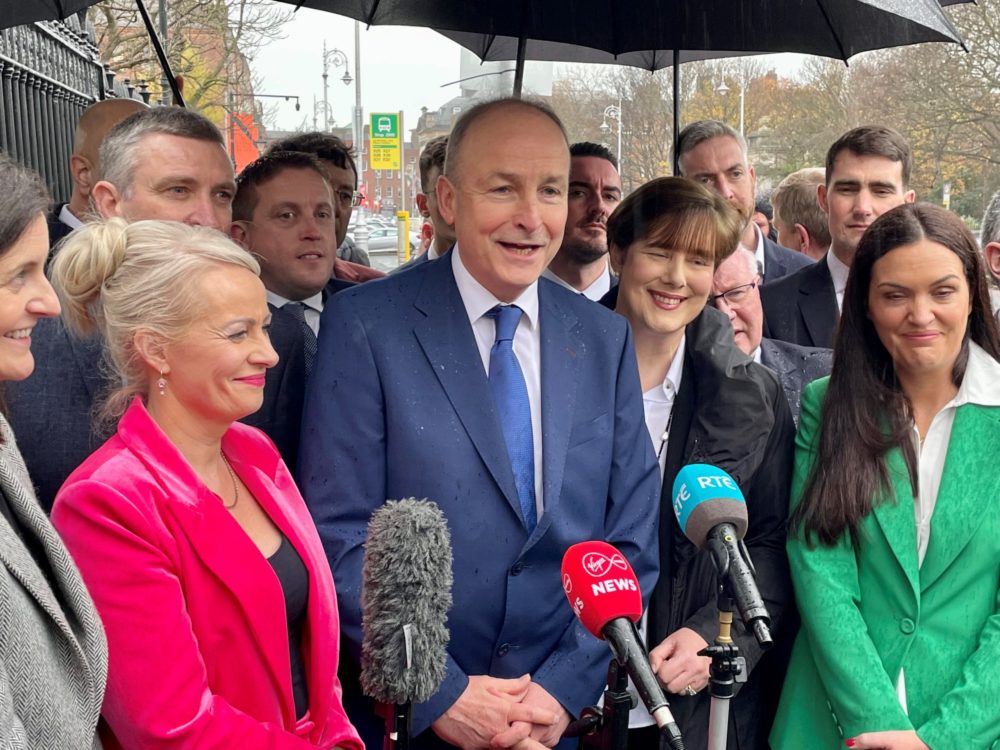
Lila Haines
No party emerged from Ireland’s 29 November general election with a mandate to govern alone - far from it - but Fianna Fáil‘s 48 seats put them in pole position in efforts to form a coalition government.
With a combined total of 86 seats Fianna Fáil (FF) and Fine Gael (FG), the two larger parties in the outgoing government, fell just short of the 88 seats required for a majority in Dáil Éireann, newly enlarged from 160 to 174 seats.
Attention shifted swiftly to the government formation process, involving internal party discussions and a complex web of talks between leaders, parties and independent TDs.
It looked as if negotiating a new government could drag on into 2025, though probably not for as long as the four-plus months it took FF, FG and the Green Party to negotiate a programme for government in 2020.
Initial soundings proceeded at pace, however, and clear pointers began to emerge a mere fortnight after polling day.
[mid-content-banner]
The Contenders
The early mood music from Fine Gael and Fianna Fáil suggested they would be willing to become coalition partners again and to work either with parties of the left or ‘reliable’ Independents.
The outgoing coalition’s third partner, the Green Party / Comhaontas Glas, had a catastrophic election, losing 11 of its 12 TDs despite or because of delivering well on climate commitments, and made clear they won’t enter government or join an opposition alliance.
During the campaign FF leader Micheál Martin hinted at a preference for Labour as a partner, while Sinn Féin called on their supporters to give their lower preference votes to the People Before Profit/Solidarity (PBP/S) alliance or the Social Democrats (SocDems).
Sinn Féin itself was never seriously in contention for government, even without the scandals that shook them over the months preceding the general election and, though their 39 TDs put them one seat ahead of Fine Gael, Micheál Martin was adamant during and after the campaign that he would not go into government with them.
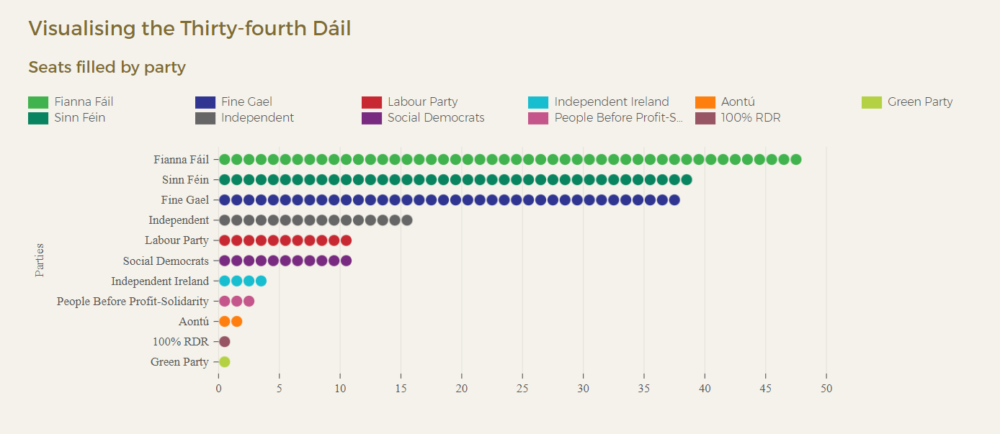
As the shadow boxing for Cabinet places kicked off Fine Gael floated a demand for ‘parity of esteem’ with FF, including a repeat of the 2020-24 rotating Taoiseach arrangement, despite FF’s ten-seat advantage over their main potential partner.
Micheál Martin responded amiably enough with soothing words about respect, but some in his party seemed to need convincing. Other possible partners needed convincing too.
The initial big question was: would FF and FG prefer Labour or the SocDems as a third partner or would they have to do a deal with Independents? The answer could indicate a lot about the nature of the next government, with implications for key policies, especially on climate change.
[taboola-banner]
The junior partner stakes
Labour leader Ivana Bacik admitted that her party (with 11 seats) was having ‘robust’ internal discussions, with strong views for and against entering government.
Some were probably haunted by the spectre of Labour’s near wipe-out following their last coalition (2011-16) with Fine Gael, while others favoured being in government anyway – perhaps believing they should do their democratic duty again as Labour has done since the foundation of the State.
Two weeks after voters cast their ballots, Ms Bacik said it was unlikely Labour would enter government but that she was seeking another meeting with the FF and FG leaders to see if there was ‘any basis for commencing negotiations’.
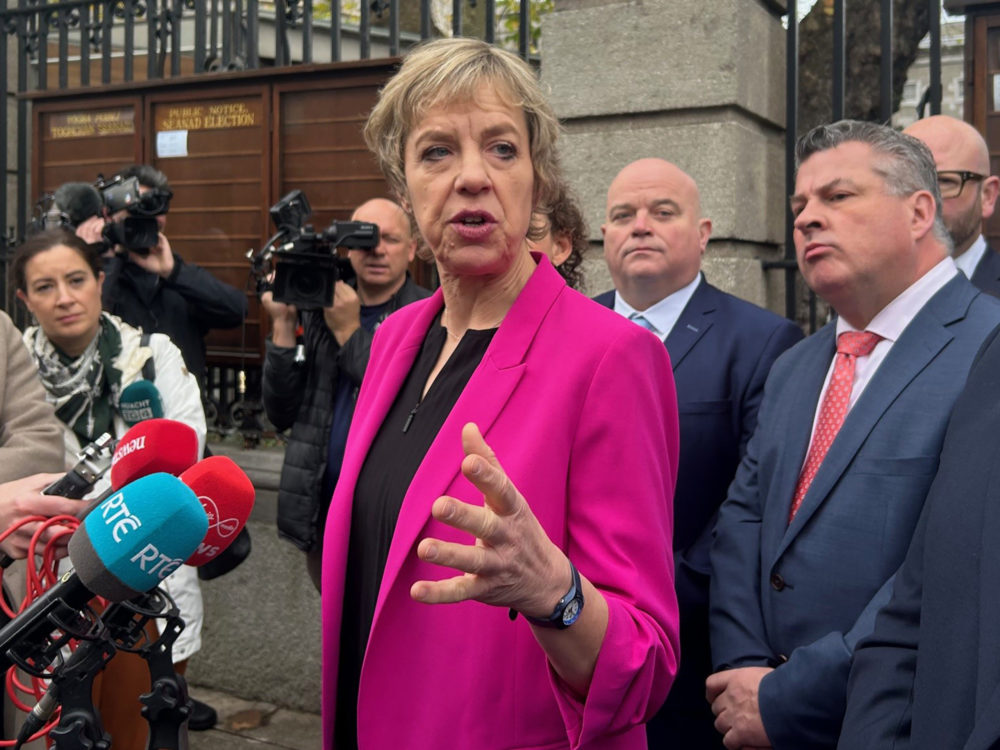
The Social Democrats also took 11 seats, but their attractiveness as 3rd partner may have waned after it emerged that one of their new TDs had sold his shares in a software firm that supplies technology to Israel later than he originally claimed. Having removed the party whip from him a bare week after he was elected, the SocDems announced they would continue to engage with other parties on government formation.
Independents – 23 TDs, including two minor parties, who can be broadly described as conservatives - offer another source of Cabinet fillers. (The far right flopped in the election but they haven’t gone away.)
Some independents have formed alliances of convenience and it may be one such group that ends up in the next government: the Regional Independents technical group has emerged as a frontrunner, and demanding that they be treated as a full government partner.
They also announced they would propose one of their number, Verona Murphy, for the position of Ceann Comhairle (Speaker or Llywydd of the Dáil) – this gave the Irish language a rate moment in the spotlight when the outgoing Ceann Comhairle declared that the role should be held by a fluent Irish speaker, which he is and Ms Murphy is not.
If even the most ‘responsible’ of independents, whether the Regional Independents or others, joins the government it could lead to a potentially significant conservative shift.
[lower-mid-content-banner]
The Fantasy Government Games
Are there other options? Yes - a minority FF/FG government doing ceaseless deals with independents and smaller parties, or one bordering on fantasy that would put Sinn Féin in a powerful position.
Sinn Féin presumably understands that they’re stuck, given that at best their 39 seats plus those of S/PBP, Labour and the SocDems add up to just 64, far short of the 88 needed for a simple majority. That their overall first preference vote fell 5.5% from 2020, when their performance was the headline story of the election. That in this year’s exit poll only 8% of respondents favoured a SF/FF coalition.
Yet Mary Lou McDonald has demanded that Fianna Fáil ‘respect’ her party by meeting her to discuss government formation - presumably knowing that only a deal with Fianna Fáil could give SF its breakthrough this side of another general election, and that this would change not just the current government formation talks but also Ireland’s political dynamic.
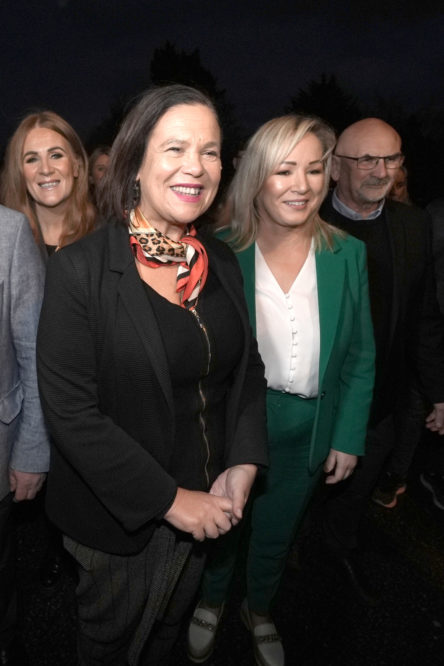
From Belfast deputy SF leader Michelle O’Neill accused parties in the Republic of double standards for refusing to share power with SF in the way Unionists and Nationalists are required to do in NI - an analogy that ignores the very specific context of 30 years of violence in which the Northern Ireland Peace Agreement was forged.
The next round
Two weeks after polling day Fianna Fáil and Fine Gael agreed on ‘the need for a stable Government, underpinned by mutual respect and clear policy direction for the next five years’ according to FF leader Micheál Martin, and have asked their negotiating teams to commence talks.
Presumably those talks will include identifying their joint red lines vis a vis whatever contenders for third partner enter the final stretch.
Will they also involve agreeing a high level of commitment to climate change action? Or explore how to respond to the likely threat to Ireland’s economic model emanating from Washington under the second Trump presidency?
As for the known major issues, there may be more agreement across the board than any party might care to admit.
Take housing – all parties want to build ambitiously to crack the crisis, but with degrees of difference about how to succeed.
What’s not to the fore often enough is how to turn ambitions into reality – targets can’t build houses and Ireland’s construction industry is seriously under-strength and facing other barriers including infrastructure deficits and planning complexities.
Given Ireland’s budget surplus - €25bn for this year - promising to throw more money at this and other priorities might seem the easy way to win Cabinet peace and national progress. However, most of the surplus was be invested in badly needed infrastructure –could that intention withstand hard bargaining by independents bent on satisfying shorter-term local demands?
Will we know by Christmas?
Will anything concrete come of all the talking by the time the 34th Dáil convenes on 18th December? Unlikely. Tánaiste leader Micheál Martin dampened expectations early on, suggesting it was unlikely a government would be formed before Christmas.
Following kite flying about alliances and blocs, exploratory talks about talks, leader contacts, party-to-party meetings and more, the real negotiations about the details of a programme for government have not begun in earnest yet - and when they do it could take a tough and long slog.
It seems unlikely that the nature and membership of a new government will be clear before 2025.
Lila Haines is the author of ‘Radicals & Realists: Political Parties in Ireland’, published by Welsh Academic Press in 2022, which is widely available in bookshops and online, as well as on Kindle.
Support our Nation today
For the price of a cup of coffee a month you can help us create an independent, not-for-profit, national news service for the people of Wales, by the people of Wales.
Get more trusted Welsh news
Choose Nation.Cymru as a preferred source in Google News to see more of our journalism.
