


News
Huge turnout for funeral of Dafydd Elis-Thomas
Martin Shipton
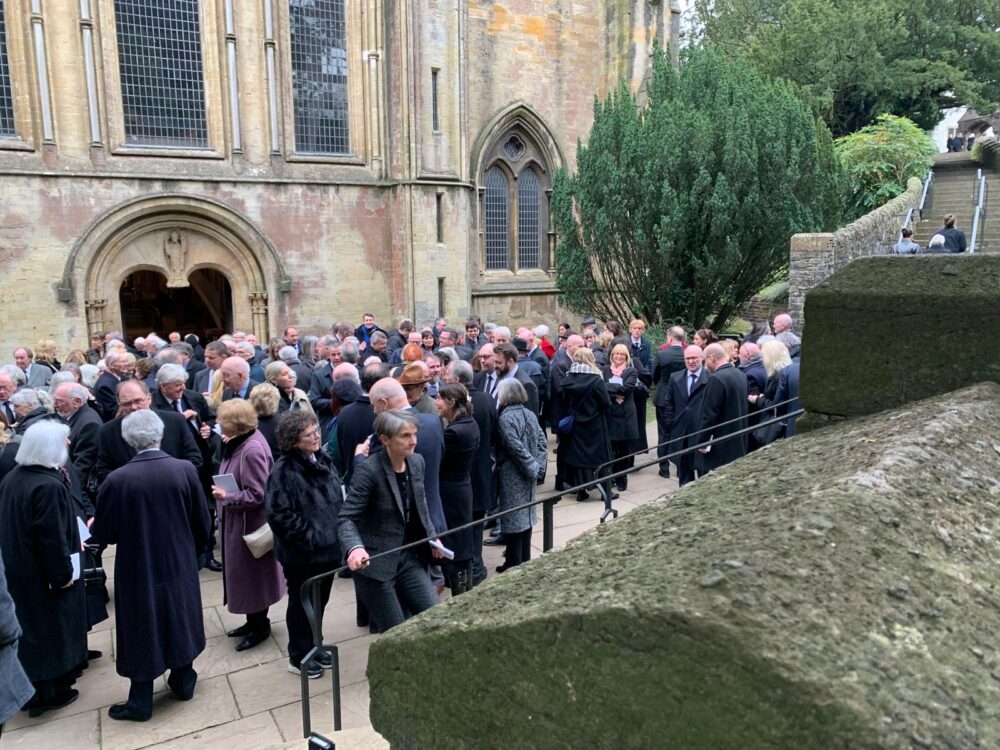
Hundreds of friends, colleagues, political opponents and relatives attended Llandaf Cathedral to pay tribute to former Plaid Cymru President Dafydd Elis-Thomas at his funeral.
Seen by many as a founding father of Welsh devolution, Lord Elis-Thomas died in February at the age of 78,
The eulogy was delivered by his close friend and biographer Aled Eirug, a journalist turned academic who worked for him as an adviser during the period when he was the first Presiding Officer of what was the National Assembly and is now the Senedd.
[mid-content-banner]
‘Dafydd El’
Dr Eirug said: “We are here to celebrate the life of The Right Honourable Lord Dafydd Elis-Thomas of Nant Conwy – known to most of us here, as ‘Dafydd El’.
“He has been recognised as one of the most influential Welsh political figures of the past fifty years, a ‘founding father’ of the Senedd, a ‘political giant’.
“He was born in Carmarthen, and brought up in Llanrwst in the Conwy valley. His father, WE Thomas, was a prominent Presbyterian minister and his mother Eirlys, a cultural leader in her community. In chapel and school concerts, Dafydd was a precocious child, and trained in public performance and debating skills from an early age. His first political memories were of the Parliament for Wales campaign in the 1950s, and Llanrwst boys being conscripted into the Army at the time of the Suez crisis.
“In 1958, he became a member of CND, and in 1962 joined Plaid Cymru. In 1964 he went to Bangor University, where as a brilliant scholar, he gained a first-class degree in Welsh, and established himself as a formidable debater, student politician, and literary critic.
“As chair of Plaid Cymru’s youth section, he opposed the Investiture of the Prince of Wales in 1969, ironically given the warm personal friendship he developed with Prince Charles in later life. In February 1974, he won the Meirionnydd seat and became the youngest Member of the House of Commons at the age of 27. An energetic and campaigning MP, he supported Labour’s devolution proposals, which ended in failure in 1979. Following that, he moved Plaid Cymru towards the left.
“In the House of Commons, he showed bravery in opposing the Falklands/ Malvinas War, and a readiness to court unpopularity by moving the writ for the Fermanagh and South Tyrone by-election after the death of its MP, the IRA hunger striker, Bobby Sands.
“In 1984, he became Plaid Cymru’s President, led it to support the miners’ strike, and aligned the party with the decade’s main causes – anti-Thatcherism, the Welsh language movement, Greenham Common, and the anti-apartheid campaign.
“Throughout his life he had a strong connection to the countryside. He was a passionate walker and runner in the landscape, and an early champion of the environmental movement.
“After 18 years in the Commons, in 1992, he controversially took a seat in the House of Lords and was appointed Chair of the Welsh Language Board, where he ensured that the language was seen as available to all, and above party politics.
“In May 1999, he was elected to the National Assembly for Wales, and undoubtedly the political highlight of his life was as the Assembly’s first Presiding Officer. He worked with the First Minister, Rhodri Morgan, to embed the new institution into Welsh life, and secured an iconic home for the Assembly – the award-winning Senedd building, which reflected the principles of a transparent democracy.
“The 2011 referendum gave reality to Dafydd’s teenage dream of a legislative Senedd. After standing down as Llywydd that year, he found it difficult to settle into life as a backbencher, and in 2016, left the party on the occasion of his seventieth birthday, to become an independent Member. In 2017, he was appointed deputy Minister for Culture, Sport and Tourism in Government – a role that he delighted in and was eminently suited to.
[lower-mid-content-banner]
Mischievous
“He was mischievous, challenging , entertaining and provoking, but Dafydd was also a profoundly serious man – he retained his interest in the semiotics of language, philosophy and the arts; and in religion, he moved gradually from the ascetic Calvinism of the Presbyterian church, through the liberalism of Congregationalism, to the Church of Wales, where he was made a lay canon in this very Cathedral.
“Even his friends thought that Dafydd could sometimes be inconsistent in his political judgement – but he would argue that he was simply adapting to the political realities of the time. He was perceptive, lively, hugely charming, courteous and inspirational.
“His critics have characterised him as a political chameleon, and of failing to rein in, his intellectual agility. He could certainly be a contrarian and was remarkably adept at presenting unorthodox political views. But he was true to his fundamental belief in that whatever he did, he did wholly for the benefit of Wales.
“He understood the need for Plaid Cymru to extend its political hinterland, and as Presiding Officer, he knew the importance of ensuring that the legitimacy of the new Assembly was recognised by the support of the members of the Royal family for instance, who attended every official opening.
“His public roles were many but they came at a price. His time with the family was sacrificed to the needs of his party, parliaments and the public. His first victory in 1974 came as a seismic shock to him and Elen [his first wife], and Dafydd found it difficult to balance the many calls on his time. One of his boys memorably said that Dafydd’s method of coping was ‘never to look in the rear view mirror’ – always to look forward.
“His loss is not solely to the political and public world of course. It is a huge loss to his family – to Mair his wife, his sons Rolant, Meilyr and Cai, their mother and Dafydd’s friend, Elen, and his grandchildren, Mali, Osian, Llew and Bleddyn, who have lost a loving taid.
“Following Dafydd’s death, Mair has received literally hundreds of letters of sympathy. I’d like to read a section from one of them: ‘I was so terribly sorry to hear the very sad news about your husband and particularly wanted to write and send you my deepest possible sympathy….To all things, your husband brought an independence of mind and a generosity of spirit, not to mention a wit, that I always found immensely impressive.
"Our public life will be so very much the poorer without his thoughtful and stimulating presence. There can be few people who have contributed so much to the lives of their nation, in so many fields, for so long. I hope it will be of at least some small comfort to you, in your loss, to know the enormous respect in which your husband was held by so many people from all walks of life.’
“A deeply affecting tribute, from King Charles, whose friendship with Dafydd extended over 55 years.
“Dafydd was my closest friend, sometimes a wise adviser, an intelligent and playful companion, and a fine man to share a glass of wine with. A brave and bold politician, a lover of Welsh culture and language, and a patriot. Wales, his family, and all of us, are poorer for his loss.
“However, reflecting on a full and well lived life, we give thanks and celebrate Dafydd El – our nation builder.”
The service was conducted in Welsh by the Dean of Llandaf, Dr Jason Bray, and the former Archbishop of Wales, Dr Barry Morgan.
Support our Nation today
For the price of a cup of coffee a month you can help us create an independent, not-for-profit, national news service for the people of Wales, by the people of Wales.
Get more trusted Welsh news
Choose Nation.Cymru as a preferred source in Google News to see more of our journalism.
