
News
Debate over peat content of soil will decide whether controversial wind farm goes ahead
Martin Shipton
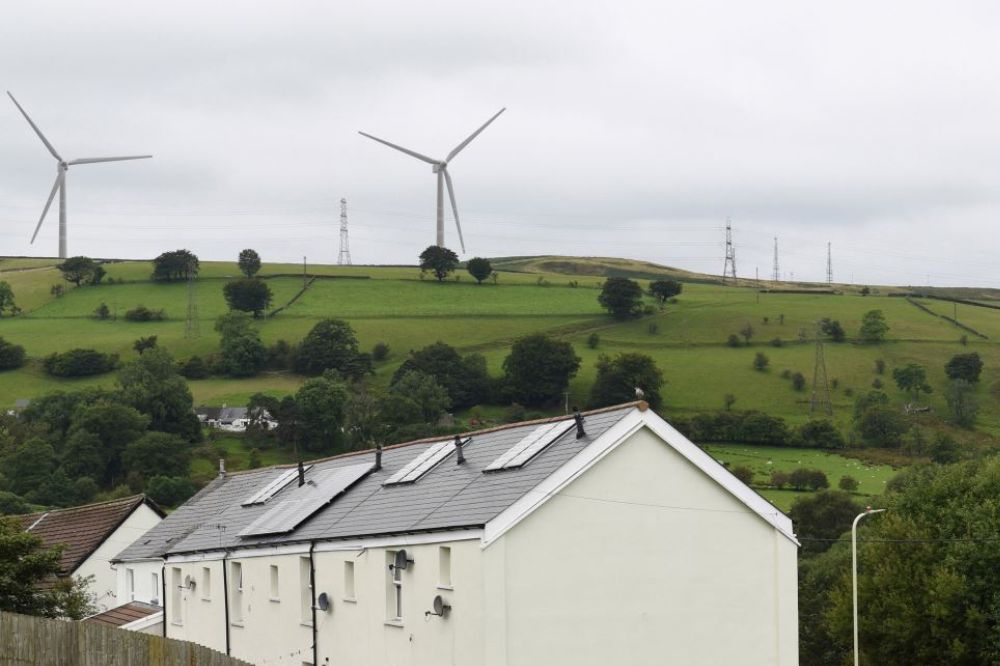
The fate of a controversial wind farm project appears to depend on a technical assessment of whether the soil it would be built on could reasonably be classified as peat.
According to Bute Energy, the proposed Twyn Hywel Energy Park with 14 wind turbines at Senghenydd, Caerphilly will produce enough electricity to power more than 80,000 homes.
But the head of a specialist department of the Welsh Government has lodged a formal objection to Bute’s plan, saying it would contravene the Welsh Government’s peat conservation policy.
Bute argues that the proportion of peat in the soil at the site is so small that it should be disregarded.
[mid-content-banner]
Peat conservation
A decision on whether planning permission will be granted to Bute should have been made by now, but the Welsh Government says detailed consideration of conformity with peat conservation policies could delay an announcement until as late as November 22.
The head of the Peatland, Soil, and Agricultural Land Use planning team within the Environmental Sustainability Directorate of the Welsh Government, has made a submission to the consultation relating to Bute's application.
In his submission to Planning and Environment Decisions Wales (PEDW), the official claims the application is contrary to Welsh Government planning policy because it would damage the soil on which the turbines would be erected.
[lower-mid-content-banner]
'Adverse impact'
He writes: “The proposals will have an unacceptable adverse impact on the environment and represent a net loss of the peat resource. The Department does not consider acceptable provisions for the conservation and protection of peat can be achieved, and the proposal lacks detail for the effective site restoration of mineral soils.
“The proposal has not demonstrated that the site can be reclaimed to an acceptable standard and after-use. This should have been presented in sufficient detail for … statutory consultees to form a judgement as to its feasibility. There is significant doubt as to whether satisfactory reclamation can be achieved at the site, and as such, the planning permission should be refused.
“The lack of a detailed scheme means the Department does not have confidence that the land can, as far as reasonably practicable, be brought to the required standard when it is reasonably fit for (agriculture) or be brought to the required standard when it is suitable for sustaining trees, shrubs or other plants.
“When operations cease, land needs to be reclaimed to a high standard and to a beneficial and sustainable after-use so as to avoid dereliction and to bring discernible benefits to communities and/or wildlife. The proposal lacks the necessary detail to reasonably assess and provide confidence that a high standard of reclamation and beneficial and sustainable after use can be achieved.
“The Department considers locating borrow pits [holes dug for the purposes of removing gravel, clay, soil or sand to be used in a construction project] on areas of peat, which is an acutely sensitive natural resource with multiple benefits, as unacceptable. Peat soils are extremely fragile. The proposal risks compromising the long-term integrity of the peat resource and as such puts at risk the resilience of the multiple ecosystems which peat support.
"By developing peat, the proposal compromises the resilience of ecological networks. Development proposals must consider the need to safeguard protected species and species of principal importance and existing biodiversity assets from direct, indirect or cumulative adverse impacts that affect their nature conservation interests and compromise the resilience of ecological networks and the components which underpin them, such as water, air and soil, including peat. As Policy 9 of Future Wales highlights through the identification of national natural resources, peat is the critical component underpinning these networks.”
'Misrepresentation'
Responding to the officials comments, Bute Energy’s agents Savills have told PEDW: “[The] applicant considers it important to highlight what appears to be a fundamental misrepresentation of the proposed development site. Much reference is made [to] ‘developing peat’, and a perceived failure of the proposed development to protect peat resources and ‘irreplaceable habitats’.
“[The official's] identification of the site as a peatland site is refuted.”
Citing a set of ‘Peatlands of Wales’ maps produced by the Welsh Government, Savills state: “It is clear that the proposed development site is not within, and in fact is remote from, what could reasonably be considered a peatland area (ie an area where any more than very small-scale, localised areas of peat are shown to be present). It is therefore incorrect to define the site, as a whole, as a ‘peatland site’.
“On the basis of the habitats present and the limited peat on site, the identification of the proposed development site as one suitable for development is entirely appropriate … The localised and discontinuous pockets of peat which have been identified at the site have been almost entirely avoided through careful and extensive design iteration of the various elements of the Twyn Hywel scheme.
“Turbines in the initial scheme layout which were found to be sited on areas where deeper peat is present were removed from the design, as was a borrow pit search area where a potential was identified for deeper peat to be present … It can be seen that all turbine locations, all turbine hardstandings except one, and the large majority of other infrastructure elements are located in areas where peat depths less than 0.3m have been recorded, ie where soils comprise mineral or organic/peaty soils, but not functional peat … [The] average depth of peat/soil at almost all proposed infrastructure elements is less than 0.3m, ie the soils are not defined as peat.
"The average depth of peat/soil at proposed turbines and their hardstandings is 0.1 m and 0.19 m, respectively. It cannot therefore reasonably be considered that soils with less than 20 cm of organic turf over rock or mineral soils should be defined as peat in the policy context cited by [the official].”
Garn Fach Wind Farm
Another wind farm project has also been delayed as planning experts decide whether it conforms with the Welsh Government’s peat policies. Garn Fach Wind Farm, near Newtown, proposed by EDF Energy Renewables, is an 85 MW, 17 turbine project, each with a tip height of up to 149.9 metres.
According to EDF, the site would be capable of generating enough renewable electricity for 69,000 homes and help the Welsh and UK Governments to meet climate targets.
A Welsh Government spokesperson said: “Both applications involve development on peat resources - therefore further consideration is being given to our peat policy.
"We hope to conclude our consideration of this matter soon, allowing the applications to be determined.”
Support our Nation today
For the price of a cup of coffee a month you can help us create an independent, not-for-profit, national news service for the people of Wales, by the people of Wales.
Get more trusted Welsh news
Choose Nation.Cymru as a preferred source in Google News to see more of our journalism.