


News
Animal rights group 'finds legal breaches at three game farms in Wales'
Martin Shipton
An animal rights group has claimed that three game farms in Powys are in breach of regulations designed to protect the interests of birds bred for shooting.
Animal Aid has reported the alleged breaches to the Animal and Plant Health Agency (APHA) and Powys County Council’s Trading Standards Department.
A letter to APHA and Powys Trading Standards from Animal Aid’s campaign manager Fiona Pereira states: “An Animal Aid investigation into three game farms in Powys in April found issues relating to animal welfare and breaches of the Code of Practice for the Welfare of Gamebirds Reared for Sporting Purposes.
"In addition, we discovered breaches of the Animal By-Products (Wales) Regulations 2006 and Schedule 2 of the Government of Wales’ Declaration of an All-Wales Avian Influenza Prevention Zone."
[gallery type="slideshow" link="file" size="full" ids="238837,238845,238844,238843,238842,238841,238840,238839,238838"]
[mid-content-banner]
Breaches
“Please find, below, the findings of our investigation along with the relevant breaches.
1) Bryn Coch, Tregynon, Newtown, SY16 3LG
Investigated April 24 2025
Barren Cages - Breach of Code
The raised, industrial style laying units used to confine breeding pheasants and partridges at Bryn Coch were barren and without enrichment. The Code of Practice stipulates:
‘Barren raised cages for breeding pheasants and small barren cages for breeding partridges should not be used. All laying systems used for the housing of birds should be designed and managed to ensure the welfare of the birds. Any system should be appropriately enriched.’
‘Gamebird keepers should explore possible methods of enrichment with their veterinary surgeon or other suitable adviser. Laying birds should be provided with nest areas sufficient for the number of birds housed.’
‘The breeding, rearing house or pen system should be designed and managed in such a way as to minimise aggressive behaviour within the flock. This may be achieved by providing physical and sight barriers, scratching areas, perches and hiding places within the pens, together with other forms of environmental enrichment.’
[lower-mid-content-banner]
Dead birds on top of cages.
The Animal By-Products (Wales) Regulations 2006 states: “Animal By-Products (Wales) Regulations 2006 – require various records to be kept on the disposal of animal by-products such as fallen stock and hatchery waste."
In addition, game and hatchery waste in the form of surplus chicks, live unhatched chicks or embryos must be disposed of in accordance with the Welfare of Animals (Slaughter or Killing) Regulations 1995 and the Animal By-Products (Wales) Regulations 2006.
Further, according to Schedule 2 of the Government of Wales’ Declaration of an All-Wales Avian Influenza Prevention Zone document (30 January 2025): “waste and fallen stock must be held in appropriately biosecure facilities in this part of the premises with clear separation between both the live-bird part and the restricted access bio-secure barrier part”
The cause of death of the birds was unknown, but again, the Government of Wales’ Declaration of an All-Wales Avian Influenza Prevention Zone document (30 January 2025) states: “Records of all poultry and other captive bird deaths and disposal must be kept and made available to an inspector on demand. Records must include: date of death and any clinical signs; date of disposal and location of relevant animal by-product disposal facility”
2) Unnamed farm, Bwlch-y-ffridd, Newtown, SY16 3JN
Investigated April 23 2025
The name of this farm is unknown, but vans belonging to Cambrian Birds were photographed parked at the farm. The site only holds ring-necked pheasants. These were all breeding birds held in ground pens. The floors of the pens were wet, muddy and dirty.
Barren Enclosures for groups of pheasants (Breach of Code)
There was no enrichment or perches. The nesting chambers had a small amount of straw.
The Code of Practice stipulates: "All laying systems used for the housing of birds should be designed and managed to ensure the welfare of the birds. Any system should be appropriately enriched."
Feather loss (Breach of Code)
Several birds were filmed with bare skin on the rump.
The Code of Practice states: "Birds should be checked at least twice daily during the breeding and rearing period for signs of disease or injury and to ensure that their welfare needs are being met and at least once daily at other times. This inspection should be carried out by knowledgeable staff.
"All birds suffering ill health, injury or subject to equipment failure must receive immediate and appropriate attention, including the involvement of a veterinary surgeon where necessary. In cases where euthanasia proves essential, this must be carried out humanely and should be performed by trained members of staff."
Lack of protection from the weather (Breach of Code)
Extra single males were held in very small ground pens in blocks of 12 pens. They had a perch available but no shelter from the weather. A dead bird was found on the floor next to these pens.
The Code of Practice stipulates that the birds must have “protection from adverse weather conditions, extremes of temperature and predators” and that “All housing and penning for laying birds should have sufficient shelter to provide protection for all birds during periods of adverse weather.”
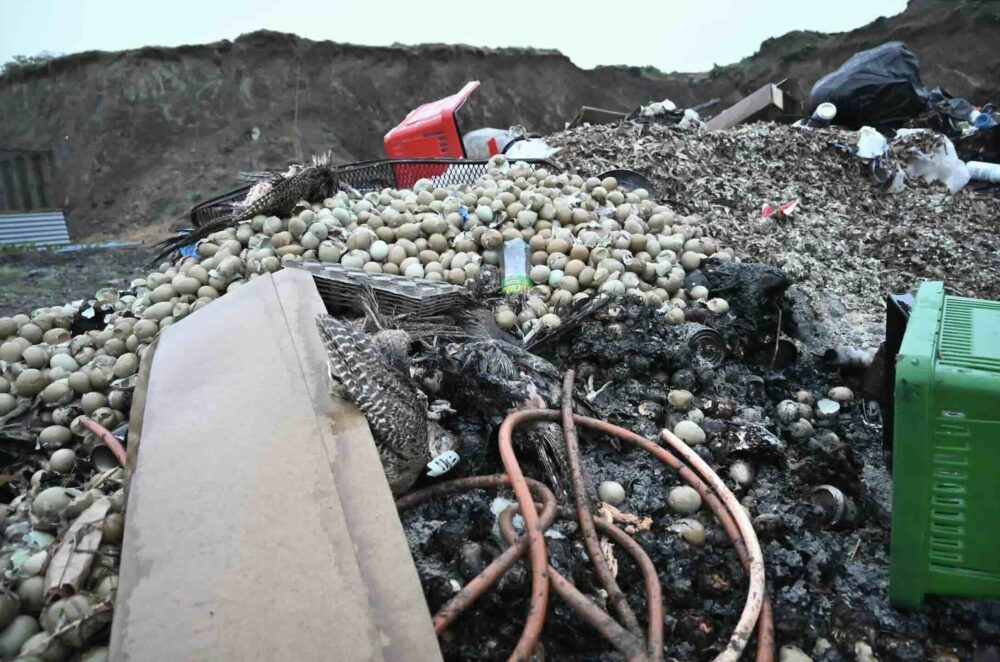
Exposed dump containing eggs and dead birds (reported to APHA on May 9 2025)
This breach of Animal By-Products (Wales) Regulations 2006 and Schedule 2 of the Government of Wales’ Declaration of an All-Wales Avian Influenza Prevention Zone document has already been reported to APHA and Powys Trading Standards.
3) Keepers Cottage, Pool Quay, Welshpool, SY21 9JZ
Investigated April 23 2025
This farm had breeding pheasants held in ground pens.
Barren Enclosures for groups of pheasants (Breach of Code)
The Code of Practice stipulates: ‘All laying systems used for the housing of birds should be designed and managed to ensure the welfare of the birds. Any system should be appropriately enriched.’
Lack of protection from the weather (Breach of Code)
Extra single males were held in very small ground pens. They had a perch available but no shelter from the weather.
The Code of Practice stipulates that the birds must have “protection from adverse weather conditions, extremes of temperature and predators” and that “All housing and penning for laying birds should have sufficient shelter to provide protection for all birds during periods of adverse weather.”
“Animal Aid has provided photographic evidence of the breaches of animal welfare legislation and the Code of Practice. Video evidence is also available.
“Animal Aid has a strict investigations policy which adheres to biosecurity measures, obtains access to premises without causing any damage to property and seeks to ensure that no stress is caused to animals at sites visited.
“It is imperative that APHA Wales and Trading Standards intervene in order to ensure that the welfare and ABP/Bird Flu regulations are enforced.”
Ms Pereira told Nation.Cymru: “On inspecting old records of bird flu outbreaks in Wales, two of those outbreaks occurred at game farms, both in February 2022:
Keepers Cottage, Pool Quay, Welshpool, SY21 9JZ
(No farm name found) Bwlch-y-ffridd (village), Newtown, SY16 3JN
“On checking planning applications, there was an application from 2020 for an agricultural building for the farm at Bwlch-y-ffridd. The applicants’ names were given as Mr A Pryce and Ms S Jones. Anthony Pryce and Sarah Louise Jones are the directors of Cambrian Birds Ltd [a company that runs game shoots]. On investigating the site on April 23 there were two marked Cambrian Birds vans parked at the Bwlch-y-ffridd site.”
Emails
Nation.Cymru sent emails to the owners of Bryn Coch farm and to Cambrian Birds.
We left a voicemail message for the owners of Keepers Cottage.
Bryn Coch farm is owned by James and Wendy Shearer.
Mrs Shearer emailed us to state: “With response to your email, the pictures are not an accurate representation of our bird housing.
“Our housing system do [sic] contain enrichments.
“We believe we provide excellent care for our birds and take pride in how we look after them.
“We check our birds several times daily for health and welfare reasons, if a dead bird is found on site it is removed from the pen and placed on top for James Shearer to examine it and establish a cause, and decide if it needs to be taken to the vet for further investigation. This bird in the picture was awaiting James’s assessment. It would then be moved and locked away until correct and legal disposal.
“We are very cautious about people visiting our birds due to the risk of Avian Influenza. We are very concerned irresponsible people are breaking into premises and moving from one farm to another without proper approved bio security protocols. They are putting the health and welfare of our birds at risk.
“At the time that the suggested illegal visitations took place there were many UK housing orders in place and avian influenza was considered by the UK government to be a very significant risk. Such illegal and deliberate visitations to vulnerable birds was probably illegal and definitely highly irresponsible as they were causing serious risks of the spread of Avian Influenza.”
We received an email from the public relations team of Cambrian Birds that stated: "As a result of the defamatory allegations which have been raised against us, we are liaising with our solicitors as to the most appropriate course of legal action to take.”
We responded, asking the team to explain what was defamatory in the communication from Animal Aid and what Cambrian Birds’ locus in the farm is. The company did not reply.
Support our Nation today
For the price of a cup of coffee a month you can help us create an independent, not-for-profit, national news service for the people of Wales, by the people of Wales.
Get more trusted Welsh news
Choose Nation.Cymru as a preferred source in Google News to see more of our journalism.
