


Wednesday, 15th July 2026 Cardiff 17° · Partly cloudy
NationCymru A news service by the people of Wales, for the people of Wales.

Feature

What’s on the minds of Welsh voters ahead of the Senedd election?
By Kyle Bright
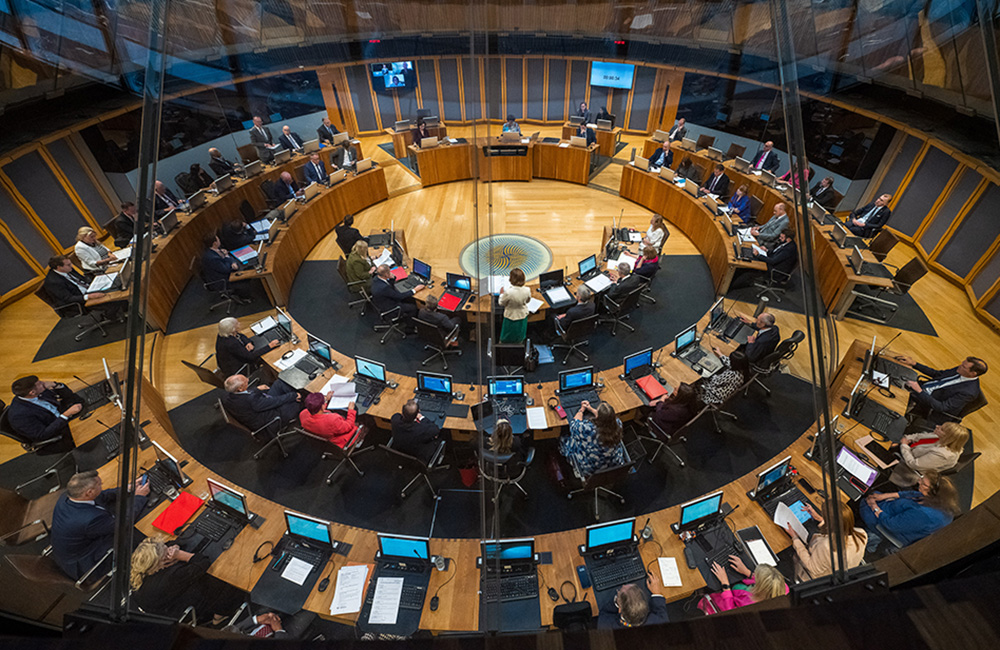
Y Siambr. Image: Senedd Cymru

Kyle Bright

It’s easy to forget in the midst of analysis and speculation what’s most vital to any election: what are voters thinking, and what do they want to see from the seventh Senedd?

New opinion polling by YouGov gives insight into the views of Welsh voters, from their approval of political leaders to the issues they want to see a future government prioritise.

All eyes are on what promises to be a historic Senedd election in May with Labour in decline, a battle between pro-independence and unionist parties, and a new proportional voting system at play.

There’s a lot to delve into, but these are the four key takeaways that tell us where voters are sitting ahead of the May election.

No clear favourite for First Minister

Sometimes with polls, the ‘don’t knows’ tell a bigger story than the actual responses, and this case is no different. Nearly half of Welsh people are unsure who they would back as the best candidate to lead Wales.

It's worth noting that this doesn't necessarily mean that Welsh voters are unsure what party is best to run Wales, but it reflects a gap in terms of the awareness of Welsh leaders among the public which must be bridged to connect with voters and get them on side.
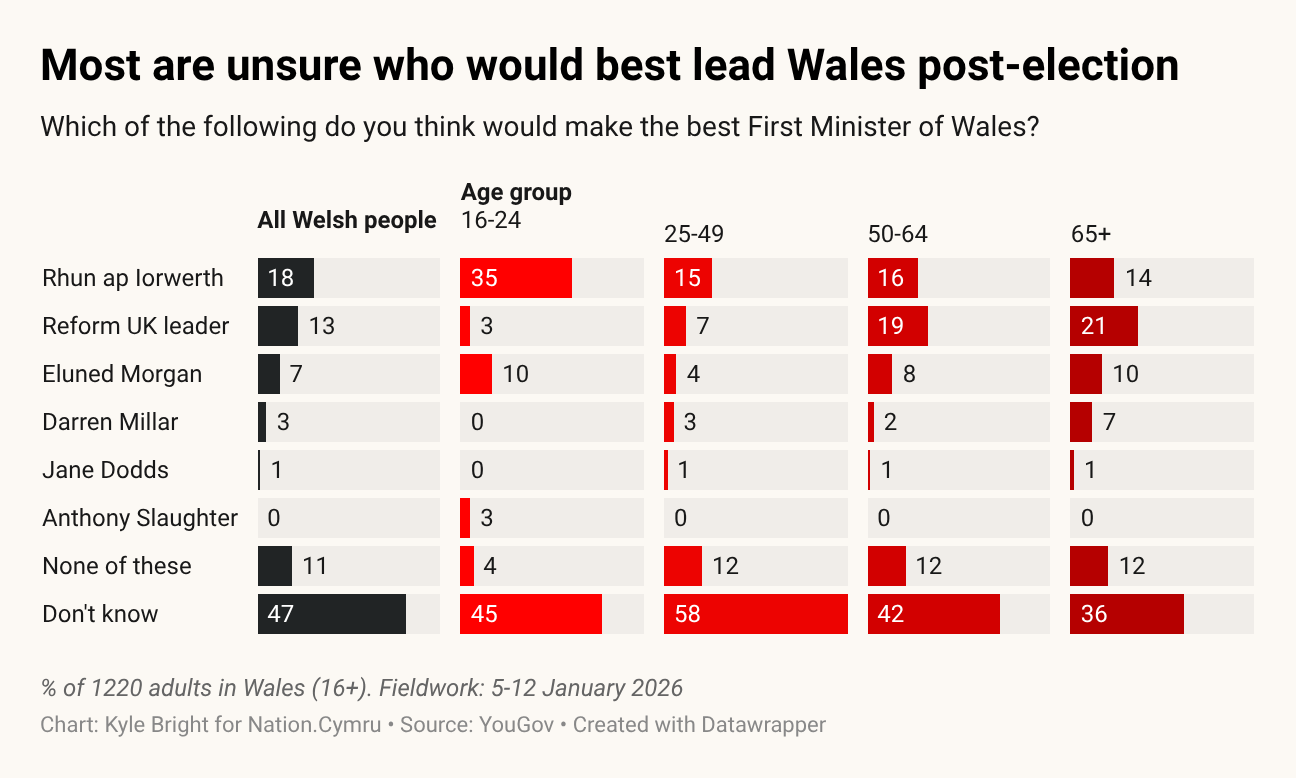
Approval ratings only underline this disconnect. Comparing Welsh and UK politicians, aside from the Plaid leader who ranks as most approved, the rest of the top five most approved politicians are UK leaders. Incumbent first minister Eluned Morgan takes sixth place.

A notable exception among the oldest group of voters is that they are more willing to back an unknown Reform leader in Wales than any of the serving Welsh party leaders.

Professor Laura McAllister, from Cardiff University's Wales Governance Centre, suggests that the delay in Reform's selection of a leader works to their advantage: “...people love [UK leader Nigel Farage] or detest him. There's nothing in the middle.

“The people who do love him are very steadfast in that strength of opinion. So there’s a strength in not having a Welsh leader, but they will have to address that at some point,”

At the opposite end of the spectrum, the youngest voters are the closest to backing a ‘favourite’ candidate for First Minister. Over a third of 16-24s would back Rhun ap Iorwerth to be First Minister.

Health is highest priority

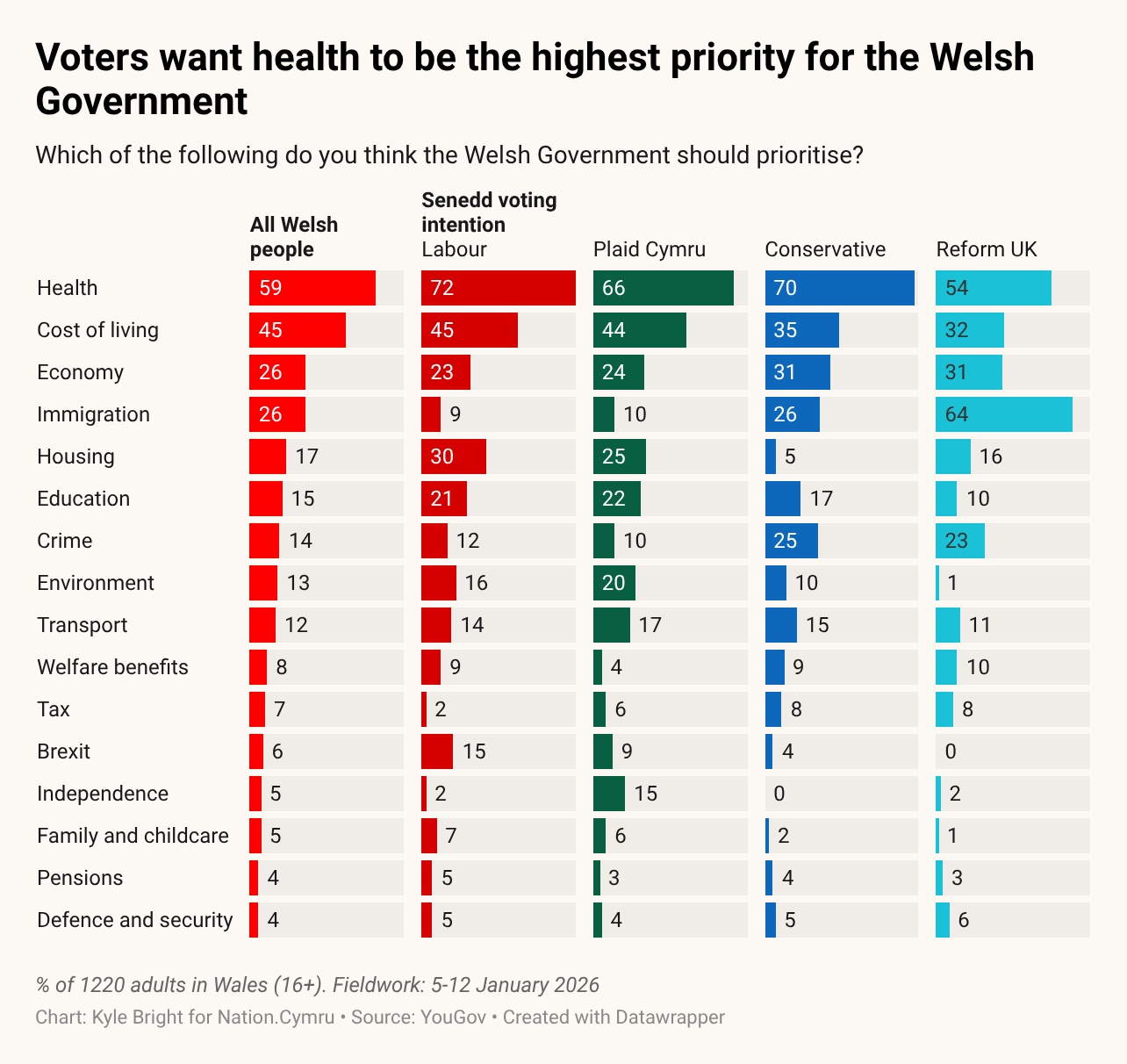
Turning to the issues that matter most to the Welsh people, and they’re very much bread-and-butter issues that affect the day-to-day lives of voters. Health takes top spot, followed by the cost of living and the economy.
This comes in the context of record numbers of waits in Welsh hospitals in recent years, alongside 38% of Welsh people struggling to pay their energy bills at least once over the last three months.

A stand out issue for Reform voters is the issue of immigration. It is important to mention upfront that the powers over immigration policy lie with the UK Government in Westminster, not the Welsh Government.

Related policies, such as the Nation of Sanctuary which aims to help refugees and asylum seekers integrate into Welsh communities, have often taken attacks from Reform.

However, the polling shows the issue is uniquely significant to them. This gives some food for thought for Reform and their campaign – perhaps a pivot to give attention to higher ranking issues may be needed for them to better attract a wider range of voters in Wales.

On Reform's policy strategy, McAllister added: "...until they produce a manifesto, it’s hard to decipher exactly what they would say.

“Even on immigration, they’re big headline narratives, but less in terms of actual operational policy.

“Whether that will restrict its base is debatable. The base is fairly solid, because what we’ve seen with recent opinion polling is not so much a decline in support for reform, but a plateau which is based on the people who didn’t know how they were going to vote, having now decided and switched to Plaid and the Greens mainly, not to Reform.”

Voters oppose abolition of the Senedd and independence

When it comes to the future constitutional path of Wales, voters are not fully enthusiastic for independence nor abolition of the Senedd.
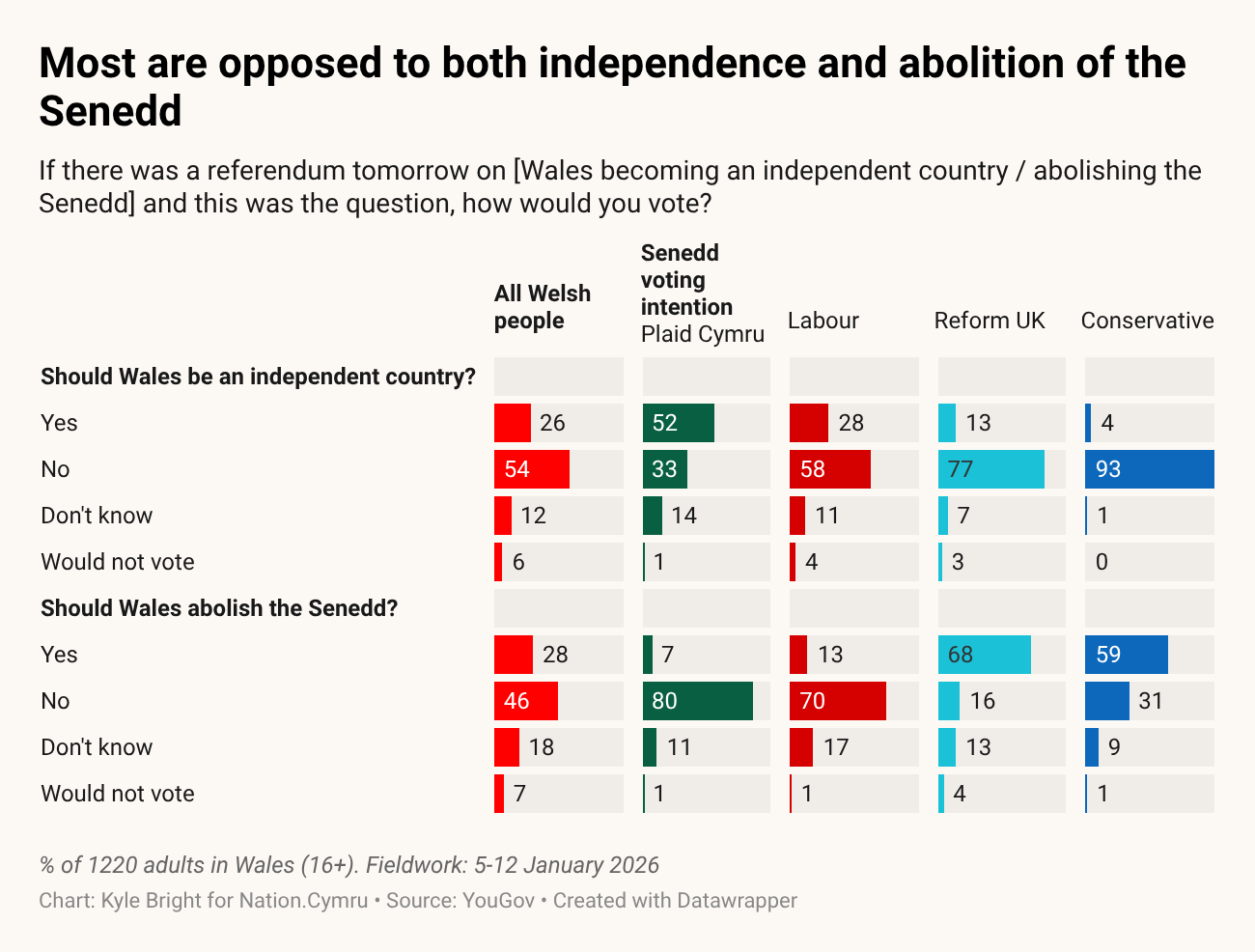
Plaid Cymru, as a pro-independence party, will obviously need to balance this if they were to get elected. Their stance according to their leader is for them to “make the case” to voters for independence during their first term, rather than calling a referendum.

A Plaid Cymru spokesperson said: “We’ve made clear that May’s election is not an independence election.

“May’s election is about providing Wales with the ambitious leadership the people of Wales deserve to get to grips with issues in our NHS, help ease the cost of living crisis with our transformative childcare offer, raise educational standards to give every child the best start in life, and get our economy moving following 27 years of stagnation on Labour's watch.”

Laura McAllister predicts we can expect to see Plaid's treatment of the independence issue come under fire in this election campaign: “...you've seen it this week with Eluned Morgan that there's a kind of language or narrative around separatism, as they term it, and Plaid pushing independence by the back door. That's bound to happen and all the parties will attack Plaid on that.”

Pay attention though to the numbers who support abolishing the Senedd who intend to vote Reform or Conservative. Despite this being the case, with over two thirds in Reform’s case supporting the cause, the party line of both parties is to work with devolution. Could a shift in policy be on the cards in the future?

Wales needs its fair share of spending

On the topic of government spending, a majority of Welsh people think that Wales has been short-changed by recent UK governments.
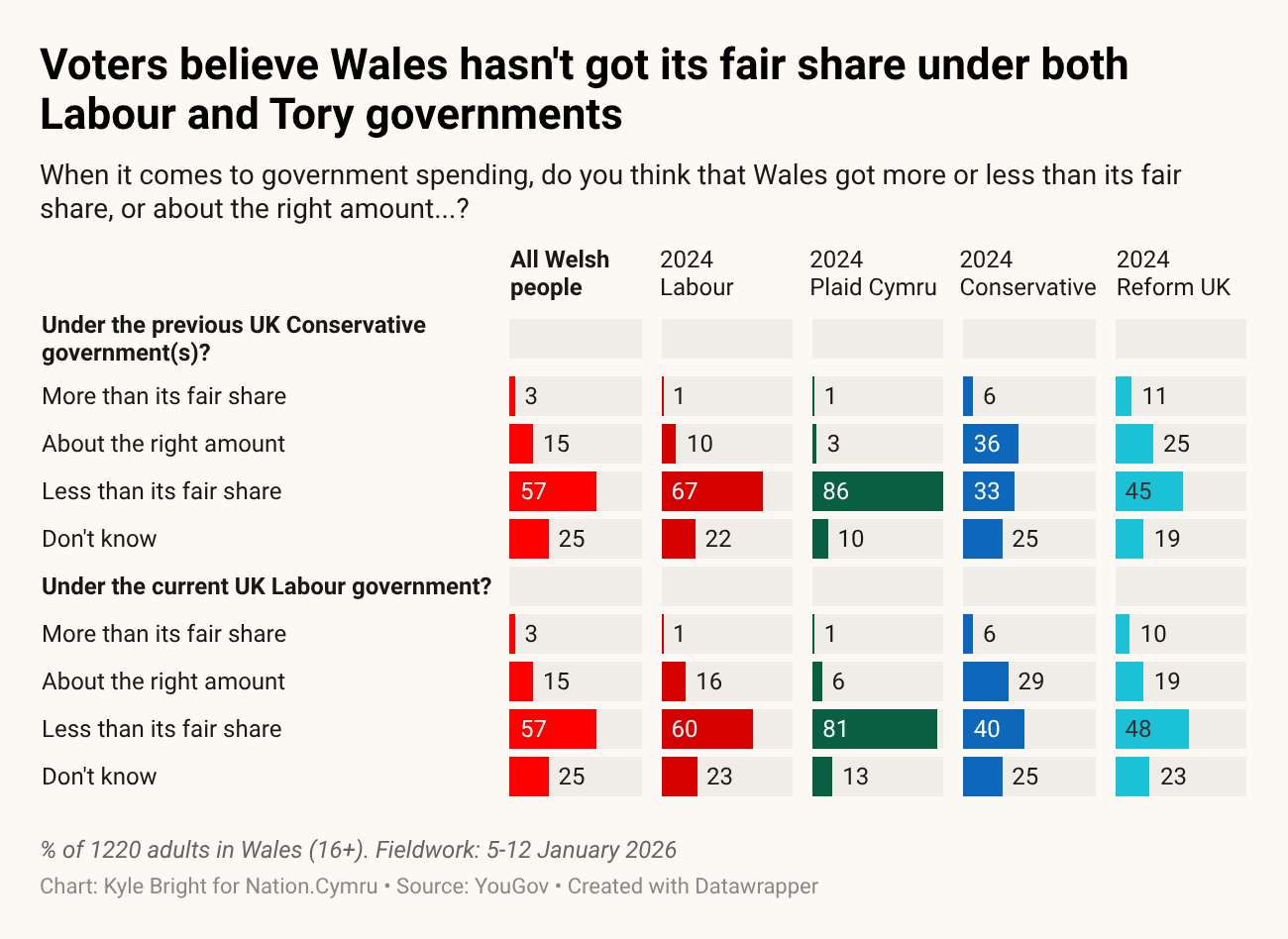
Importantly here, this belief hasn’t changed despite the arrival of a Labour government in Westminster in 2024 – in fact, the percentage who believe Wales is underfunded has remained identical (57%).

This suggests that regardless of whether two Labour governments are in control at both ends of the M4, voters are not seeing enough change currently to satisfy that Wales is receiving its fair share.

Professor McAllister commented: “The fact that Eluned Morgan has shown herself to be so powerless in arguing the case for HS2 funding and the revenues from Crown Estate to no avail is hugely problematic for Labour.

“You don't ask for something unless you're pretty sure you're going to get something in return. And I'm afraid everything Eluned Morgan's asked for, she hasn't been able to deliver on.”

When asked how a Plaid government would ensure Wales receives a fair share of funding, a spokesperson replied: “Plaid Cymru have no London boss - we're only accountable to the people of Wales, and we will never stop demanding that Wales gets our fair share. Rhun ap Iorwerth, as First Minister, would be unrelenting in standing up for Wales.”

The issues with the allocation of spending to Wales are structural, and will be a major obstacle regardless of whichever parties enter government in May, according to McAllister: “Although Wales has done better from Barnett this year, it's certainly nowhere near in terms of the benefits Scotland gets from the Barnett formula. So I think that's quite telling.”

The Barnett formula is used to determine how much cash devolved governments receive in response to changes in funding by the UK Government in areas that are devolved. Therefore, if spending on health rises in England, Wales will receive equivalent funding.

She went on: “Until the funding settlement improves, there's no way that any government, whether it's a Plaid, or a coalition, or anything else, can actually address the structural economic problems that Wales faces. So a fair funding formula is probably going to be very high on any first ministers inbox list.”

You can find the full survey data provided by YouGov here.


Support our Nation today

For the price of a cup of coffee a month you can help us create an independent, not-for-profit, national news service for the people of Wales, by the people of Wales.

24 comments

Fi yn unig

Anyone considering voting Deform UK on May 7th, know this. You will be voting for YOUR OWN DEMISE. Even if you are rich, and therefore, an ‘alright Jack’, you WILL suffer the effects of societal collapse if you get your way and the rest of us will have to suffer the strains of your moaning and groaning after the event as the whole ship goes down and you cannot get onto a lifeboat. Ignorance WILL NOT be an excuse. You KNOW what you are voting for. Good luck - NOT!

Reply
Brechdan Dwylaw

That Rhun and Plaid have the Welsh people's interest at heart and the sharpest political minds to make sure they surge to power and overcome obstacles to independence like a lack of hospitals, international airports, jobs and taxation revenues.

Reply
Richard Lice

To be fair many feel the main aim is to make sure that Reform dont get anyhwere near a majority. Wales will simply be gifted back to Westminster officially or unofficially Interesting to see Refrom bristling with indignation at Advance putting up the heavyweight candidate Buckley in Manchester. The local branch unhappy Farage ignored them and pararchuted in the GB newsman Goodwin as their candidate . Farage certainly wont get away with that caper choosing candidates here in Wales ' He will evaporate support

Reply
Y Cymro

Indeed tactical voting is an option. But looking at the charts at the priorities of those intending to vote for Reform shows their utter contempt for Wales by happily self-harming to please their cult leader Nigel Farage. To them it's England first Wales last. Shameful.

Reply
Richard Lice

Sure yet doesnt need to be tactical voting as every vote counts. Lets hope Lloyd Warburton does a piece in the Cambrian News to explain the D;hondt formula Plaid are on the cusp of getting 4 out of the 6 seats in Ceredigion A handful of votes either way , Many Plaid stalwarts might think that its OK not to turn up as Plaid will win anyway . Forgetting now there is 6 seats at stake not 1

Reply

In reply to Richard Lice

Y Cymro

Oh, I agree. The pitfalls of being complacent.

Reply

In reply to Y Cymro

Richard Lice

Many in my village havent got a clue how the formula works Nobody has reached out to them to explain The Senedd need to get their act together

Reply

In reply to Richard Lice

John Brooks

Strictly speaking not every vote counts. If a party list receives single digit votes it is highly unlikely to get a seat. The votes are not transferred and are in effect 'wasted'.

Reply

In reply to John Brooks

Richard Lice

Well for Plaid these 4 constituencies they are forecasted to get 2 seats Yet its down to a handful of votes either way Caerdydd Ffynnon Taf 23.4% Pen;Y.Bont ig 22.4% Brycheiniog 21,7% Flint 21,7 % Very much every vote counts

Reply
Y Cymro

On my mind is putting Wales interests first with Plaid Cymru & Rhun ap Iorwerth after tolerating 27 years of Welsh Labour Whitehall capitulation rather than self-harming by electing to our Senedd Cymru a bunch of far-right extremists in Reform UK currently residing in a Conservative rest home for the politically insane.

Reply
Y Cymro

Voting for Reform UK will be like playing Russian roulette. And we all know how Reform UK's hierarchy love Russia and those rubles. ✉️💰

Reply
Marvin

Of course some are now banged up. I for one look forward to the interview with Mr Gill to see how he's getting on with life on the inside.

Reply
Dai Ponty

One word INDEPENDENCE if people vote reform it will be the end of Wales we will just become a county of England Farage wants one flag union jack one sports team U K for Rugby Football and other sports Wales will lose its identity also Reform will sell of the N H S can people afford private health care

Reply
Annibendod

You might prefer to post this sort of thing on facebook. It's the place to be for the older "nostalgic" gentleman I hear.

Reply
Karl

That Westminster literally, see Wednesday lunchtime when The toddlers turn up.

Reply
Jeff

Recent info on who is fronting farage for 200k via a UK church warder. A fellow from Kazakhstan (Times). Tommy 10 names endorses Matt Goodwin. Farage will bring a version of ICE to the UK streets (you know, the goons in the US that are murdering innocent people). And we have this. Epstiens stinking ties into the UK via farage. https://bylinetimes.com/2025/11/19/dinner-with-mr-brexit-bannons-european-revolution-planned-with-farage-backed-by-epstein/ Reform, the party that will strip mine the UK and attack people not white.

Reply
Alwyn

Similar to what I see - I think health/cost of living/economy are the critical issues. All this crown estate/devolve policing/HS2 - never heard anyone say this is a concern in public. Since the financial crisis, productivity has stagnated - GDP per capita, would be about 30% higher today if the pre-2008 trend had continued. Lower productivity, lower growth, less money government has for public spending. Not rocket science. I'm yet to see anything this will change between labour, plaid or reform. In fact, 100% confident things will stay exactly the same for the next 10 years. What is telling is how much time Plaid (especially) are talking about more handouts to people, more money from westminster - so far zero discussion about creating growth or innovation

Reply
Dr John Ball

An interesting contribution to this important year. One or two issues stand out, OK, I'm an an optimist, but 25% in favour of independence flies in the face of any number of previous polls that suggest the proportion is far higher - and in any event, the full case has yet to be made. The comment on the Barnett formula needs to be challenged. The Senedd budget, £27billion is I assume the block grant grudgingly given to us by our masters. But look at other numbers. According to the ONS, Tax revenue in 2022/23 (latest figures available) was £37billion. Now if you accept the "who benefits" notional expenditure adjustments I have suggested through my research and published in many outlets, including Nation.Cymru, (the 11% of revenue on debt service, 7% on defence - don't tell Putin - a £3bn accounting adjustment and UK responsibility for pensions), the expenditure is £38bn, but this includes a one off £1.4bn for energy support. You do the maths... Incidentally, the expenditure includes the police, so we are paying for it but have no control over it.  It is notable that the economy is a high public priority. The nhs, education, social support and all the rest result from a healthy economy. Sadly, Laura  McAllister is wrong. She says that any future government does not have the powers to "address the structural economic problems" that we face. In fact - and how many times have I, and others said this - the Senedd has had significant economic development powers since the establishment of the Assembly in 1999. Successive Labour governments have not used the powers, happy to plead Westminster for more money - or was the plan all along to keep us poor?

Reply
Alwyn

Hate to be a party pooper, a bigger number prefers abolishing the assembly, including 7% of plaid voters. That seems utterly bizarre, I'll love to meet the person who votes plaid and wants the assembly abolished!

Reply
Jonathan Edwards Penfeidr

I voted Plaid (Ben Lake) and I want the 'assembly' abolished. And replaced by a better bicameral system backed by a Welsh Constitution and Bill of Rights after a Constitutional Convention. I can't be the only one thinking this.

Reply
Rob

Whilst I acknowledge that there are legitimate concerns in Wales regarding the health service, the core priority of any serious government has to be economic development. A stronger economy is the key to all other matters, including properly funding the NHS, tackling the cost-of-living crisis, reducing poverty, and preventing the conditions in which political extremism thrives upon. Many of the issues emphasised by Reform, particularly immigration are not devolved, but economic development is an area where Welsh institutions do have real leverage. A Plaid Cymru led government should use every devolved tool currently available to strengthen the Welsh economy, whilst fighting for further devolved powers which they could directly improve economic performance. The objective here is to demonstrate that Wales is more than capable of economic self-sufficiency, built on growth, productivity, and rising living standards. As President Bill Clinton once put it: “It’s the economy, stupid.” 

Reply
David J

What is on my mind is annibyniaeth, annibyniaeth, and, er.. annibyniaeth. Everything else follows from that.

Reply
John Ellis

I was born and reared in the north-west of England, moved to Wales as a university student and ended up living and working here for the whole of my 20s and 30s. Then family issues prompted me to go back to my home area just before I hit 40, where I stayed until - infected by hiraeth, I guess! - I came back to Wales in retirement just before I got to 70. So my memories of Wales go back sixty years by now, and in the light of that maybe my 'take' on all this isn't wholly insignificant. When, way back in 1964, I first arrived in Wales, the notion of actual independence seemed then to be an issue only for an insignificant few. Not that national sentiment was absent - far from it. But then the prime issue which drove nationalist opinion was the status of the language, and when positive changes on that matter seemed to be progressing, attention switched to campaigning for Welsh language radio and TV services. Still, actual independence seemed to me to be peripheral in the scale of priority issues. That was the situation which seemed to be prevailing at the time when I moved back to the Manchester area in 1984. When I returned to live in Wales in 2016, I found that things had changed significantly. 'Yes Cymru' had by then emerged as a movement, and even in the small and very conventional country town nearest to where I live, at the time before the pandemic hit us they could gather at least 30-odd people with banners on a Saturday morning to demonstrate in support of independence. That would have been completely unimaginable in the '60s and '70s in that sort of community. But even so, as I talk to my neighbours these days, I still don't discern much of a driving enthusiasm for independence. For sure people now don't dismiss the idea with a chortle of incredulous contempt, as would have been the case with most in the '60s and '70s. Now quite a few more are ready to envisage the possibility; but even so rather a lot are cautious and apprehensive about the possible implications. Which inclines me to the view that Plaid are right to say that if they do end up leading the government after May 7th, they won't be putting independence top of their policy agenda during their first term of office. There's nothing wrong about continuing to be honest about their convictions and aspirations for the future, but if they push too far beyond policies with which the bulk of voters find tolerable, the inevitable consequence will be that people tempted to support the party will start to nervously back away.

Reply

Leave a comment

Comments are reviewed before they appear.
