


Culture
Yr Hen Iaith part eight: Two Brothers and Three Invasions
Continuing our series of articles to accompany the podcast series Yr Hen Iaith. This is episode eight.
Jerry Hunter
In this episode we discuss a tale which explores a theme central to medieval articulations of Welsh identity, one taking as it’s starting point the knowledge that the Welsh are the descendants of the people who lived in Britain before a series of foreign peoples invaded.
However, while this narrative provides a fanciful look at the threat of foreign invasion, it also presents a peaceful fraternal relationship linking Britain to a land behind its borders. Indeed, that international family link proves to be the means of salvation.
Like several other medieval Welsh tales, this one ends by providing its title: A’r chwedyl hwnn a elwir Kyfranc Llud a Lleuelys. Ac uelly y teruynha. (‘And this tale is called the Cyfranc of Lludd and Llefelys. And thus it ends.’)
The word cyfranc can mean a range of things, including ‘a meeting’, ‘an adventure’, ‘an attack’ and ‘a clash’. It might also be taken as a genre term describing a tale in which such plot developments are essential.
We can, in fact, describe this text as the ‘Meeting of Lludd and Llefelys’, because the two brothers are reunited at a crucial point in the story. Some of the other possible meanings of the word also make sense, given that the assaults of three gormes – three ‘oppressions’ or ‘invasions’ – provide the challenges which must be overcome.
[mid-content-banner]
Lludd is ruler of a very Welsh Britain. This is the golden age of medieval Welsh imagination, a period before the ‘Ancient Britons’ were deprived of their land by foreign invaders. His brother Llefelys marries the king of France’s daughter and resides across the sea in that land.
Then trouble arrives: A gwedy llithraw talym o amser, teir gormes a dygwydwys yn Ynys Prydein ar ny welsei neb o’r ynyssed gynt eu kyfryw. (‘And after a period of time passed, three invasions fell upon the Island of Britain the likes of which none in the islands had ever seen before.’)
Triads
Medieval manuscripts contain long lists of ‘triads’, brief orderings of legendary material presenting cyfarwyddydor ‘the stuff of tales’ in thematically-linked groups of three.
There is a triad describing teir gormes, the ‘three (foreign) invasions’ or ‘oppressions’ as the Kywdavt y Corryanyeit, ‘The Coraniad People’, y Gwydyl Fychti, ‘the Picts’ and y Saeson, ‘the English.’
Interestingly, a fictional race, the Coraniaid (containing the word cor, which can mean ‘dwarf’), is placed alongside legendary reflexes of historical peoples.
Supernatural
In her introduction to that stunning feat of scholarship, Trioedd Ynys Prydein: The Welsh Triads, Rachel Bromwich describes the Tale of Lludd and Llefelys as ‘an expanded triad’, noting also that it alters the contents of the teir gormes.
Indeed, while the magical Coraniaid appear in the story, the Picts and the English are replaced by two more supernatural threats. One is a horrible diaspat or ‘shriek’ heard every May Eve which weakens men, causes women to miscarry, drives young people insane, and leaves all animals on land and sea infertile.
The final of the three is the mysterious disappearance of food and drink from Lludd’s court.
Lludd goes to meet his brother Llefelys, and in a wonderful scene the two brothers meet on ships between Britain and France. The French-Welsh Llefelys is able to identify the source of each gormes and he knows how to solve each of three problems as well.
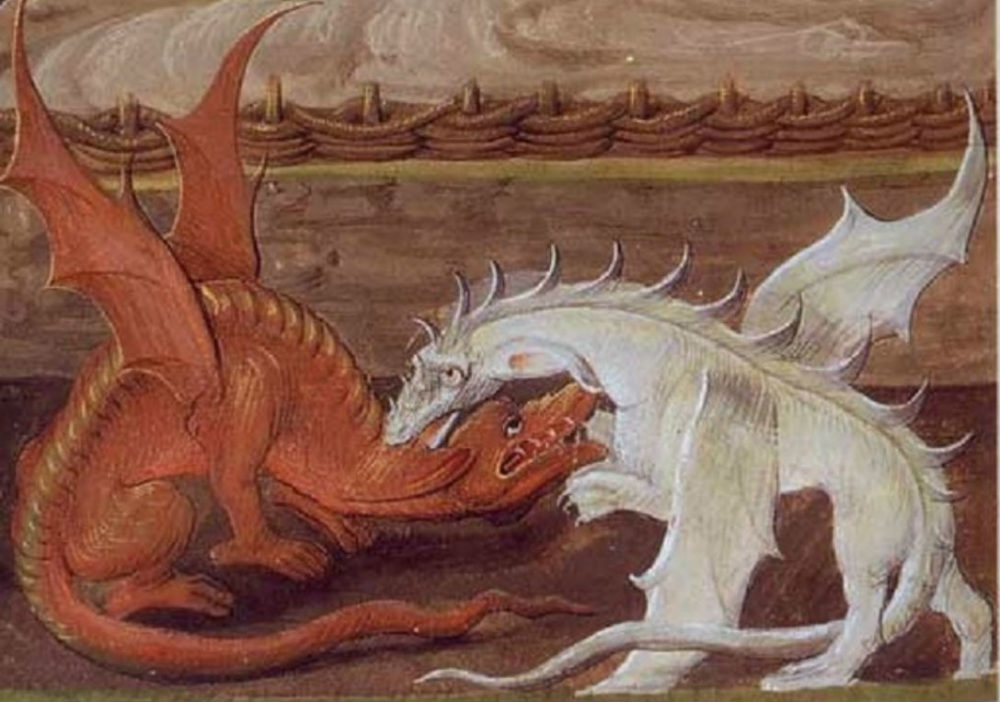
The second explanation holds the most deeply-seated cultural significance: Yr eil ormes,’ heb ef, ‘. . . dreic yw honno, a dreic estrawn genedyl arall ysydd yn ymlad a hi ac yn keissaw y goresgynn. (‘The second oppression,’ he said, ‘. . . is a dragon, and the dragon of a foreign nation is fighting with it and attempting to conquer it.’)
The one being assaulted is then described explicitly as ych dreic chwi, ‘your dragon’; this is the emblem of the Welsh, and the attack by the foreign dragon makes it ‘shriek’ in that horrible way.
Dragons
For reasons too complicated to detail here, this tale is used to explain the buried dragons which figure in Geoffrey of Monmouth’s Historia Regum Britanniae, or ‘the History of the Kings of Britain’.
Translated into Welsh as Brut y Brenhinedd, it was hugely popular in medieval Wales, judging by the large number of manuscript copies which have survived.
Another interesting thing about the ‘Cyfranc of Lludd and Llefelys’ is its place in manuscript culture: in addition to appearing in the White Book of Rhydderch and the Red Book of Hergest as do the other ‘native Middle Welsh prose tales’, it also appears in some versions of Brut y Brenhinedd, slotted in to fill a gap in the narrative which obviously worried some medieval readers and at least one writer who took it upon himself to fill that gap.
The Tale of Lludd and Llefelys is thus a narrative bridge between medieval Welsh legend and medieval Welsh historiography.
Although it is very possible that medieval readers and listeners didn’t perceive a difference between legend and history the way we do today.
Further Reading:
Rachel Bromwich (ed. and trans.), Trioedd Ynys Prydain: The Triads of the Island of Britain (Cardiff, 2014).
Gwyn Jones and Thomas Jones (translators), The Mabinogion (revised edition, London, 1993)
Sioned Davies (translator), The Mabinogion (Oxford: OUP, 2008)
You can catch up with the previous episodes here
Support our Nation today
For the price of a cup of coffee a month you can help us create an independent, not-for-profit, national news service for the people of Wales, by the people of Wales.
Get more trusted Welsh news
Choose Nation.Cymru as a preferred source in Google News to see more of our journalism.
